
Tiny Homestead Habit: Keep a “Working Bowl” on the Counter
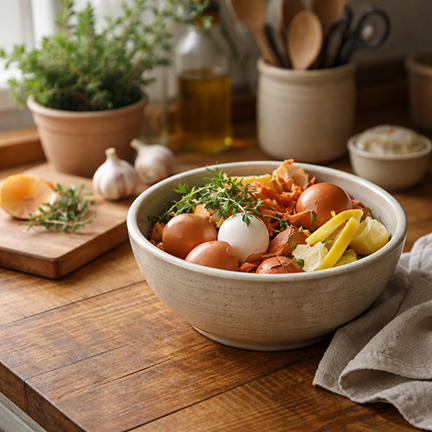
Most kitchens throw away usable scraps without thinking.
Vegetable peels go into the trash. Eggshells disappear. Herb stems get swept aside. Not because they’re useless—but because there’s no place for them to go in the moment.
A working bowl fixes that.
Quick Answer
A working bowl is a container kept on your counter to collect usable kitchen scraps during the day so they can be reused for broth, compost, or garden use instead of being thrown away.
A working bowl is a simple bowl that lives where you prep food. As you cook, you drop in eggshells, onion skins, carrot peels, herb stems, and coffee grounds.
Not trash. Not clutter. Materials that still have a next step.
The purpose of a working bowl is not perfection. It is to interrupt the habit of automatic waste.
That small interruption changes how your kitchen works.
Instead of throwing everything away immediately, you pause. You see what you’re using. You begin to recognize what can be used again.
When scraps stay visible, they become usable. When they disappear into the trash, they are forgotten.
Over time, your kitchen starts to function less like a disposal line and more like a simple, repeatable system.
What Is a Working Bowl?
A working bowl is not a system you manage. It is a tool that simplifies what you already do.
A working bowl replaces complicated systems with one visible, daily habit.
It sits on your counter. You use it all day. You empty it once.
No sorting stations. No extra bins. No complicated setup.
How to Start Using a Working Bowl
Start with placement, not intention.
Choose a bowl you like—ceramic, wood, enamel. Something sturdy, easy to rinse, and natural in your space.
Set it where you already prep food.
If the bowl is not within reach, the habit will not stick.
As you cook, drop usable scraps into the bowl instead of the trash.
At the end of the day:
empty it into a small-space compost system
or add it to a freezer bag for broth
Rinse the bowl and return it to the same spot.
Daily reset is what turns a container into a reliable habit.
What Goes in a Working Bowl?
Keep it simple and practical.
Use it for:
Vegetable peels and ends
Onion skins and garlic papers
Herb stems
Eggshells
Coffee grounds
Avoid adding:
Meat scraps (unless used immediately)
Dairy
Anything that will smell sitting out
A working bowl is for short-term holding, not long-term storage.
Why This Habit Works
It removes friction. The bowl is already where you need it.
It builds awareness. You begin to see exactly what your kitchen produces.
It creates rhythm. Prep, collect, empty, reset.
Small, visible systems are easier to maintain than complex, hidden ones.
And it quietly closes loops.
Eggshells go to the garden. Scraps become broth. Grounds enrich soil.
You do not need a full homestead system to reduce waste. You need one place to begin.
Where This Leads
A working bowl rarely stays just a bowl.
It becomes the starting point for other habits—saving scraps for broth, building a compost routine, and using what your kitchen already produces.
Learn how to use those scraps in a simple simmer pot habit
Build a system with composting in small spaces
Simple habits scale naturally when they are repeated daily.
You are not reorganizing your life. You are placing one small anchor in the middle of your day.
And that is enough to begin.
Continue the Tiny Homestead Habits Series
If this kind of rhythm works for you, you can explore more here:
Tiny Homestead Simmer Pot
