Teach the children well. They are our future.
Teach the children well. They are our future.
Welcome to our homeschool journey!
How to use this page
When you see a lesson that you’d like to explore, click on the image. A new page will open that will give you more information and a download link that contains lots of material for teaching the concept.
Before you scroll, take a quiet moment to watch the video below. It’s a small window into what homeschooling means to us—not just books and lessons, but a way of walking through life together with wonder, courage, and trust.
At The Once and Future Homestead, we believe learning begins with love—love of family, of truth, of quiet moments, and of the One who authored every page of our story. Homeschooling isn’t just an educational choice; it’s a lifestyle of discipleship, discovery, and delight.
You won’t find perfection here. You’ll find slow days and silly questions. Muddy boots and bedtime read-alouds. Kitchen table science and middle-of-math tears. And through it all, you’ll find the same gentle rhythm: turning the page, together.
Whether you’re just beginning or looking for fresh inspiration, I hope you’ll find rest, encouragement, and a few ideas here to carry into your own homeschool days.
Welcome, friend. Let’s begin this chapter together.
Graphing God’s Growing World
Homestead Math Lesson
Ages: 8–12
Time: Five lessons (30–45 minutes each)
Subjects: Math, Science, Nature Study,
Record Keeping
Big Idea
Homesteaders don't guess—they observe,
measure, record, and learn from patterns.
Graphs help us see what God is doing in the garden and around the home.
Learning Objectives
Students will:
• Collect real-world data
• Organize information into tables
• Create bar graphs, line graphs, and pictographs
• Interpret graphs and make predictions
• Practice careful observation
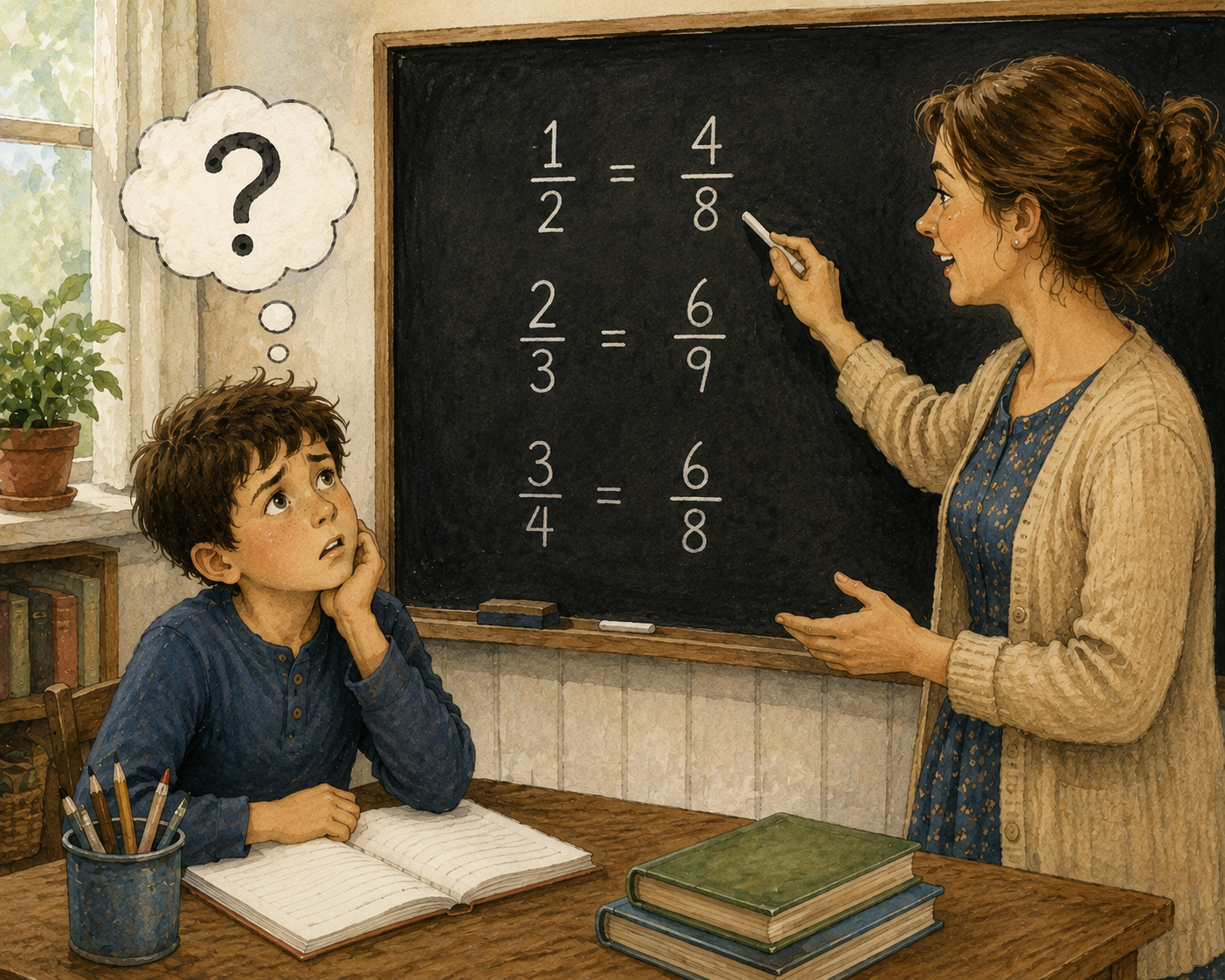
The Pantry as a Math Lab: Teaching Fractions Without a Worksheet
Fractions made more sense in our homeschool when the numbers represented something real. Measuring cups, recipes, kitchen scales, and canning jars turned abstract math into problems my children could see, solve, and actually need the answers to.
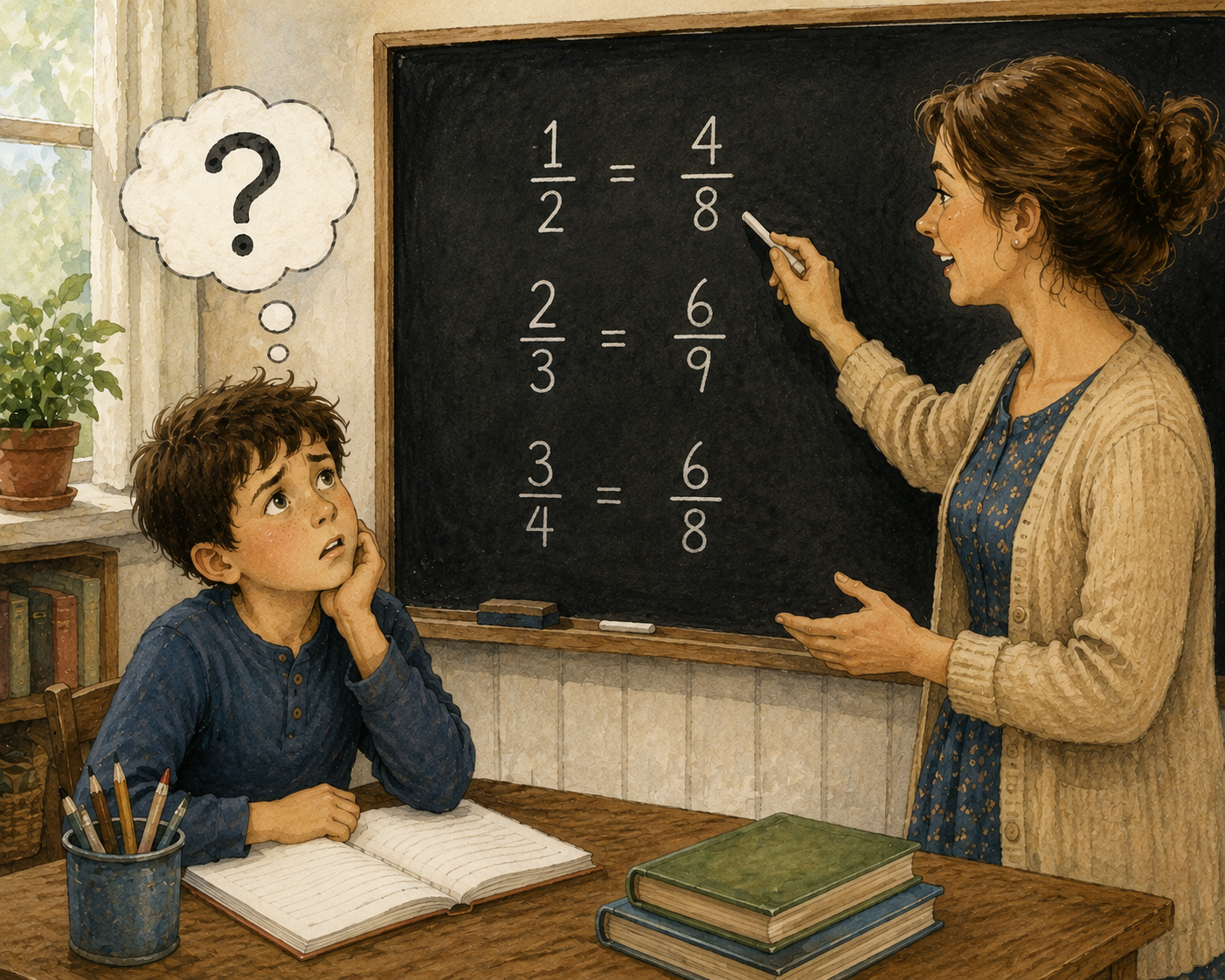
When I was homeschooling my children, fractions made considerably more sense when somebody was waiting for the biscuits.
On a worksheet, ½ + ¼ = ¾ is an exercise. There is a correct answer, and the child is supposed to learn the procedure that produces it. But in our kitchen, that same child might be standing beside me with a recipe calling for three-quarters of a cup of milk and no three-quarter-cup measure.
Now we needed to know.
I wasn’t trying to make math more entertaining. I was trying to
make it make sense.
That little shift—from you need to learn this to we need to figure this out—was a big part of the way I homeschooled, and there was a very personal reason for it.
I have dyscalculia, sometimes described as "math dyslexia." Numbers on a page have never behaved for me the way they seem to behave for people who are naturally good at math. As a child, I could memorize a procedure and still not really understand what I was doing. Give those same numbers a physical meaning, though, and I had something I could hold onto.
Geometry was always the easiest kind of math for me because I could see it. A triangle was a triangle. I could look at its sides and angles, draw it, turn it around, and understand the relationships in front of me. The math had a shape.
Fractions began to make sense in much the same way when they stopped being marks on paper. A half cup made sense. I could see it. I could pour two of them into a one-cup measure and prove to myself that two halves really did make a whole. Three-quarters wasn't just a 3 sitting over a 4; it was a half cup and a quarter cup sitting on the counter in front of me.
In many ways, this was the only way I ever truly learned math myself.
So when I homeschooled my children, I taught math the way I had learned to understand it. Of course they learned the notation and the procedures, but whenever I could, I gave the numbers something real to represent. We measured them, weighed them, divided them, doubled them, spent them, baked them, and put them into jars.
I wasn't trying to make math more entertaining.
I was trying to make it make sense.
A math problem changes when the answer is something
you actually need.
When Numbers Meant Something
Of course my children learned what numerators and denominators were. They learned how fractions were written and how to work with them on paper. But I didn't want the symbols to be the only thing they understood.
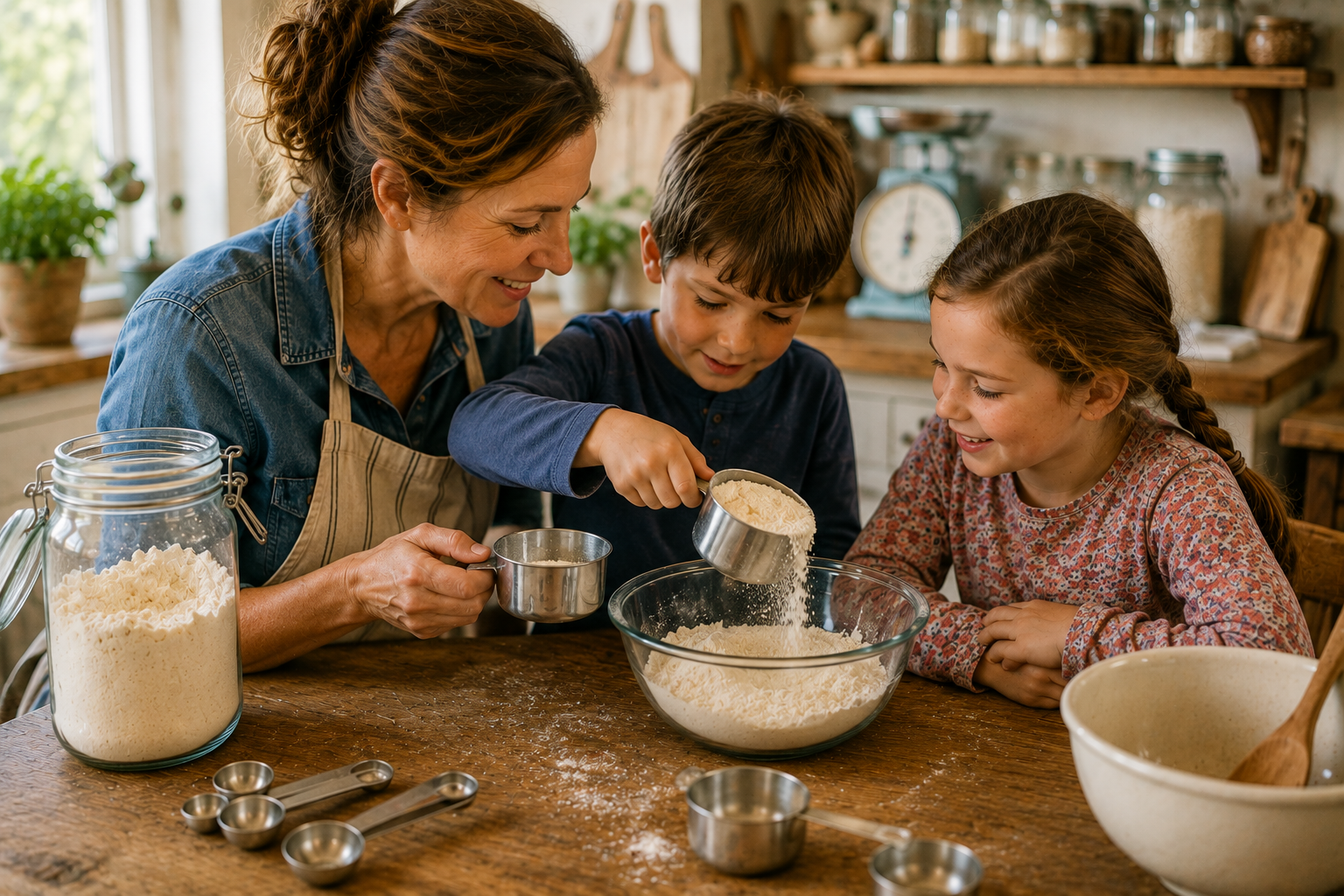
Our measuring cups were already fraction manipulatives.
I could put a one-cup measure beside the half cup and quarter cup and let a child pour two half cups into the one-cup measure. Then we could try four quarter cups. A half cup and a quarter cup together showed us exactly what three-quarters looked like.
My child wasn't merely being told that two halves made a whole. She could see it happen.
Better yet, she could use it.
If our recipe needed ¾ cup of something and we didn't have a ¾-cup measure, how could we get it?
Now ½ + ¼ = ¾ wasn't a problem somebody had invented to see whether she remembered a rule. It was useful information standing between us and whatever we were making.
That was the kind of math lesson I loved.
We Started With What We Were Making
A recipe could become an entire math lesson without my announcing that we were about to "do math."
If a recipe made twelve muffins and we only wanted six, we had to halve it.
Two cups of flour became one. One cup became half a cup. Half a cup became a quarter cup.
If we needed twenty-four muffins instead, we doubled it.
I didn't have to invent a reason for multiplication or fractions. The recipe had already given us one.
"We need twice as much milk. The recipe says ¾ cup. How much do we need?"
Sometimes a child could solve that problem with the measuring cups before being able to explain the arithmetic neatly on paper. That never bothered me. In fact, I considered it useful information. It meant the understanding was developing before the notation caught up.
Once the child had figured it out with the cups, we could talk about how to write down what had just happened.
The symbols described something the child already understood.
Measuring Cups Were Math Manipulatives
Even when we weren't cooking, the measuring cups could teach quite a lot.
A younger child could arrange the cup, half cup, third cup, and quarter cup from largest to smallest. We could see how many quarter cups it took to fill the half cup, how many halves filled the whole cup, or whether three one-third cups really did equal one cup.
Water was particularly good for this, although I learned to put the whole operation on a tray unless I wanted to include an impromptu lesson on mopping.
Three-quarters wasn’t just a 3 sitting over a 4. It was a half cup and a quarter cup sitting on the counter in front of me
As the children got older, the questions could grow with them. If two quarter cups equal one half cup, how many eighths would make a half? If we needed 1½ cups, how many half-cup measures would we use?
Instead of beginning with a page full of fraction problems, we could discover the relationships first.
Tablespoons Were Fractions Too
Then there were the measuring spoons.
Sixteen tablespoons equal one cup.
That one fact could keep us busy for quite a while.
If a cup contained 16 tablespoons, how many tablespoons were in half a cup? A quarter cup? Three-quarters of a cup?
Then I could turn the question around. If a recipe called for 12 tablespoons, how many cups was that?
With a younger child, we could simply count tablespoons into a cup measure and watch what happened. An older child could calculate the conversion first and then measure it to see whether the answer was right.
The kitchen had a lovely habit of checking our math for us.
Then We Brought Out the Scale
A kitchen scale opened up another whole layer of mathematics.
We could put a bowl on the scale, tare it, and weigh a cup of flour. Then we'd scoop another cup and weigh that one.
Were they exactly the same?
Usually not.
That gave us something else to think about. A "cup" was a unit of volume, but grams measured weight. Those weren't simply two different ways of writing the same thing.
As my children became ready for more advanced work, a recipe could lead us naturally into ratios, percentages, and conversions.
If a bread recipe used 500 grams of flour and we wanted half a batch, how much flour would we need? What about one and a half batches? If the water weighed 70 percent as much as the flour, how much water would we need?
The same activity could be happening around the same kitchen table while different children were doing very different levels of mathematics.
One child might be finding the half-cup measure for me. Another might be doubling the recipe. An older child could be working with weights, ratios, or percentages.
That was one of the things I loved about homeschooling several children together. They didn't all have to be doing identical work in order to be learning from the same experience.
Preserving Season Was Full of Math
Canning and preserving gave us another wonderfully practical reason to calculate.
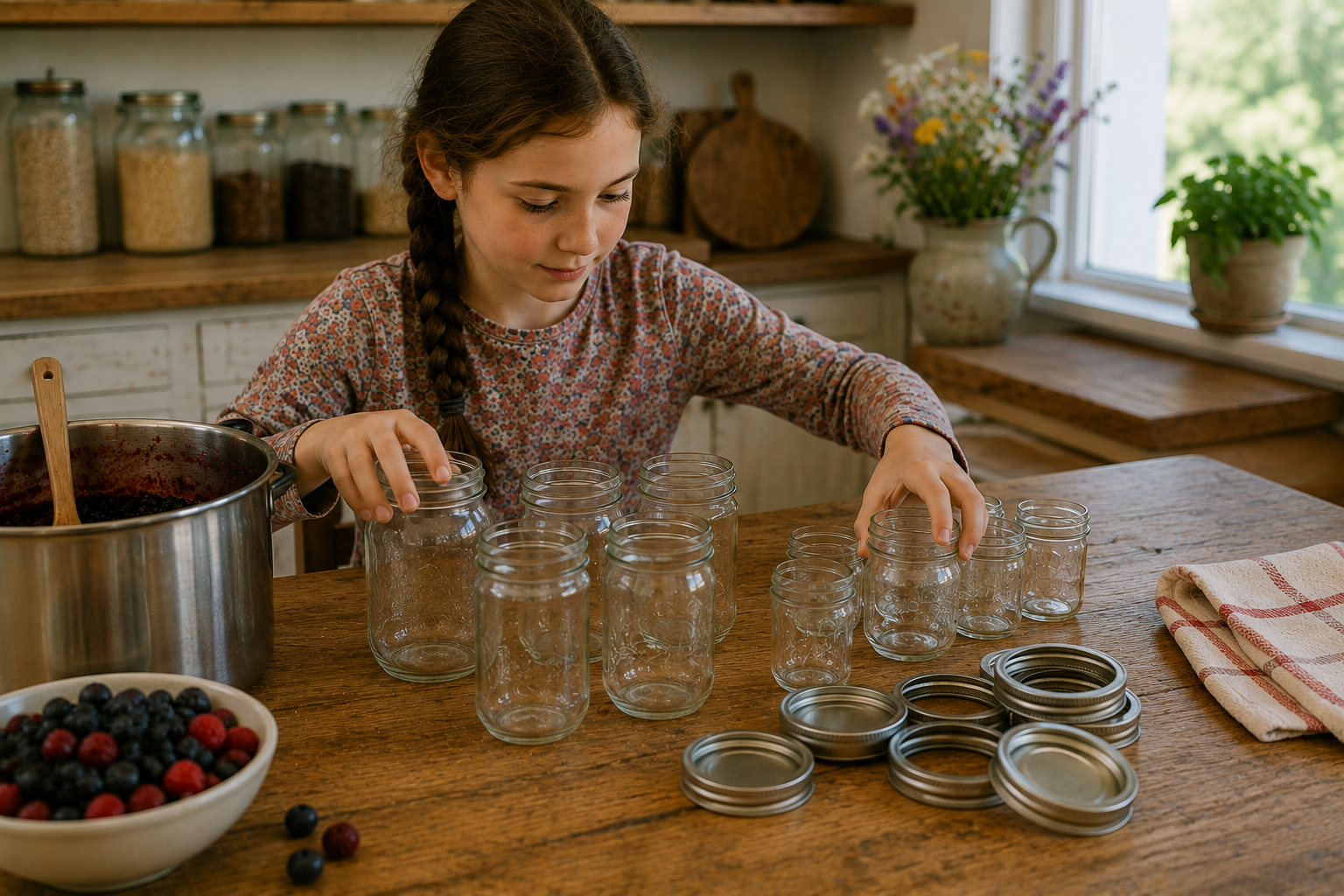
If a batch of jam was supposed to yield six half-pint jars and we doubled it, how many jars would we need to prepare?
Easy enough.
But what if we only had pint jars?
What if we had five pint jars and four half-pint jars? Would that be enough?
Now fractions, multiplication, addition, equivalence, volume, and estimation mattered because I wanted to know whether we had enough jars ready before I had a pot of hot preserves waiting for somewhere to go.
With an older child, I could take the problem farther.
If twenty pounds of peaches cost $32 and gave us a certain number of jars, how much did the fruit in each jar cost? What happened when we added the cost of sugar and lids? What did the whole batch cost us?
And if we were going to sell those jars, what would we have to charge?
Without changing subjects, we had wandered from arithmetic into ratios, unit pricing, percentages, cost, and profit.
Except we hadn't really wandered at all.
That was where the math was.
One Kitchen Table, Several Ages
This was one of the reasons I liked teaching through ordinary life. Real work doesn't come labeled "third grade" or "seventh grade."
I could give a little one a genuine job: "Find me the half-cup measure."
Another child could measure two halves and discover that they made a whole.
Someone else could halve the recipe.
Real work doesn’t come labeled “third grade” or “seventh grade.”
An older child could double it.
A teenager could convert the recipe from volume to weight, compare the unit price of two different bags of flour, work with ratios, or calculate the cost per finished loaf.
We could all be involved in the same work while each child was doing mathematics appropriate to his or her ability.
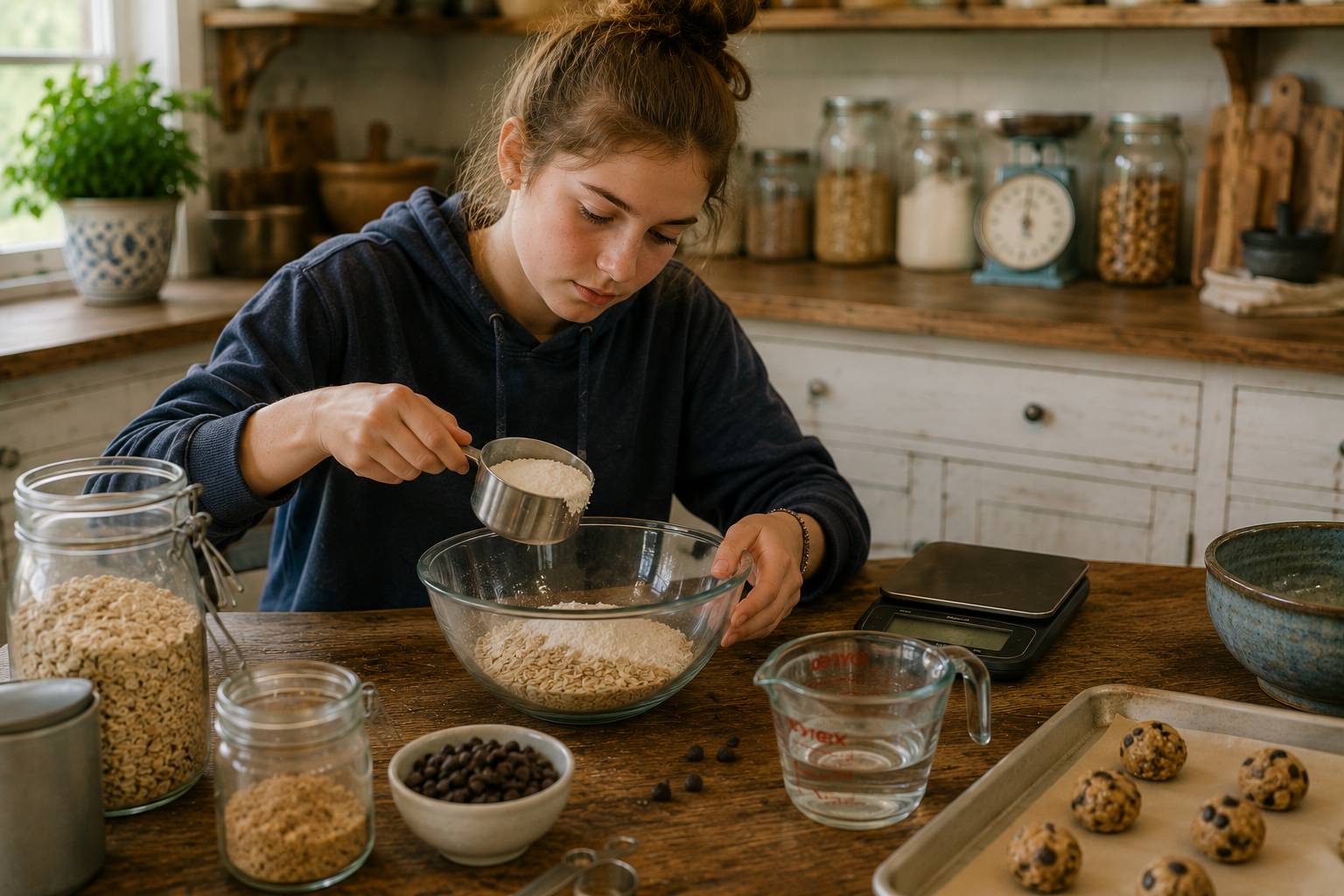
I didn't need four separate lessons scattered across four separate workbooks. I needed one real task and questions appropriate to the children sitting around my table.
I Wanted the Problem to Come First
Looking back, I think this was one of the most important parts of the way I taught.
Instead of teaching a procedure first and promising my children that someday they might need it, I tried whenever possible to let them encounter the need first.
We have ⅓ cup of honey, but we're doubling the recipe. How much do we need?
We have eight jars. Will the whole batch fit?
This bag of flour costs less, but that bag is bigger. Which one is actually the better buy?
The bread recipe is written for two loaves, and we only want one. What do we do with ¾ teaspoon of yeast?
Those weren't questions I invented because it was Tuesday and the curriculum said we were studying fractions.
We actually needed the answers.
And that changed the question in the child's mind. Instead of wondering, What answer does Mom want me to put in the blank? the question became, How are we going to figure this out?
That was the question I wanted my children learning to ask.
The Pantry Was Already Full of Math
Don’t just teach the answer. Give them a reason to need the answer.
I didn't need special manipulatives to teach fractions. I had them nested inside one another in a kitchen drawer.
I didn't always need a worksheet about measurement conversions. I had tablespoons, cups, flour, water, recipes, and a scale.
And I certainly didn't need to manufacture word problems about imaginary people buying imaginary bags of flour. We could go to the store and find out which bag really was the better buy.
Our pantry was full of fractions, ratios, weights, volumes, percentages, estimation, multiplication, division, and money.
More importantly, it was full of reasons to use them.
That was the kind of education I wanted for my children—not simply knowing how to produce the right answer, but knowing how to think when a real problem was sitting in front of them.
Don't just teach the answer. Give them a reason to need the answer.
That's when math stops being something that happens on a worksheet and becomes a tool a child knows how to use.
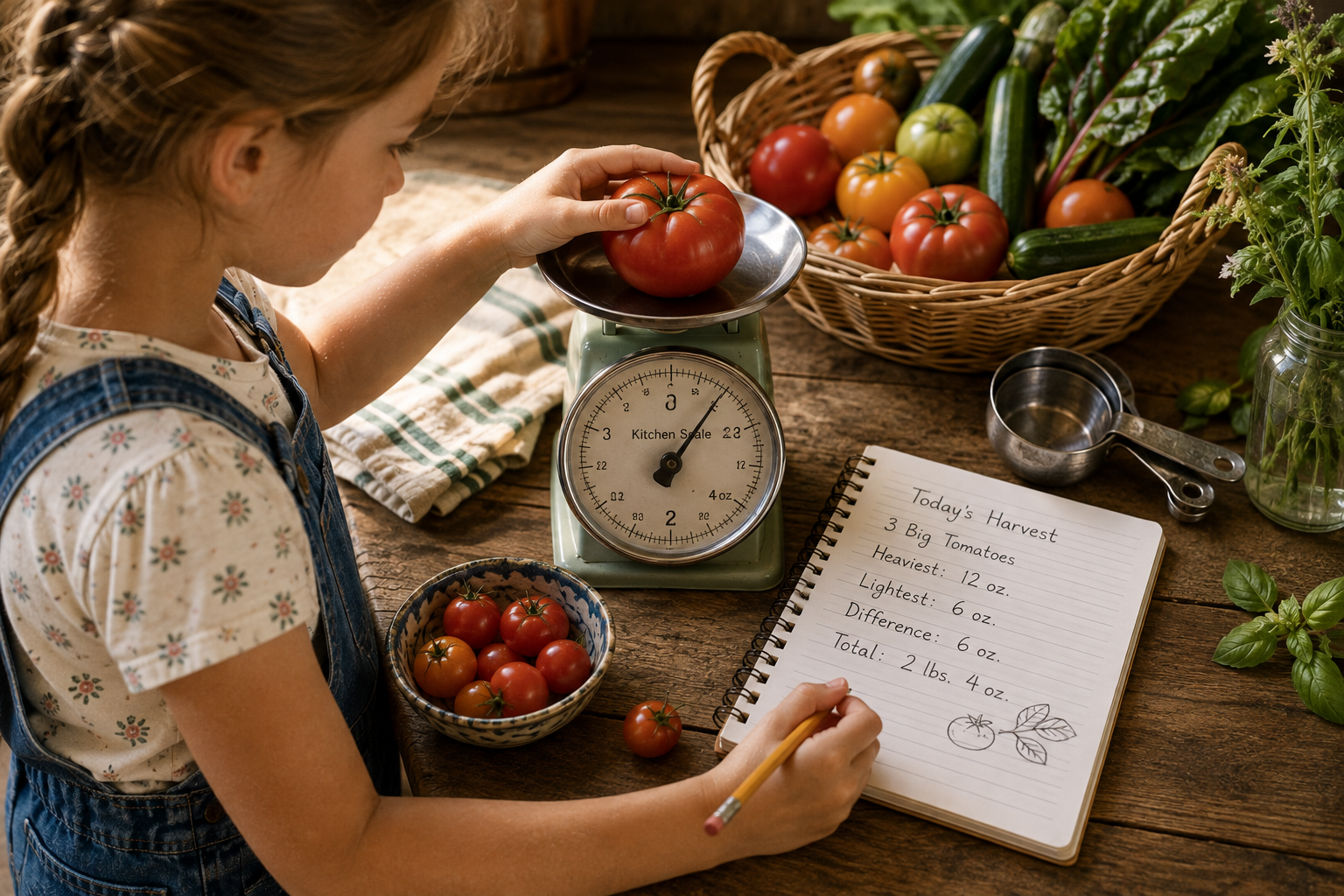
Measuring from the Garden
Rulers, tape measures, kitchen scales, and measuring cups can turn an ordinary trip to the garden into a practical math lesson. Help children explore inches, feet, fractions, weight, area, estimation, and more while measuring things that actually matter to them.
Kitchen Table School
One of the best things about teaching children at home is that math doesn’t have to stay at the kitchen table.
Sometimes it grows outside.
A garden is full of things begging to be measured. A bean vine climbs another inch. A tomato gets heavier. A pumpkin slowly takes over its corner of the garden. The row that looked perfectly straight when you planted it turns out to have its own ideas. Even a handful of strawberries can become a math lesson before somebody eats the evidence.
And unlike a page of measurement problems in a workbook, these measurements have a reason behind them.
We want to know.
Start With a Ruler
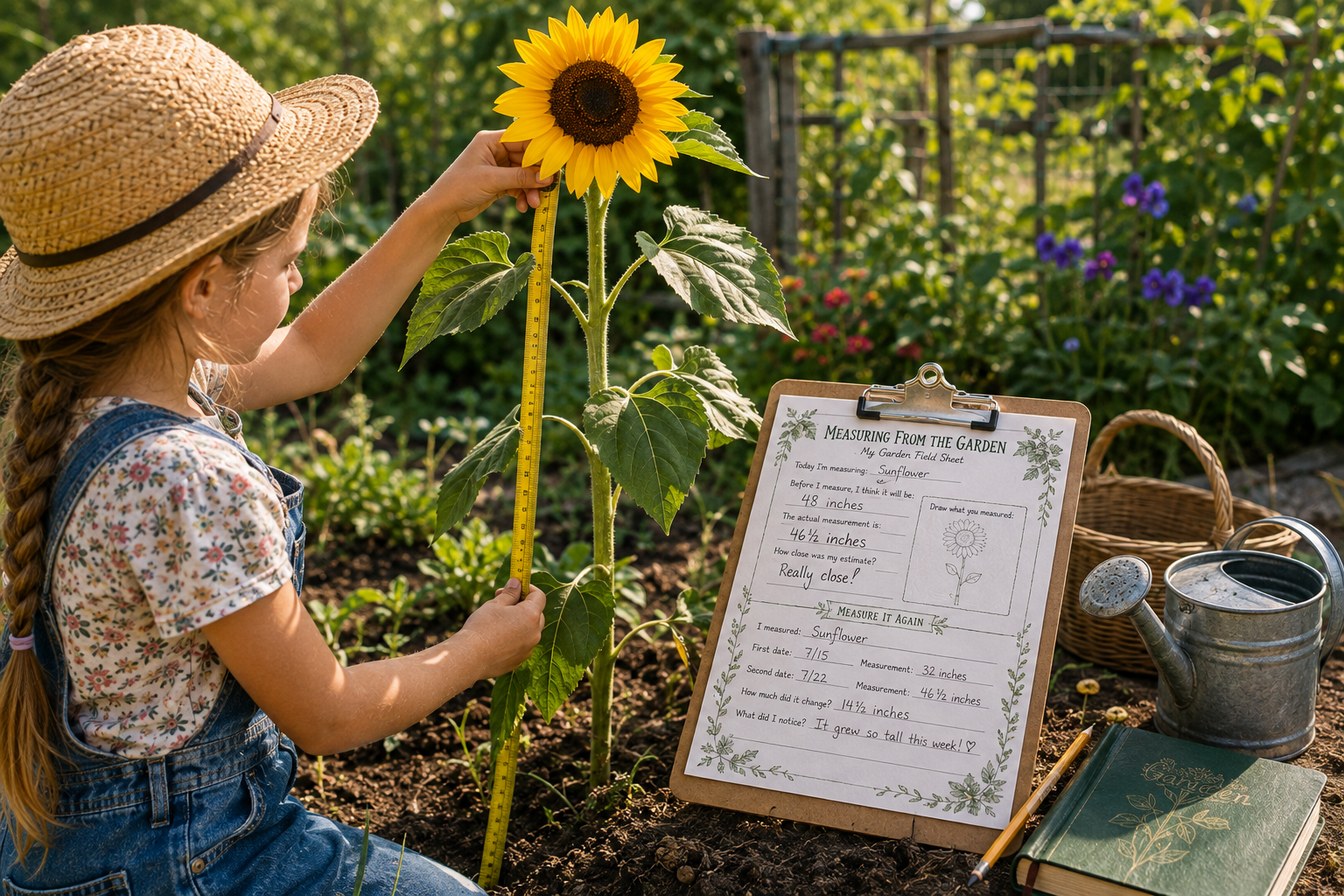
For a young child, measuring can begin as simply as carrying a ruler into the garden.
How long is that cucumber?
How wide is the biggest leaf on the squash plant?
How tall is the basil?
Which carrot is longer?
Before measuring anything, let the child guess. A child might look at a cucumber and decide it is six inches long, then discover that it is actually nine. That little moment teaches something important about measurement: our eyes aren't always very good measuring tools.
A ruler gives us a common language.
Once inches make sense, introduce half inches and quarter inches naturally. Garden produce rarely has the courtesy to grow to exactly seven inches.
That crooked cucumber may be 7½ inches long, which gives fractions an immediate purpose.
When Twelve Inches Becomes a Foot
The garden is also a wonderful place to discover why we need different units.
Measuring a radish with a yardstick would be ridiculous. Measuring the length of the garden bed with a six-inch ruler would be equally ridiculous, although doing it once might convince a child of that far better than explaining it.
Bring out the tape measure.
Measure the length and width of a raised bed. Measure the distance between plants. Measure how far a vine has traveled. Measure the height of a trellis.
Sooner or later, twelve inches will turn into a foot.
Instead of simply memorizing 12 inches = 1 foot, a child can actually see it happen on the tape measure.
Then try predicting.
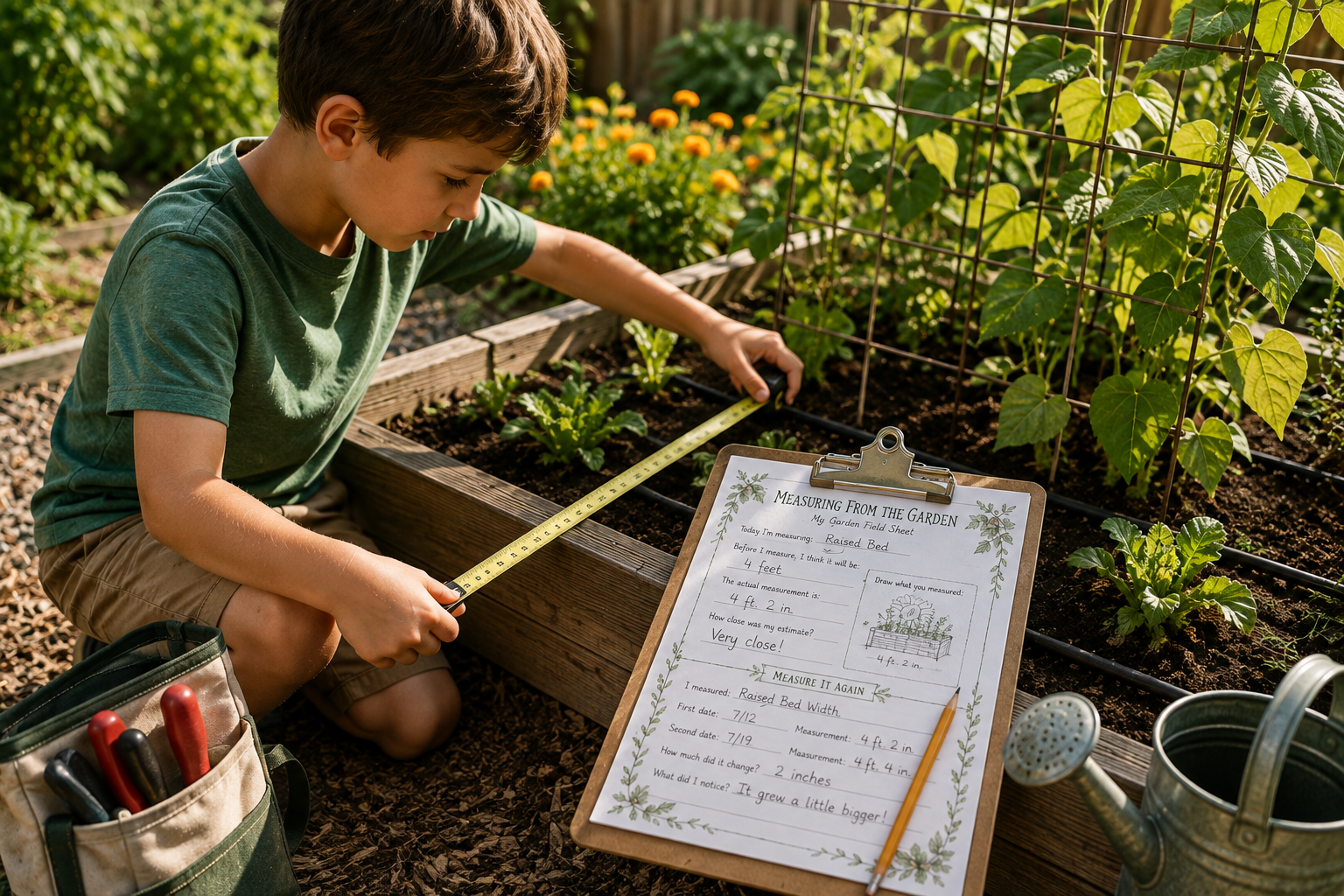
If a garden bed is four feet long, about how many inches should it be?
Don't calculate it first. Guess. Measure it. Then figure out why the answer makes sense.
That's mathematical thinking, not just arithmetic.
Measure the Same Thing Again
Some of the best garden measurements aren't taken once.
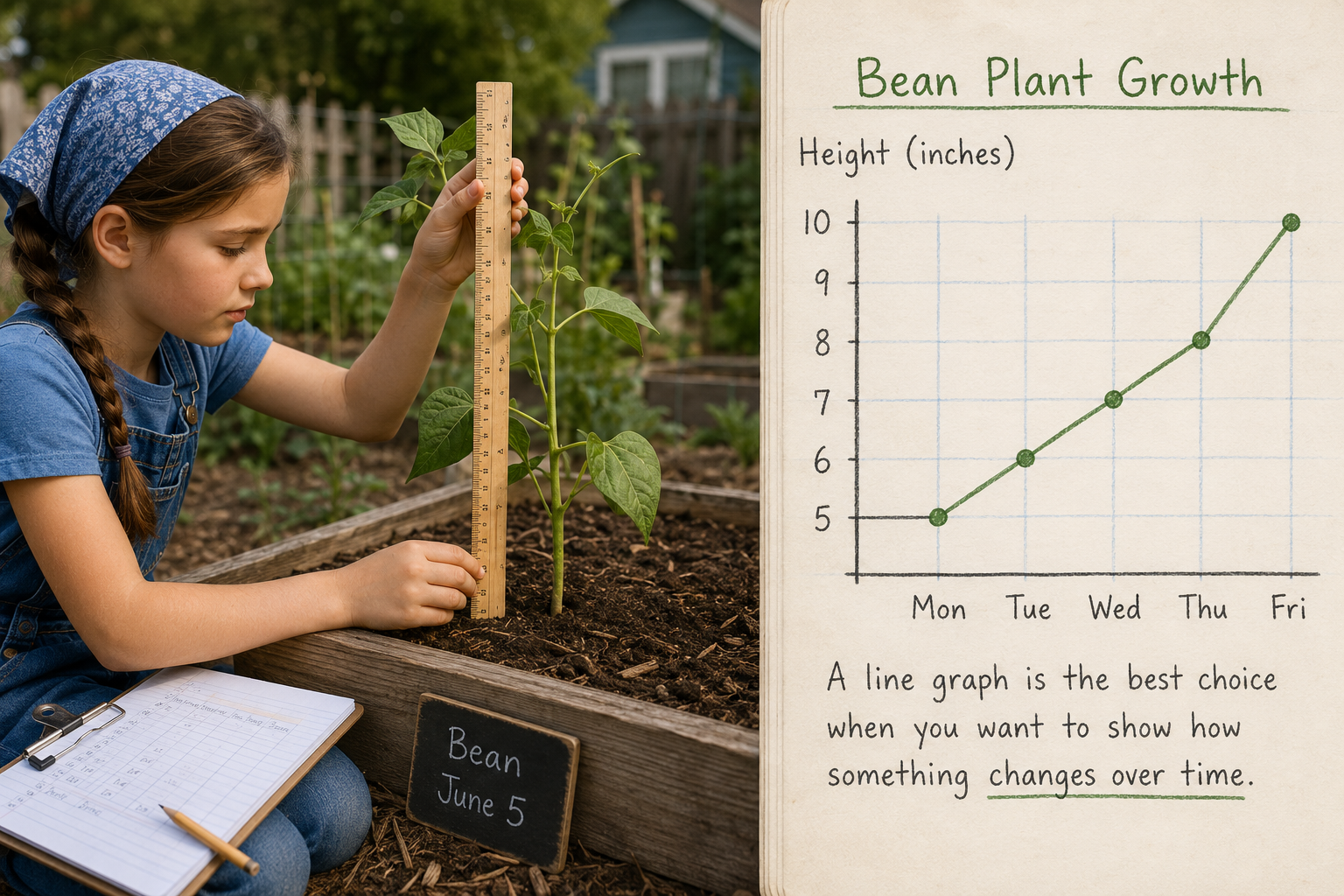
Choose something that's growing quickly—a sunflower, bean vine, cucumber vine, tomato plant, or pumpkin—and measure it regularly.
Mark the date and measurement in a notebook.
A week later, measure again.
Now the questions get more interesting.
How much did it grow?
Did it grow more this week than last week?
How tall do you think it will be next Tuesday?
If it keeps growing at about the same rate, when might it reach the top of the trellis?
The child has quietly moved from measuring into subtraction, comparison, estimation, data collection, and prediction.
Older children can calculate an average rate of growth. Younger children can simply draw a line showing that the plant is taller than it was before.
Both are doing real mathematics.
Bring the Harvest to the Kitchen Table
Eventually the garden lesson follows us back inside.
Now we can weigh things.
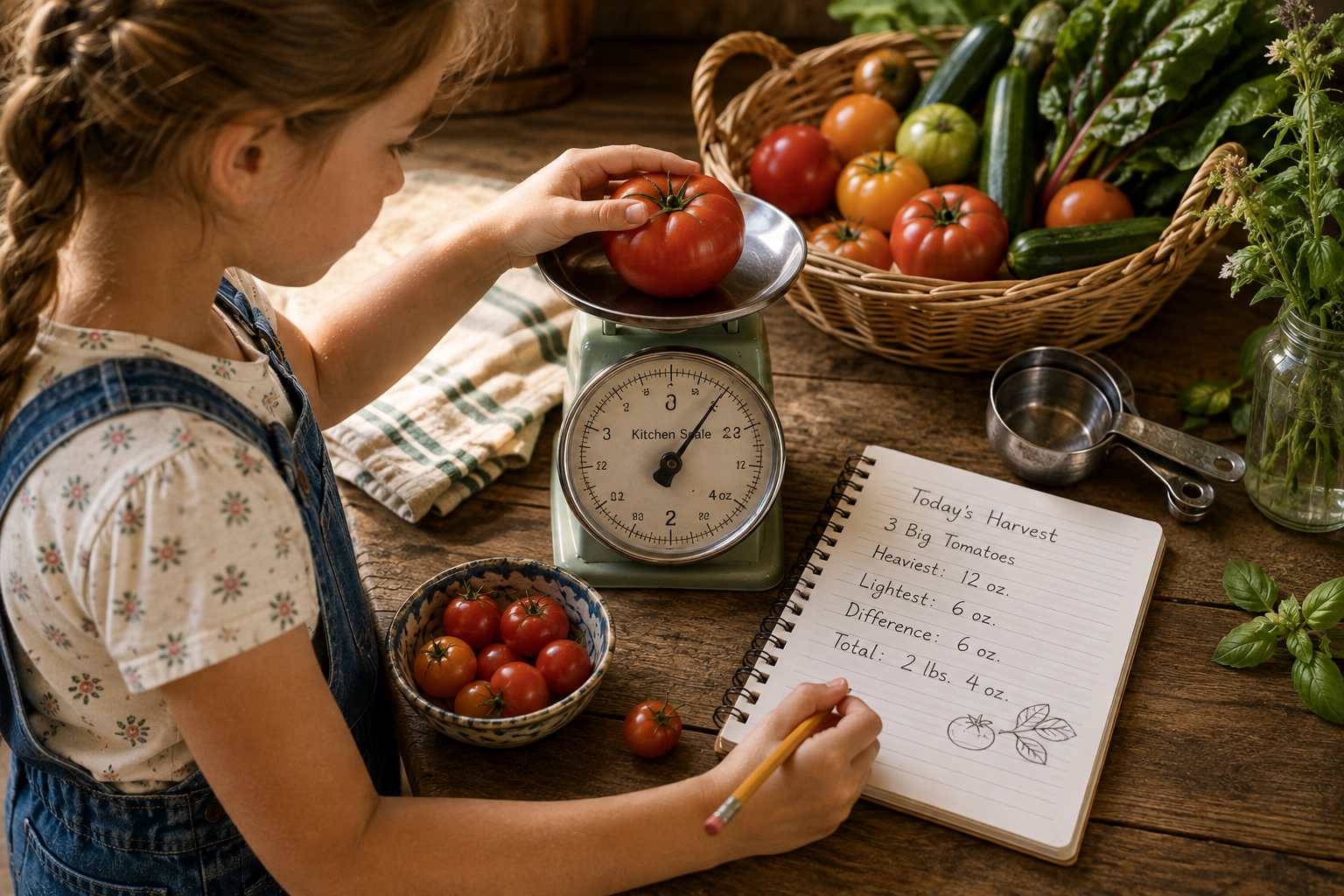
Put the kitchen scale on the table and let children compare vegetables before checking their actual weights.
Which tomato feels heavier?
Do three little tomatoes weigh more than one large tomato?
How many cucumbers does it take to make a pound?
How much did today's entire harvest weigh?
This is also a good place to introduce ounces and pounds. Sixteen ounces stops being an isolated fact to memorize when a child can keep adding tomatoes to the scale until the display reaches one pound.
If you use both a digital scale and an old-fashioned kitchen scale, even better. Reading the markings on an analog scale is its own little math lesson.
Measuring What We Use
Garden measurement doesn't end with length and weight.
Bring the measuring cups into it.
If you've picked basil for pesto, how many cups of loosely packed leaves do you have? If a recipe needs two cups and you have three, how much will be left?
Measure berries before making jam. Measure chopped herbs. Measure beans after shelling them. Measure tomatoes before turning them into sauce.
Then play with the quantities.
If the recipe calls for one cup and you're making half a batch, what do you need?
What if you're doubling it?
A child who has held a ½-cup measure and poured it twice into a one-cup measure has experienced the relationship between one-half and one whole. The fraction isn't floating mysteriously on a worksheet anymore. It is right there in her hands.
Don't Forget the Garden Itself
Older children can begin measuring the space rather than just what grows in it.
How much room does a garden bed take up?
Measure its length and width and introduce area.
A 4-foot-by-8-foot bed gives you 32 square feet of growing space. Now seed-packet spacing starts to mean something.
If lettuce plants need to be six inches apart, approximately how many can we fit?
Would we fit more if we planted them in a grid instead of a single row?
How much soil would we need to fill a new raised bed?
How much fencing would go around the garden?
These are the sorts of problems adults actually solve. Children don't have to wonder when they will ever use this math. They're already using it.
Let the Child Ask the Question
This may be the most important part.
You don't need to turn every trip to the garden into a formal math lesson. In fact, please don't.
Sometimes a tomato should just be a tomato.
But keep a ruler, tape measure, kitchen scale, measuring cups, pencil, and notebook handy. When someone wonders whether this week's zucchini is bigger than last week's, you've got a lesson.
Follow the question.
"I wonder how tall that is."
Let's measure it.
"I think this pumpkin weighs more than that one."
Let's find out.
"Do we have enough strawberries for the recipe?"
How could we figure it out?
That little phrase—how could we figure it out?—may teach more mathematics than anything on the page.
Because math isn't really about getting through a workbook.
It's one of the ways we make sense of the world around us.
And sometimes the world around us happens to be growing zucchini.
Take the Lesson Outside
To make it easy to put these ideas into practice, I created a free two-page Measuring from the Garden printable to take along with you. The first page gives children a place to estimate and measure something they find in the garden, draw what they measured, and come back later to see how it has changed. The second page takes the math a little further with garden-bed measurements, plant spacing, harvest weights, kitchen measurements, and a chance for children to invent a garden math problem of their own. Print the pages, tuck them onto a clipboard with a pencil, grab a ruler or tape measure, and head outside. You don't need to complete every section—or even call it a lesson. Just follow the questions your garden gives you.

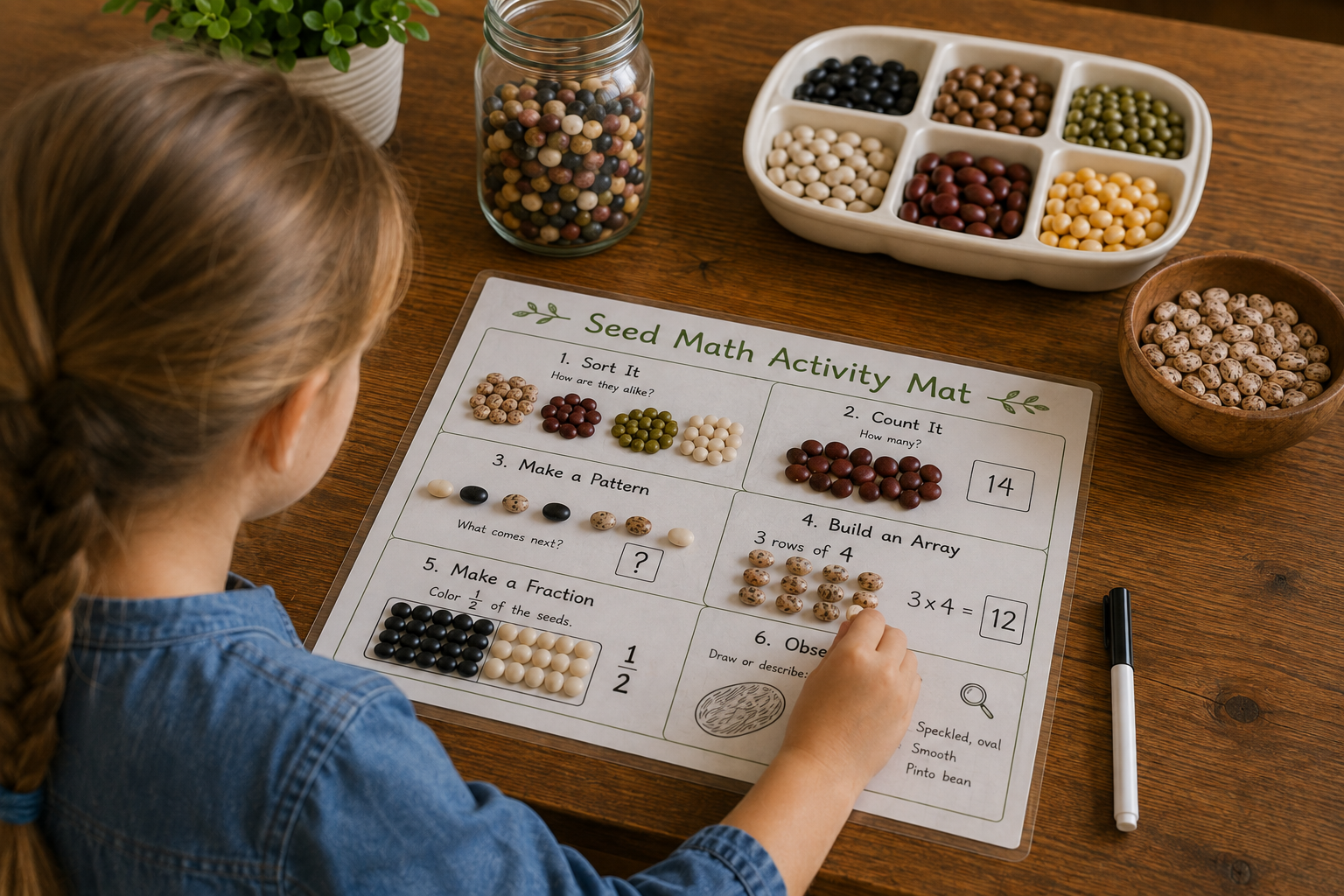
Seed Math Activities: Growing Math Skills at the Kitchen Table
A handful of beans or seeds can become an entire math lesson. These simple, hands-on seed math activities help children explore counting, patterns, multiplication, fractions, measurement, estimation, and more—right at the kitchen table.
Kitchen Table School
Some of the best math manipulatives don't come in a brightly colored box from an educational supply company.
Sometimes they come in a seed packet.
Beans, peas, sunflower seeds, corn kernels, and pumpkin seeds are just about perfect for hands-on math. They're small enough to count and sort, different enough to compare, and plentiful enough that nobody needs to panic when one rolls under the refrigerator.
And unlike plastic counting bears, seeds have a story.
A bean isn't merely something that represents the number seven. It's something a child can hold in his hand today, push into the soil tomorrow, and—with a little water, sunshine, and patience—pick from a plant months from now.
That's the kind of learning I love.
Start With a Bowl of Seeds
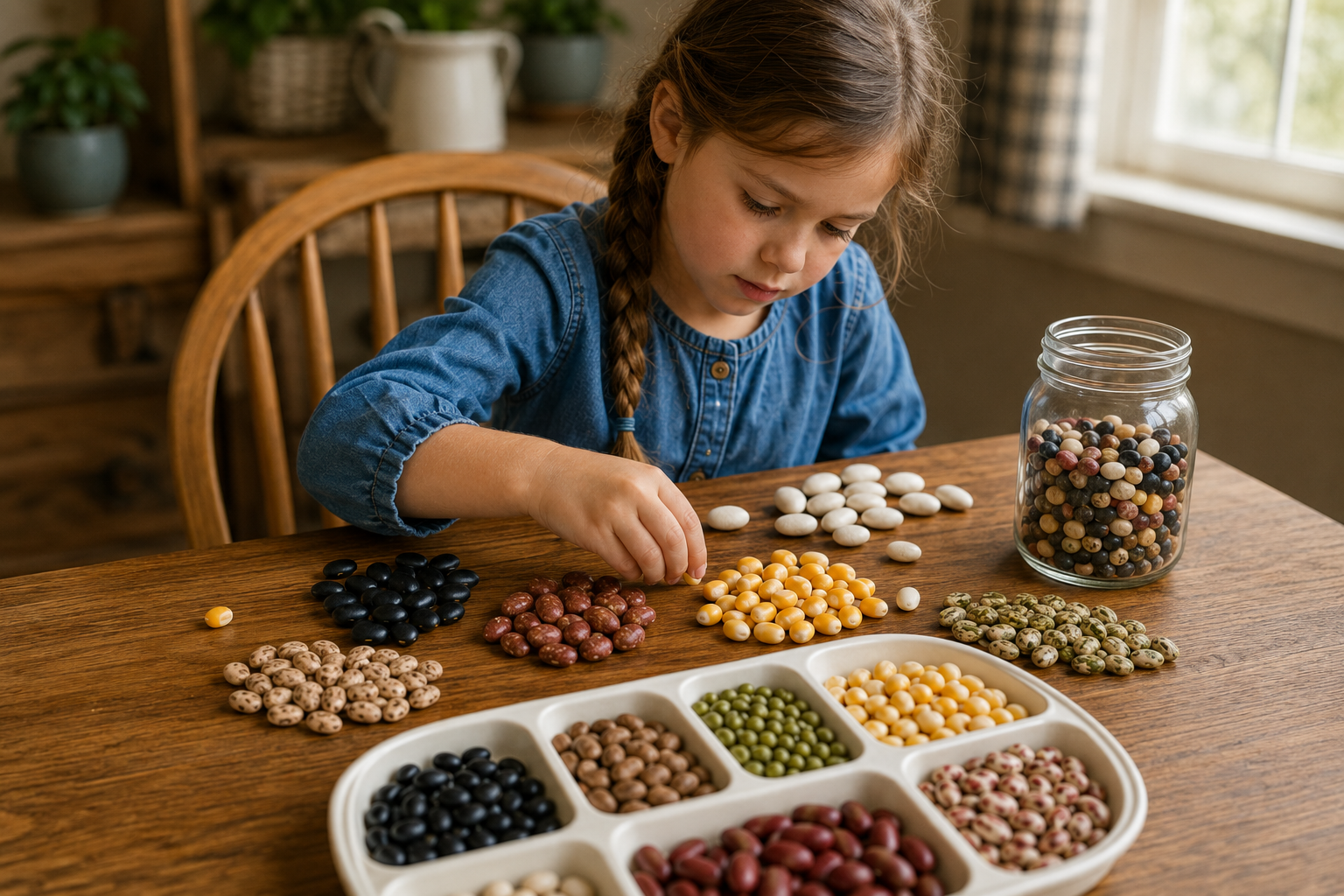
You don't need anything elaborate for seed math. Gather several kinds of dried beans or seeds from the pantry, garden, or inexpensive seed packets.
Choose larger seeds for younger children, especially if you have little ones who are still inclined to investigate things with their mouths. Seed activities with small children should always be supervised.
Then put the seeds on the kitchen table.
Before you give any instructions, see what your children do with them.
They may begin sorting them without being asked. They may line them up from smallest to largest. Someone may make a picture. Someone else will almost certainly announce that one bean looks like a potato.
They're already observing, comparing, classifying, and organizing.
In other words, they're doing math.
Count the Seeds
For your youngest mathematicians, begin with simple counting.
Put a small pile of seeds in front of your child and ask her to count them. Have her move each seed from one side of the table to the other as she counts.
That little movement matters. It helps children understand one-to-one correspondence—that each object counted represents one number.
Try making number cards from 1 through 10. Let your child choose a card and place the correct number of seeds on it.
Older children can work with larger numbers. Give them a handful of beans, have them estimate the quantity first, and then count to see how close they came.
Don't skip the estimating. Being able to make a reasonable guess about quantity is an important mathematical skill.
Sort and Classify
Mix several kinds of seeds together and ask your child to sort them.
Don't tell him how.
That's the interesting part.
He might sort them by color, size, shape, or type. Once he's finished, ask:
Why did you put these together?
Now rearrange them using a different rule.
A child who sorted beans by color the first time might sort them by size the second time. Older children can create increasingly complicated classification rules.
Try:
light and dark
round and long
large, medium, and small
edible seeds and seeds we don't normally eat
seeds from fruits and seeds from vegetables
seeds that grow underground crops versus above-ground crops
Classification is foundational mathematical thinking—and it crosses beautifully into science.
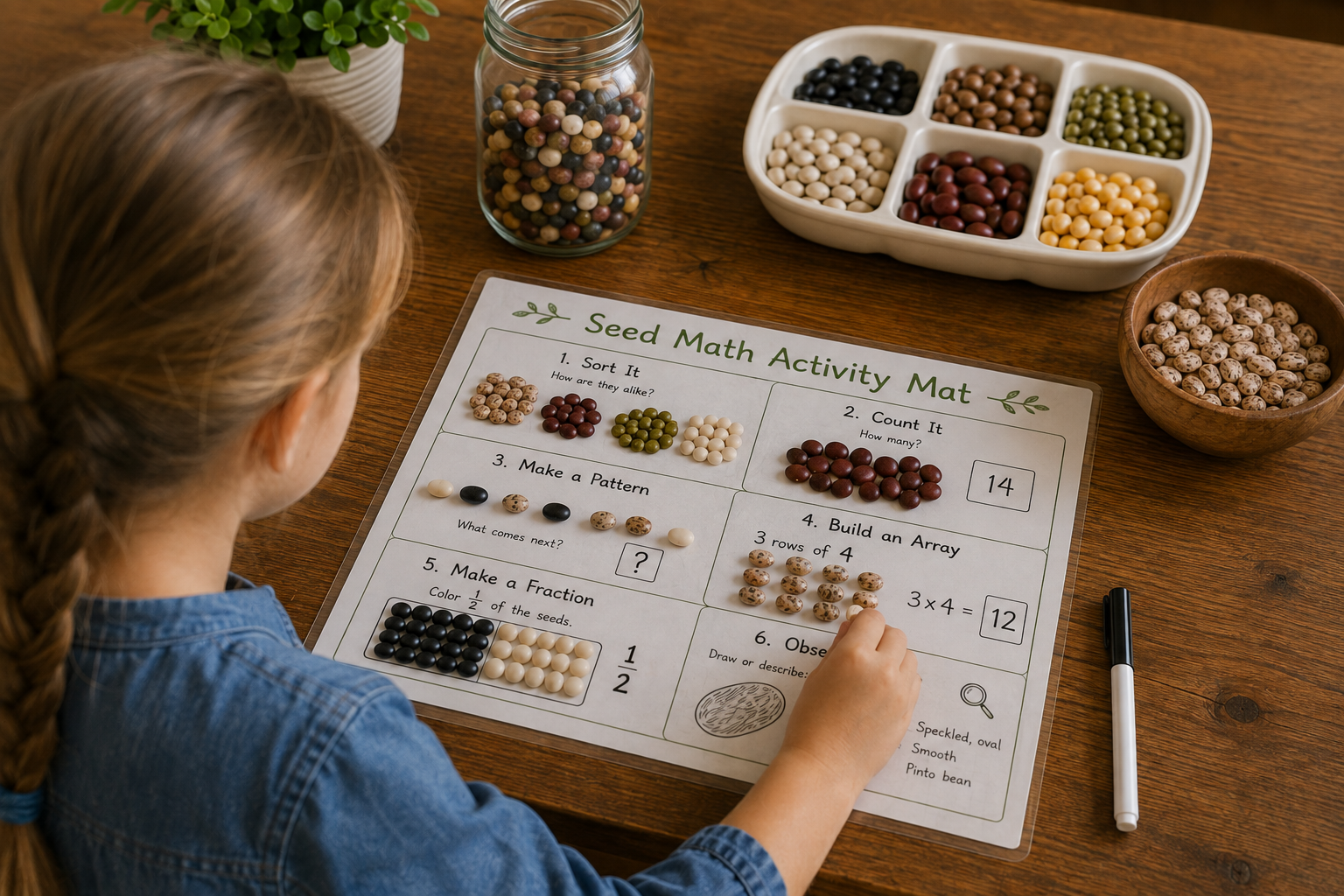
Make Patterns
Start a pattern with your seeds:
Bean, bean, corn.
Bean, bean, corn.
Bean, bean...
What comes next?
Once your child understands the idea, let her make patterns for you to complete.
Begin with simple AB patterns and gradually make them more complicated:
ABAB
AABAAB
ABCABC
ABBABB
AABCAABC
For older children, turn the activity around. Make a complicated seed pattern and ask them to describe the repeating unit.
Suddenly you've moved from preschool pattern play toward the kind of thinking they'll eventually use in algebra.
Practice Addition and Subtraction
Seeds make wonderful counters.
Try a tiny garden story:
"I planted five bean seeds in one row and four in another. How many seeds did I plant altogether?"
Let the child physically build the problem with seeds.
For subtraction:
"We planted ten sunflower seeds, but three didn't sprout. How many plants grew?"
Move three seeds away.
The symbols 10 − 3 = 7 are abstract. Ten sunflower seeds sitting on the table are not.
Once children understand what the numbers mean, the symbols have something to attach themselves to.
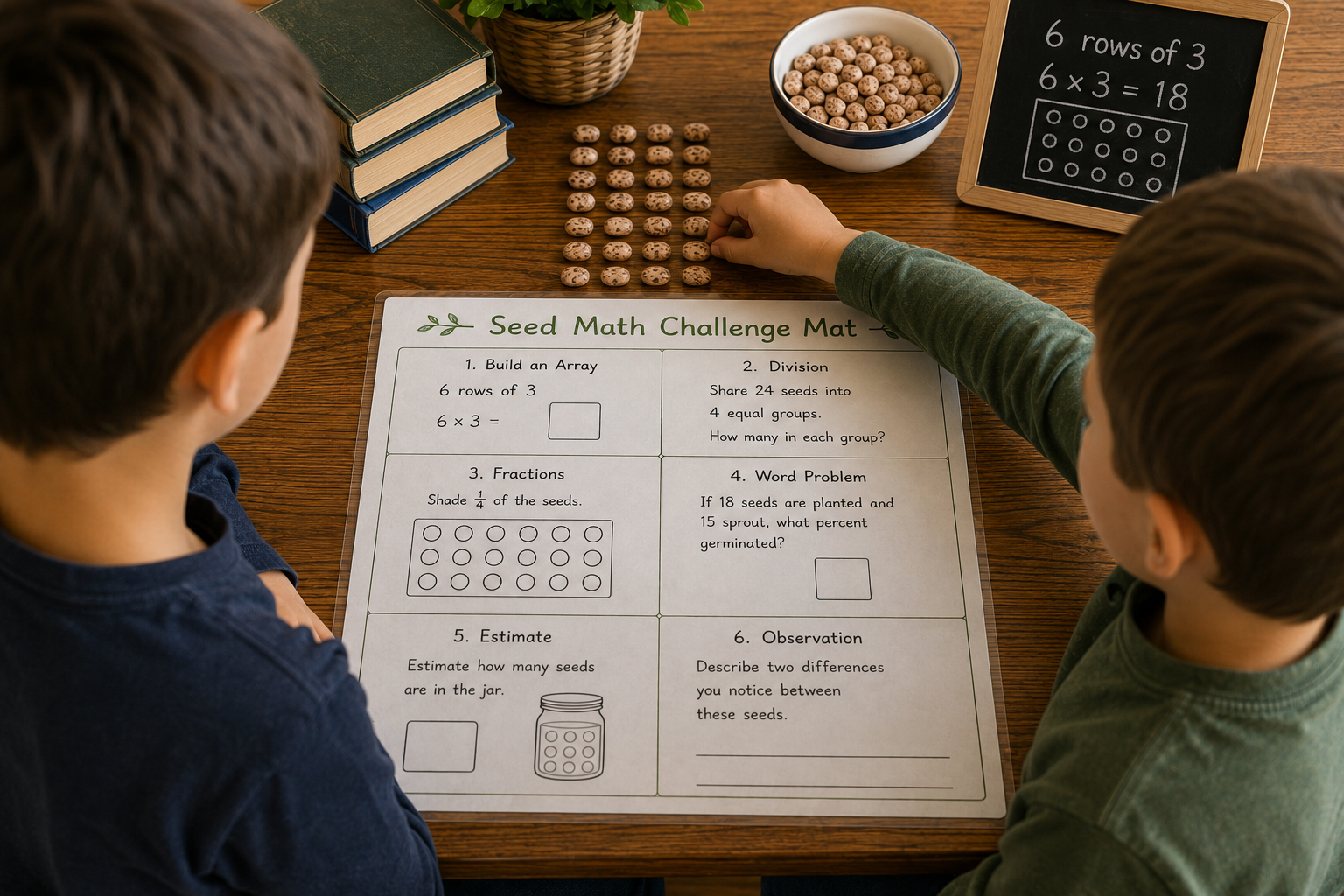
Build Multiplication Arrays
Now plant an imaginary garden.
Make three rows with four bean seeds in each row.
Ask:
How many rows are there?
How many seeds are in each row?
How many seeds altogether?
Then write:
3 × 4 = 12
You've just created a multiplication array.
And unlike an arbitrary worksheet array, this one reflects something gardeners actually do.
Try different garden beds:
2 rows of 6 peas
4 rows of 5 beans
5 rows of 8 corn seeds
Children who are beginning multiplication can build each problem. Children who already know their multiplication facts can predict the answer first and then use the seeds to check themselves.
Discover Division
Take 24 beans and announce that you have four garden rows.
How many seeds should go into each row if every row gets the same number?
Let your child distribute the beans one at a time.
Then write:
24 ÷ 4 = 6
Try changing the question:
What if we want six seeds in each row? How many rows can we plant?
Same seeds. Same numbers. Different way of thinking.
Explore Fractions
Seeds make fractions wonderfully visible.
Put 12 beans on the table.
Ask your child to divide them into two equal groups.
Each group is one-half.
Put them back together and divide them into four equal groups.
Each group is one-fourth.
Then begin asking questions:
What is half of 12?
What is one-fourth of 12?
What is three-fourths of 12?
Older children can write the corresponding equations after building them.
You can also mix seed varieties.
Put out 10 seeds—5 beans, 3 corn kernels, and 2 pumpkin seeds.
What fraction are beans?
5/10, which can also be written 1/2.
Now fractions aren't mysterious pieces of pizza that nobody actually gets to eat. They're right there on the table.
Measure and Compare
Seeds are terrific for informal measurement.
How many bean seeds long is your pencil?
How many sunflower seeds wide is a notebook?
Which seed makes the best measuring unit?
Children will quickly discover an important principle: measurement only works well when the units are reasonably consistent.
That's why measuring a pencil with a mixture of giant lima beans and tiny lentils gives rather questionable results.
It's also a delightful way to introduce the reason we use standard units.
Graph Your Seeds
Sort a mixture of seeds by type and count each group.
Then make a simple bar graph.
Younger children can make a concrete graph by lining up the actual seeds in columns.
Older children can transfer their results to graph paper.
Ask questions about the graph:
Which group has the most?
Which has the least?
How many more beans are there than corn kernels?
How many seeds are there altogether?
What fraction of the seeds are sunflower seeds?
One bowl of seeds has now taken you from counting all the way to data analysis.
Estimate Germination
Here's where seed math gets even better.
Plant some.
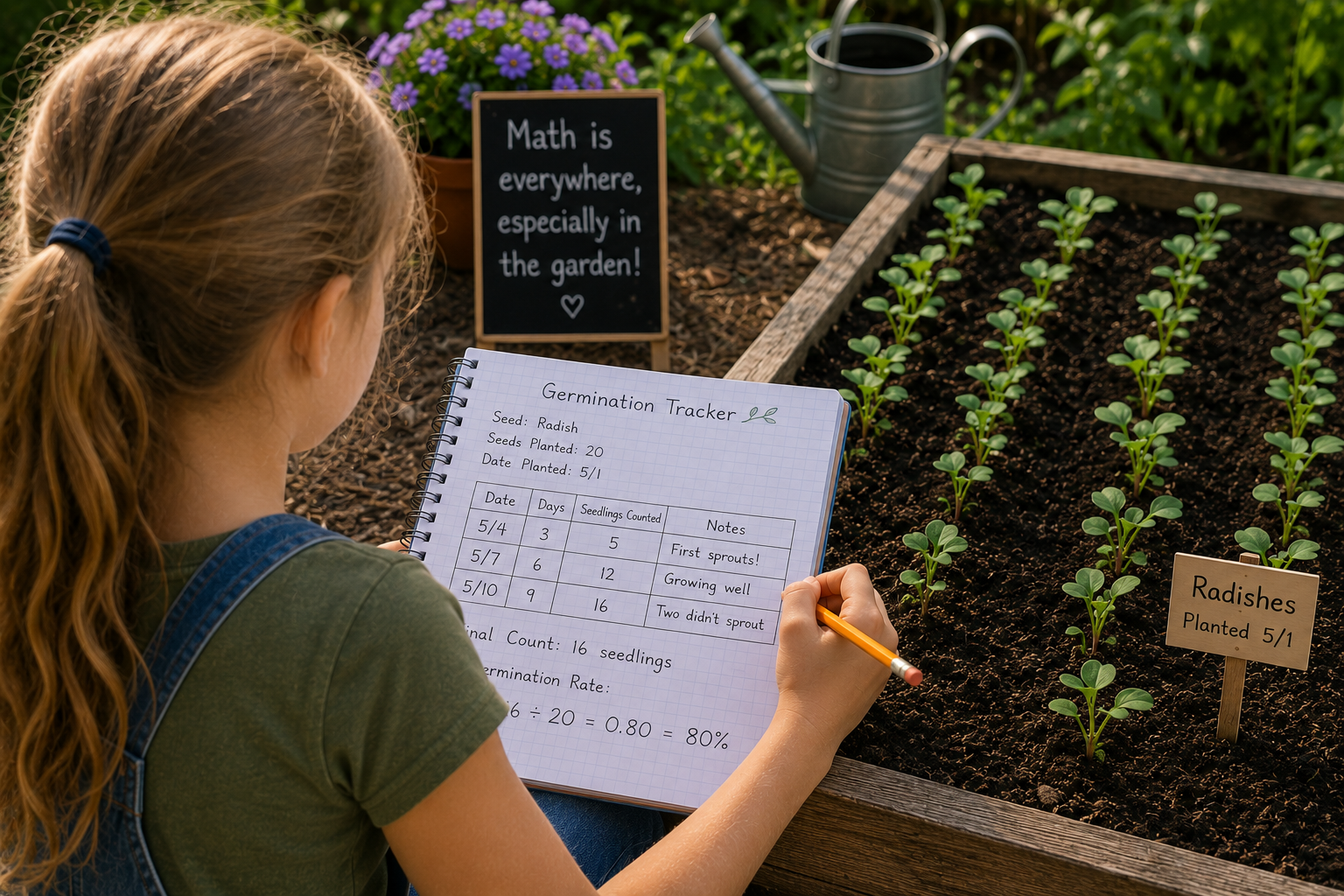
Before planting, count your seeds. Suppose you plant 20 radish seeds.
Ask your child to predict how many will germinate.
A week later, count the seedlings.
If 16 of your 20 seeds sprouted, younger children can simply compare 16 sprouts with the 20 seeds planted.
Older children can calculate the germination rate:
16 ÷ 20 = .80
or
80% germination
Now percentages have a reason to exist.
Keep a record and compare different kinds of seeds. Which had the best germination rate? Does the age of the seed matter? Does soaking make a difference?
At this point, your math lesson has wandered cheerfully into science, gardening, record keeping, and experimental design.
I see no reason to chase it back into its proper subject.
Plan a Tiny Garden
For older elementary children, take the math outside.
Give your child the dimensions of a small garden bed—or let him measure one.
Then look at the planting directions on the seed packet.
If beans should be planted four inches apart, how many will fit in a four-foot row?
How many rows will fit in the bed?
How many seeds will you need?
Do you have enough seeds in the packet?
How many plants could the entire bed hold?
Now you're working with measurement, multiplication, division, area, estimation, and practical problem solving.
And there is an actual garden at the end of the equation.
Let Several Ages Learn Together
This is one of my favorite things about hands-on learning.
You don't necessarily need a separate lesson for every child.
Put the same bowl of seeds in the middle of the table.
Your preschooler can sort and count.
Your early elementary child can practice addition and subtraction.
Another child can make multiplication arrays.
An older student can calculate fractions, percentages, germination rates, or garden spacing.
They're working with the same materials and sharing the same experience, but each child is doing mathematics at an appropriate level.
That makes life considerably easier when you're teaching several children at once.
Math Is Already Everywhere
Children sometimes get the impression that math lives in textbooks.
It doesn't.
Math is in recipes and fence posts. It's in egg cartons and feed buckets. It's in measuring garden beds, doubling bread recipes, figuring out whether six bales of hay will fit in the truck, and deciding how many bean plants will fit along a trellis.
It's even hiding in a handful of seeds.
So pour some beans onto the kitchen table and see where the lesson goes.
You may start with counting.
You may end up planting a garden.
Around here, I'd call that a very successful school day.
Kitchen Science: Yeast & Bread
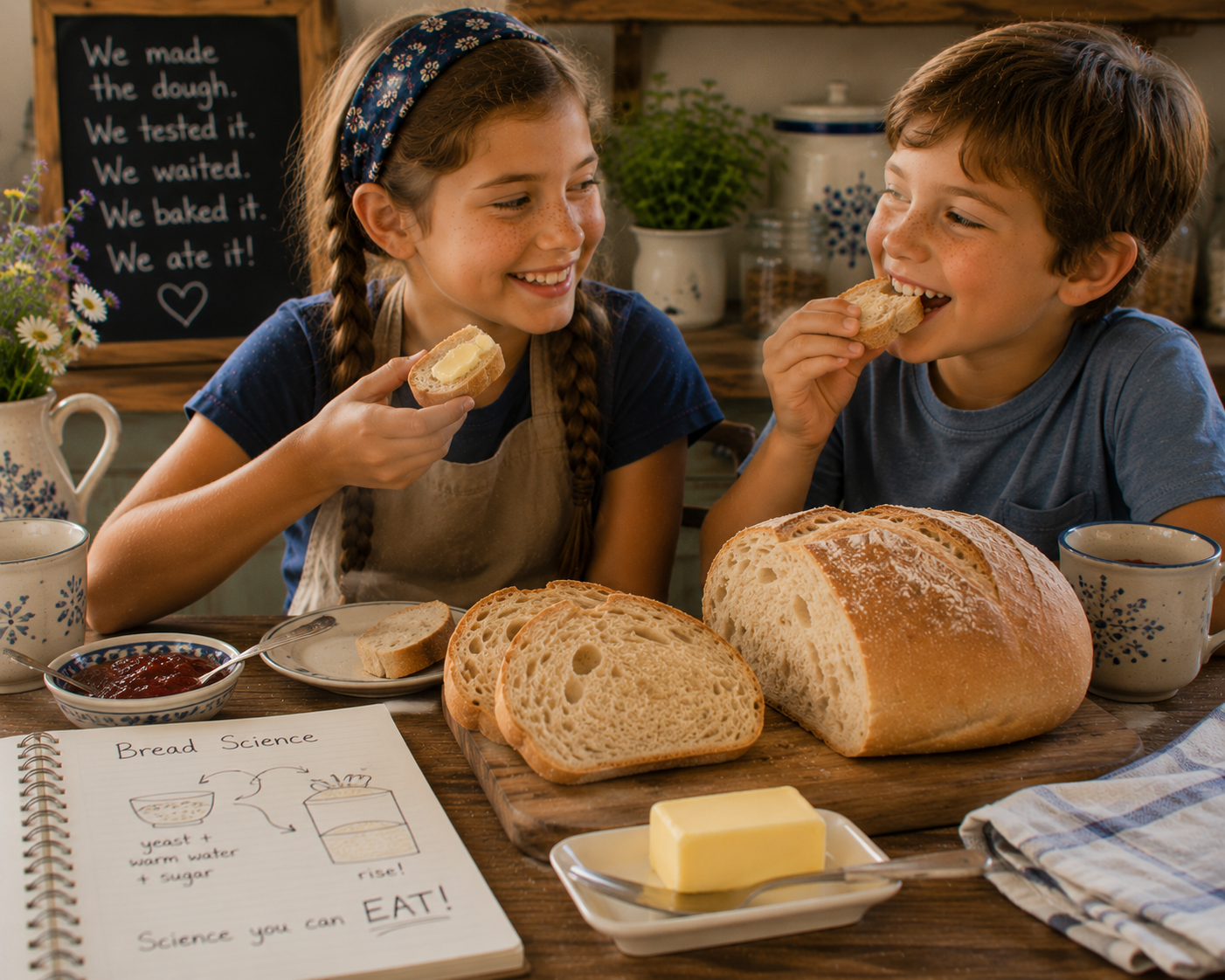
Making bread with children looks like a cooking lesson. Flour goes into a bowl, water gets measured, yeast is added, everybody gets flour on themselves and probably the floor, and eventually there is bread.
But sitting there on the kitchen table is a laboratory.
Making bread with children looks like a cooking lesson. Flour goes into a bowl, water gets measured, yeast is added, everybody gets flour on themselves and probably the floor, and eventually there is bread.
But sitting there on the kitchen table is a laboratory.
Bread lets children watch biology and chemistry happen with their own eyes. Yeast wakes up. Sugars are consumed. Gas is produced. Proteins link together into stretchy networks. Temperature changes the speed of reactions. A soft lump of dough expands until it is nearly twice its original size, and then the heat of the oven transforms it again.
And at the end of the science lesson, you get to put butter on it.
That may be my favorite kind of curriculum.
Meet the Yeast
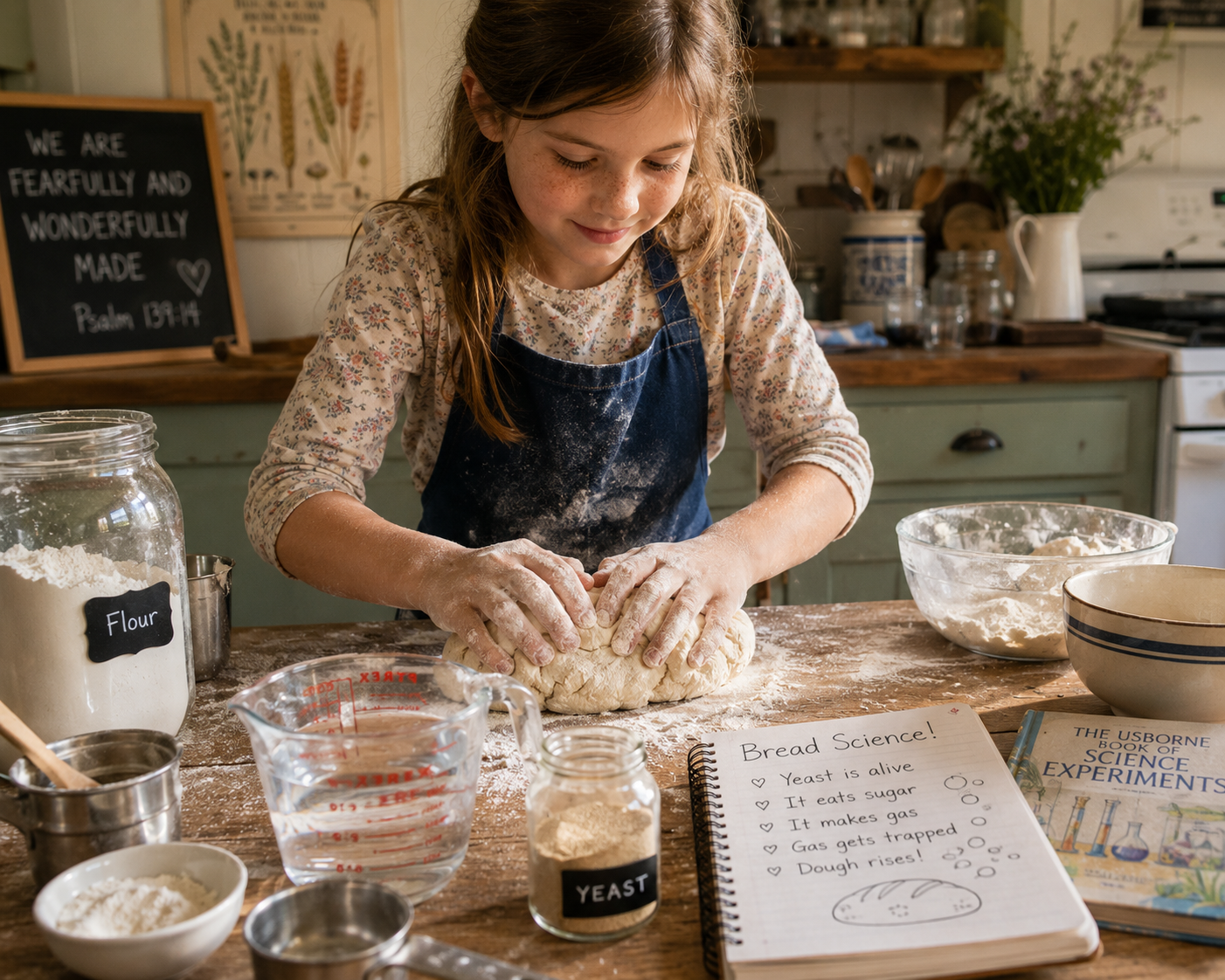
Yeast is alive.
The little granules in a packet or jar don't look particularly lively, but baker's yeast is made up of microscopic, single-celled fungi. When yeast is dry and cool, its activity slows dramatically. Give it moisture and suitable warmth, and it becomes active again.
You can see evidence of that activity before you ever make the dough. Put warm water into a clear glass or jar, add yeast and a little sugar, and watch. Before long, tiny bubbles begin to appear. Given enough time, a foamy layer may form across the top.
Don't tell the children what is happening just yet. Ask them.
What do you think those bubbles are?
Let them look. Let them smell it. Let them make guesses. Write the guesses down if you want to come back to them later.
Those bubbles are carbon dioxide. As yeast obtains energy from sugars through fermentation, it produces carbon dioxide and ethanol. We can't see an individual yeast cell doing its work, but we can see the results of millions of them working together.
Already, that little glass on the kitchen table has given us a biology lesson.
Where Does the Gas Go?
Watching yeast bubble in a glass is interesting. Watching it lift an entire bowl of dough is even better.
When flour and water are mixed, proteins in wheat flour begin interacting. Two of those proteins, gliadin and glutenin, combine to help form the stretchy network we call gluten. Mixing, kneading, and time help that network develop.
Children can feel the difference themselves. At first, bread dough may be shaggy, sticky, and prone to tearing. As the gluten develops, the dough becomes smoother, stronger, and more elastic. Pull a small piece of well-developed dough gently between your fingers and it may stretch thin enough for light to pass through before it tears. Bakers call this the windowpane test.
Meanwhile, the yeast is still at work.
Carbon dioxide produced by the yeast becomes trapped in tiny pockets within the stretchy dough. As those pockets fill and expand, the whole mass of dough grows larger.
That's what we're watching when bread rises.
The yeast isn't pushing the bread upward. It is producing gas, and the structure of the dough is trapping much of that gas inside.
A bowl of bread dough has now given us biology, chemistry, and a little physics—and we haven't even turned on the oven.
Turn the Bread Into an Experiment
You don't need a science kit for this lesson. Use the yeast, flour, glasses, measuring spoons, thermometer if you have one, and other ingredients already in your kitchen.
The most important part isn't the equipment. It's learning to ask a question and then changing one thing at a time to find the answer.
Temperature is an easy place to begin. Put equal amounts of yeast into three clear glasses. Add the same amount of sugar to each and the same amount of water, but change the water temperature. Make one cool, one comfortably warm, and one hot.
Before adding the yeast, ask everyone to predict what will happen. Which glass will show activity first? Will they all behave alike? Will hot water make the yeast work fastest?
Write down the predictions and then watch.
The cool-water yeast should work more slowly. Yeast in appropriately warm water should become active more quickly. Water that is hot enough can damage or kill the yeast, leaving little or no activity to observe.
That last glass teaches a particularly useful scientific lesson. A child may reason that if warmth makes yeast more active, then hotter water ought to make it even more active.
It sounds perfectly sensible.
And it can be wrong.
That's why we experiment.
What Does Yeast Eat?
Temperature is only one variable you can investigate. On another bread-making day, you might compare yeast in plain warm water with yeast in warm water containing a little sugar. Older children may want to compare different amounts of sugar or investigate what happens when salt is introduced.
You could keep going until every drinking glass in the house contains a mysterious bubbling substance, but I wouldn't.
One question is enough.
A younger child can draw pictures of two glasses and show which one produced more bubbles. An older child can measure the height of the foam at regular intervals, record the results in a table, and turn the measurements into a graph. Another child might write a paragraph explaining why the results did or did not support the original hypothesis.
Same experiment. Different levels of learning.
That's one of the beauties of teaching several ages around the same kitchen table. The subject doesn't have to change just because the children are at different stages.
The Dough Has More to Teach Us
Once the experiment becomes an actual loaf of bread, the questions don't have to stop.
Why do we knead dough? What happens if we don't knead it enough? Why do we cover dough while it rises? Why does dough usually rise faster in a warm kitchen than in a cold one? What does salt do? Why does the dough become puffier instead of simply filling with visible bubbles?
Children can investigate some of those questions instead of simply hearing the answers.
Before kneading the main batch, pinch off a small piece of dough. Leave that piece alone while the rest is kneaded. Later, compare them. Stretch both pieces. How do they feel? Which one stretches farther? Which tears more easily?
Now gluten isn't just a vocabulary word in a science book. They have felt the difference with their own hands.
That matters.
Then Comes the Oven
Putting the loaf into the oven starts another series of changes.
For a short time, the loaf may rise rapidly as gases already inside the dough expand and yeast activity briefly accelerates. Bakers call this oven spring. As the internal temperature continues to climb, the yeast dies and fermentation stops.
The bread's structure begins to set. Starches absorb water and gelatinize, proteins firm, moisture evaporates, and the soft dough gradually becomes a loaf that can hold its shape.
Then the crust begins to brown.
That browning isn't simply the bread "getting toasted." Heat drives reactions between sugars and amino acids in the surface of the dough, including what is known as the Maillard reaction. Those reactions create new flavors, aromas, and colors.
Which proves that science can smell absolutely wonderful.
Ask the children to compare the dough before and after baking. The ingredients are still there, but they have been transformed. The texture, smell, taste, color, structure, and moisture have all changed.
And unlike many laboratory specimens, this one is excellent with butter.
Don't Explain Everything
This may be the hardest part of teaching science this way.
When we know the answer, we want to tell it.
A child asks, "Why did that one rise more?" and the explanation is right there on the tip of our tongue.
Try asking, "What do you think?"
Let the child look again. What was different between the two samples? What was the same? What did we predict before we began? Does what we observed agree with our prediction?
And let children be wrong.
A wrong prediction followed by an observable result is not a failed lesson. It may be one of the most useful things that can happen in science. A child discovers that an idea can sound completely reasonable and still need to be tested against what actually happens.
We aren't merely teaching children a collection of scientific facts. We're teaching them how to ask questions, observe carefully, compare results, revise their thinking, and find out.
Those habits will serve them long after they have forgotten the word gliadin.
Follow the Questions
Bread has a way of wandering into other subjects before anyone notices.
Measuring ingredients brings in fractions, multiplication, volume, and weight. Doubling or halving a recipe adds another layer of math. Recording yeast activity introduces tables and graphs. Writing observations becomes language arts.
Then someone asks who first figured out that letting dough sit around until it bubbled made better bread, and suddenly we're in history. How did ancient people make leavened bread without little packets of commercial yeast? What is sourdough starter? Why were bread and grain so important to ancient civilizations? How was grain ground before electric mills?
Follow those questions.
You don't need to turn every loaf into a unit study. Sometimes bread should simply be bread. But when genuine curiosity appears, don't be too quick to steer everyone back toward the lesson you planned.
The unexpected question may be the lesson.
And Then Eat the Evidence
This is one of the things I have always loved about learning at home. Subjects refuse to stay politely inside their assigned boxes.
The kitchen doesn't know that science is supposed to happen during science time and math during math time. Real life mixes them all together.
A child weighs flour, divides a recipe, watches a living organism metabolize sugars, observes gas becoming trapped in an elastic protein network, records measurements, smells chemical reactions taking place in an oven, learns a little history—and then sits down with the family and eats the experiment for supper.
No worksheet could make that more real.
So the next time you're making bread, pull out an extra glass or two. Ask a question. Change one variable. Make a prediction. Watch the bubbles. Feel the dough change beneath your hands. Notice what happens in the oven.
Then cut the loaf while it's still just warm enough to melt the butter.
The kitchen table is already a science lab.
And this experiment tastes very good.
Now download the lesson for your child!
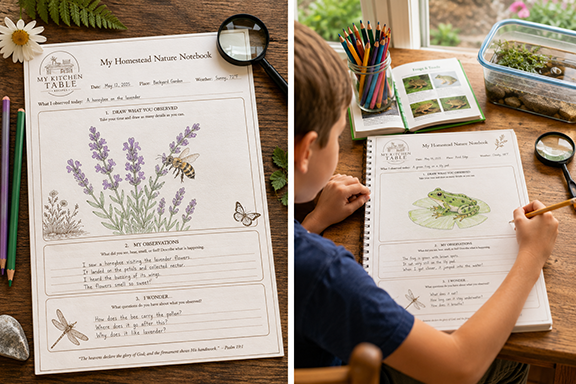
Keeping A Nature Notebook
A nature notebook is more than a collection of pretty drawings. It teaches children to look closely, record what they actually observe, ask good questions, and return again to discover what has changed.
Years ago, when I was homeschooling my children, nature study did not require a complicated curriculum.
Sometimes it required a notebook.
We kept birdwatching notebooks, and the children learned to look closely enough to tell one bird from another. They recorded what they saw, drew pictures, asked questions and gradually began recognizing familiar visitors without needing someone to tell them what they were looking at.
The notebook wasn't the education.
Paying attention was.
That is still one of my favorite ways to teach children about the natural world, and a homestead—or even a very small patch of ground—is an especially good classroom for it. There is always something changing. A plant has put out another leaf. A spider has built a web where there wasn't one yesterday. The first strawberry is beginning to turn red. A bird that was common all winter has disappeared, while another has suddenly arrived.
A child who learns to notice those things is doing far more than nature study.
He is learning how to learn.
You Don't Need a Homestead to Study One
The name homestead nature notebook may conjure up acres of pasture, chickens scratching in the yard, a large vegetable garden and perhaps a convenient red barn in the distance.
None of that is required.
Right now, our own homesteading happens at our little blue condo. We have a small amount of growing space, and Jeff does most of the gardening while I tend my strawberries. Yet there is still plenty to observe.
A nature notebook can begin on an apartment balcony, in a suburban backyard or beside one tomato plant growing in a pot. It can travel to a park, a walking trail, Grandma's house or the patch of weeds beside the driveway that adults have been ignoring for years.
In fact, that patch of weeds may turn out to be extremely interesting.
The important thing is not how much nature is available.
It is how carefully we look at what is there.
Begin With a Real Notebook
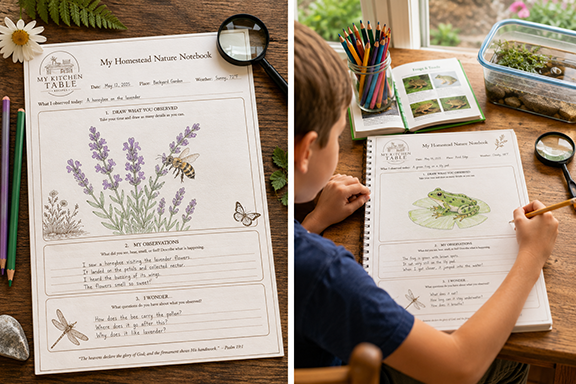
I prefer an actual paper notebook for this.
A child can certainly photograph things, and photographs can be useful references later. But drawing requires a different kind of attention. To draw a leaf, you have to notice its shape. You begin to see whether the edge is smooth or toothed, how the veins branch, whether the leaves grow opposite one another or alternate along the stem.
The drawing does not have to be beautiful.
That needs to be established immediately, especially with a child who announces, “I can't draw.”
This is not an art contest. The purpose is to record what was observed.
A spiral-bound sketchbook works beautifully because it gives children room to draw and write on the same page. Older children may enjoy a more formal field journal. Younger children can use an inexpensive blank notebook and dictate their observations to an adult when writing becomes an obstacle to the actual lesson.
Put the child's name and the year on the front.
Then begin.
The First Entry
For the first nature-notebook lesson, don't send children outside with instructions to “find something interesting.”
That's enormous.
Give them one thing to observe.
It might be a strawberry plant, a tree, a chicken, an ant trail, a bird at the feeder, a tomato blossom or even a dandelion.
Ask the child to spend a few minutes simply looking before drawing or writing anything.
This part is harder than it sounds.
We are accustomed to glancing at things and immediately deciding what they are. That's a leaf. That's a bird. That's a bug.
Nature study asks us to stay with the thing a little longer.
What shape is it?
How many leaves can you count?
Where do they attach to the stem?
Is the top of the leaf the same color as the underside?
Does the insect walk continuously or stop periodically?
What is the bird doing?
Those questions aren't a worksheet to be answered in order. They are examples of the kinds of questions a good observer begins asking.
After looking, make the first entry.
Put the date at the top. Add the place. Record the weather if it seems relevant. Then draw what you observed and write a few sentences about it.
That's enough.
Teach the Difference Between Seeing and Assuming
Here is where nature notebooks become particularly good science lessons.
Suppose a child writes:
The bird was looking for worms.
Perhaps it was.
But did we see worms?
What we actually observed may have been:
The bird hopped across the lawn and stopped several times to peck at the ground.
That distinction is enormously important.
One statement records an observation. The other offers an interpretation.
There is nothing wrong with interpretation. Scientists make hypotheses all the time. We simply need to know which is which.
The notebook can contain both:
I observed the bird pecking at the ground.
I wonder if it was looking for worms or insects.
Now we have science happening.
We have evidence, a question and something we could investigate further.
Go Back to the Same Things
One of the best things you can do with a nature notebook is resist the temptation to make every entry about something new.
Go back.
Draw the same strawberry plant next week.
Visit the same tree once a month.
Count birds at the same feeder.
Watch the same patch of garden.
This is where the notebook becomes more than a collection of nature drawings.
A child who draws a tree in September, November, January, April and June has recorded seasonal change. A child who watches a strawberry plant move from blossom to green fruit to ripe berry has recorded a life cycle. A child who keeps track of which birds visit throughout the year has begun collecting data.
And now there are questions worth asking.
When did we first see blossoms?
How long did it take before we found the first ripe berry?
Were the same birds here in January and July?
When did the leaves begin changing color?
The answers aren't coming from a textbook.
They're coming from the child's own records.
That matters.
Let the Notebook Grow With the Child
A nature notebook can begin very simply with a picture, a date and one sentence.
It does not have to remain that way.
As children grow, measurements can become part of their entries. They can record temperatures, rainfall, plant height, the number of eggs collected, sunrise and sunset times, or the number of birds of each species observed during a particular period.
Older students can learn proper plant and animal names. They can use field guides to identify species, research unfamiliar behavior and begin adding scientific vocabulary to their entries.
Eventually the notebook can cross rather delightfully into mathematics.
If a child records the height of a sunflower every week, those measurements can become a graph. Bird counts can become bar graphs. Temperatures can be compared from month to month. The dates of first blossoms or migrating birds can be compared from one year to the next.
This is one of the things I have always loved about homeschooling.
Subjects refuse to stay in their assigned boxes.
Science wanders into art. Art bumps into writing. Writing leads to research. Research produces numbers. The numbers become mathematics, and before long one little strawberry plant has apparently taken over the school day.
Good.
Let it.
Resist the Urge to Correct Everything
If a child draws a bird with enormous feet and a head twice the appropriate size, leave it alone.
If the purpose of the entry is observation, we want children to become more observant—not more anxious about producing something that looks correct to an adult.
You can ask questions.
“Were its legs really that long?”
“Look at your leaf and then look at the real one. Do you notice anything you want to add?”
That sends the child back to the subject instead of back to you for the right answer.
Over time, the drawings will often become more accurate because the seeing becomes more accurate.
That is the skill we are after.
Make Room for Wonder
Not every entry needs measurements, scientific names or research.
Sometimes a child sees something wonderful.
Record that, too.
Tape in a feather if it is legal and safe to keep it. Press a fallen leaf or flower. Write down the funny thing the goat did. Sketch the enormous spiderweb discovered one foggy morning. Record the first robin, the first frost, the first tomato, the day the tadpoles suddenly had legs.
Write down questions even when nobody knows the answers yet.
Especially then.
A nature notebook should contain facts, but I don't want it to squeeze the wonder out of nature in the process.
I want a child to learn the names of things and still be astonished by them.
A Record of More Than Nature
Keep the notebooks.
Years from now, they will contain something you did not realize you were recording.
Childhood.
There will be uncertain handwriting that gradually becomes confident. Funny spellings. Crooked birds. A leaf taped to a page. An observation that makes you laugh years later. Perhaps there will be a page where an older sibling helped a younger one identify something or where a child recorded the first egg from a favorite hen.
The notebook will show what grew outside.
It will also show the child growing.
And perhaps that is why I still love this simple kind of schooling so much.
You do not need an elaborate curriculum to teach a child to observe carefully, ask good questions, keep useful records and follow curiosity wherever it leads.
Sometimes you simply need to put a notebook in a child's hands, take them outside, and say:
“Show me what you notice.”

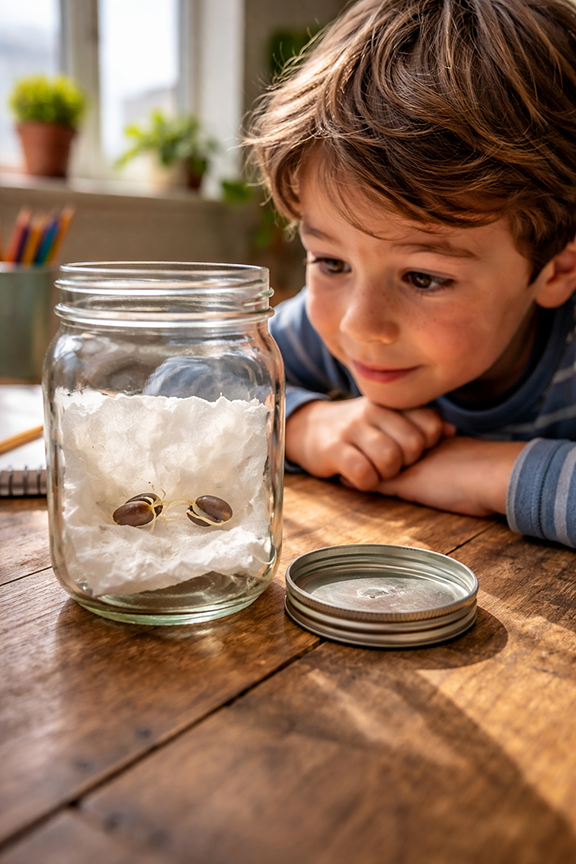
Homestead Science: The Seed Germination Experiment
Every spring we start watching the quiet miracle of seeds waking up. A dry little bean may not look like much, but inside is a tiny plant waiting for warmth and moisture. This simple experiment lets children see that hidden life begin to grow.
What Children Learn
Seeds are not dead. Inside the seed coat is a living plant embryo. When the seed receives water and warmth, the coat softens and the first root begins to push out. The root grows downward, searching for water, while the shoot grows upward toward light.
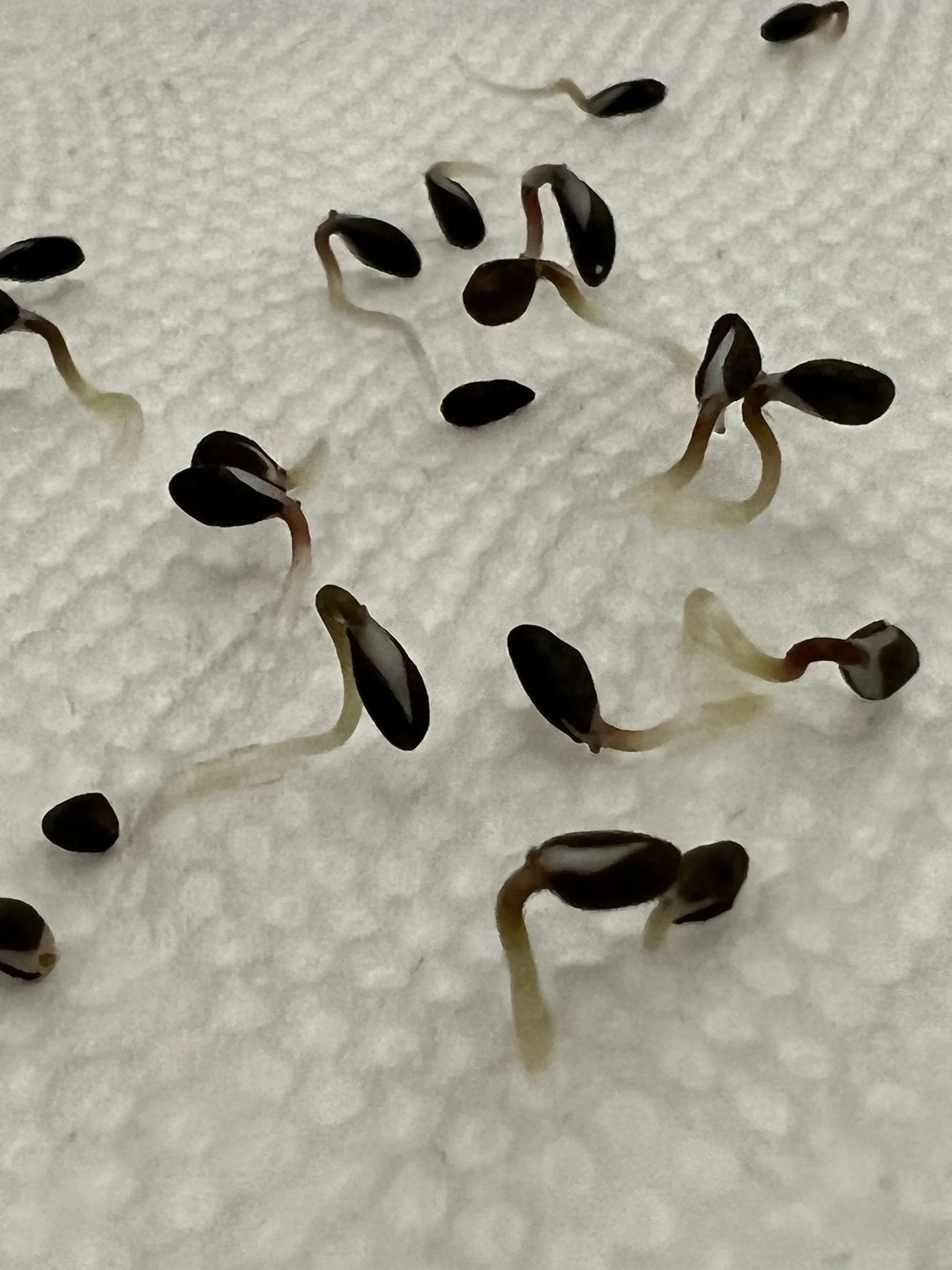
Every spring we start watching the quiet miracle of seeds waking up. A dry little bean may not look like much, but inside is a tiny plant waiting for warmth and moisture. This simple experiment lets children see that hidden life begin to grow.
What Children Learn
Seeds are not dead. Inside the seed coat is a living plant embryo. When the seed receives water and warmth, the coat softens and the first root begins to push out. The root grows downward, searching for water, while the shoot grows upward toward light.
Materials
Dry beans (kidney or pinto work well)
Paper towels
Water
A glass jar or clear cup
The Experiment
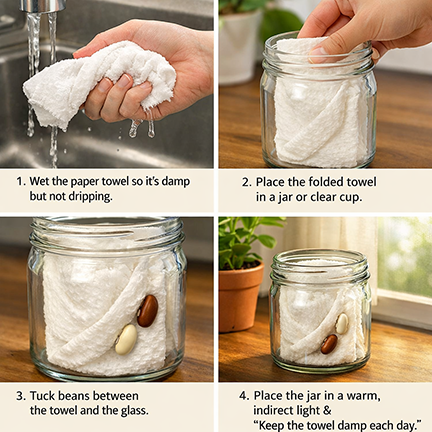
Wet a paper towel so it is damp but not dripping.
Fold the towel and place it inside a jar or clear cup.
Tuck two or three beans between the towel and the glass so they are visible.
Place the jar in a warm location with indirect light.
Keep the towel damp each day.
Within a few days the seed coat will split and a tiny white root will emerge. Soon a shoot will follow and small leaves will begin to appear.
Observation Questions
What appeared first, the root or the leaves?
How many days did it take for the seed to sprout?
Why do you think the root grows downward?
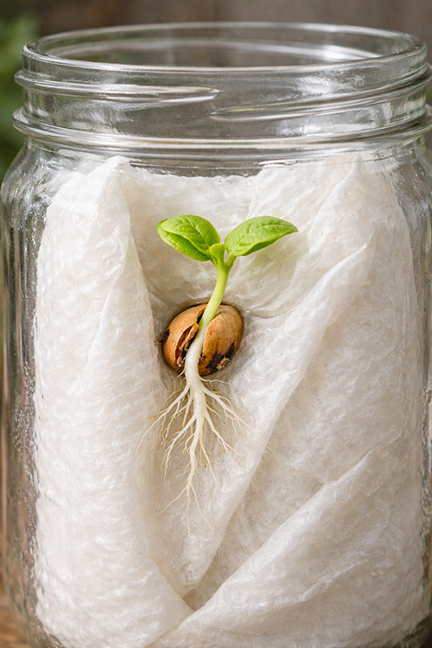
Encourage children to draw the seed each day as it changes.
Watching the transformation helps them understand that plants begin their lives long before we see them in the garden.
Homestead Connection
When we plant a garden, we are trusting this hidden process. Every carrot, tomato, or herb begins the same way—life quietly unfolding inside a seed.
Want to see a lot of seeds germinating and growing into plants?
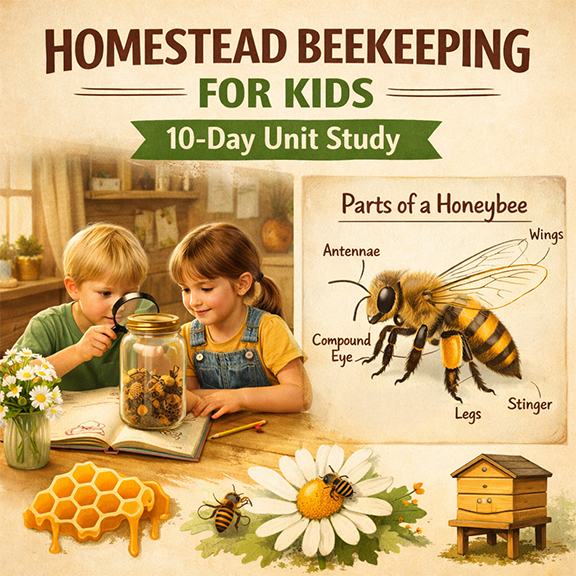
🐝 Homestead Beekeeping for kids
Children learn the beauty, purpose, and power of bees—from their biology and history to their role in homesteads, gardens, and entire ecosystems. Kids will observe, build, read, write, and even help protect pollinators in their own backyard.
Children learn the beauty, purpose, and power of bees—from their biology and history to their role in homesteads, gardens, and entire ecosystems. Kids will observe, build, read, write, and even help protect pollinators in their own backyard.
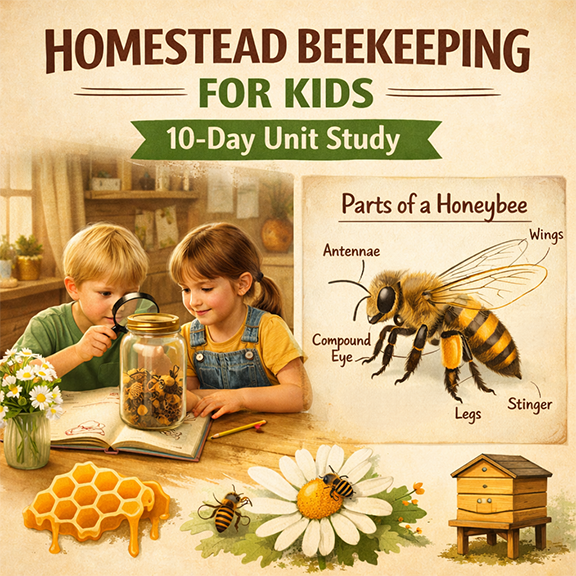
Week One
Day 1: Meet the Bees
Day 2: Bees in History
Day 3: The Science of Pollination
Day 4: Bee Homes and Hives
Day 5: What Bees Make
Week Two
Day 6: Bees in Our Ecosystem
Day 7: Bee Identification and Observation
Day 8: Bee Problems in the News
Day 9: Helping the Bees
Day 10: Catching a Wild Hive (Theory Lesson)
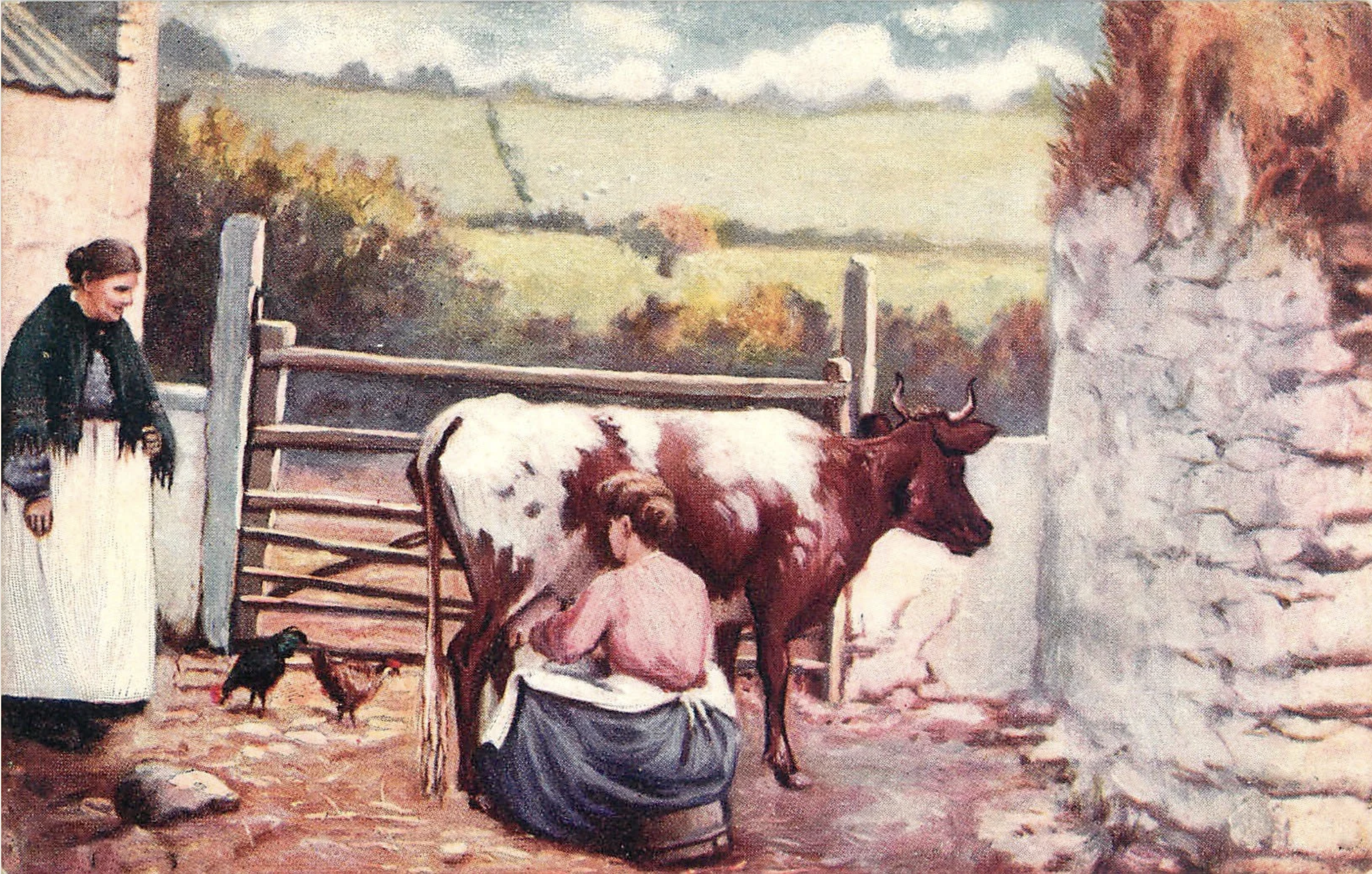
Homestead Butter-Making
We’re going to make real butter—just like kids did in the old days on the farm! This fun lesson will teach us where butter comes from, how it’s made, and how important it has been throughout history.
A joyful homeschool lesson for ages 6–8 using fresh cream
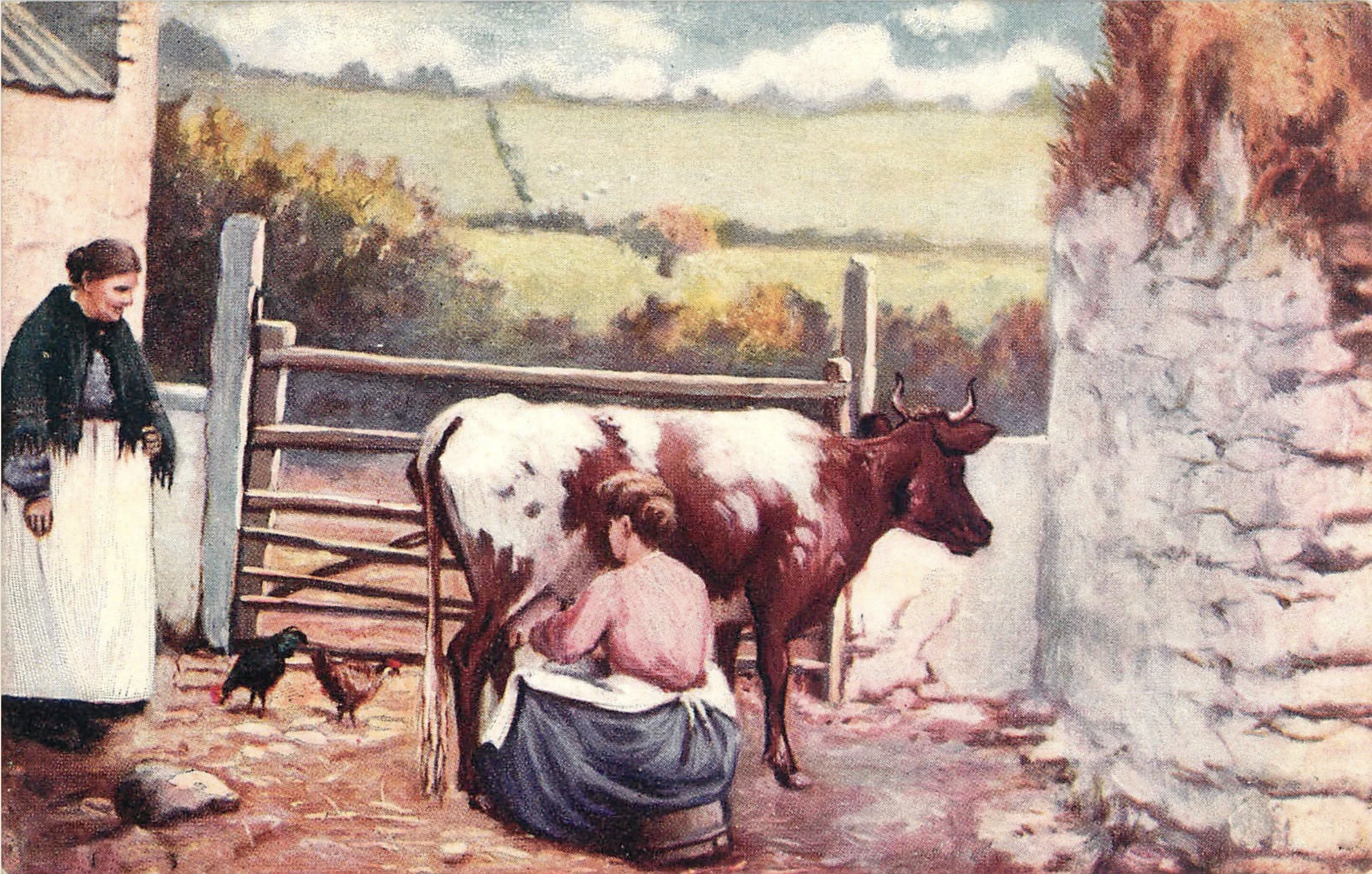
We’re going to make real butter—just like kids did in the old days on the farm! This fun lesson will teach us where butter comes from, how it’s made, and how important it has been throughout history.
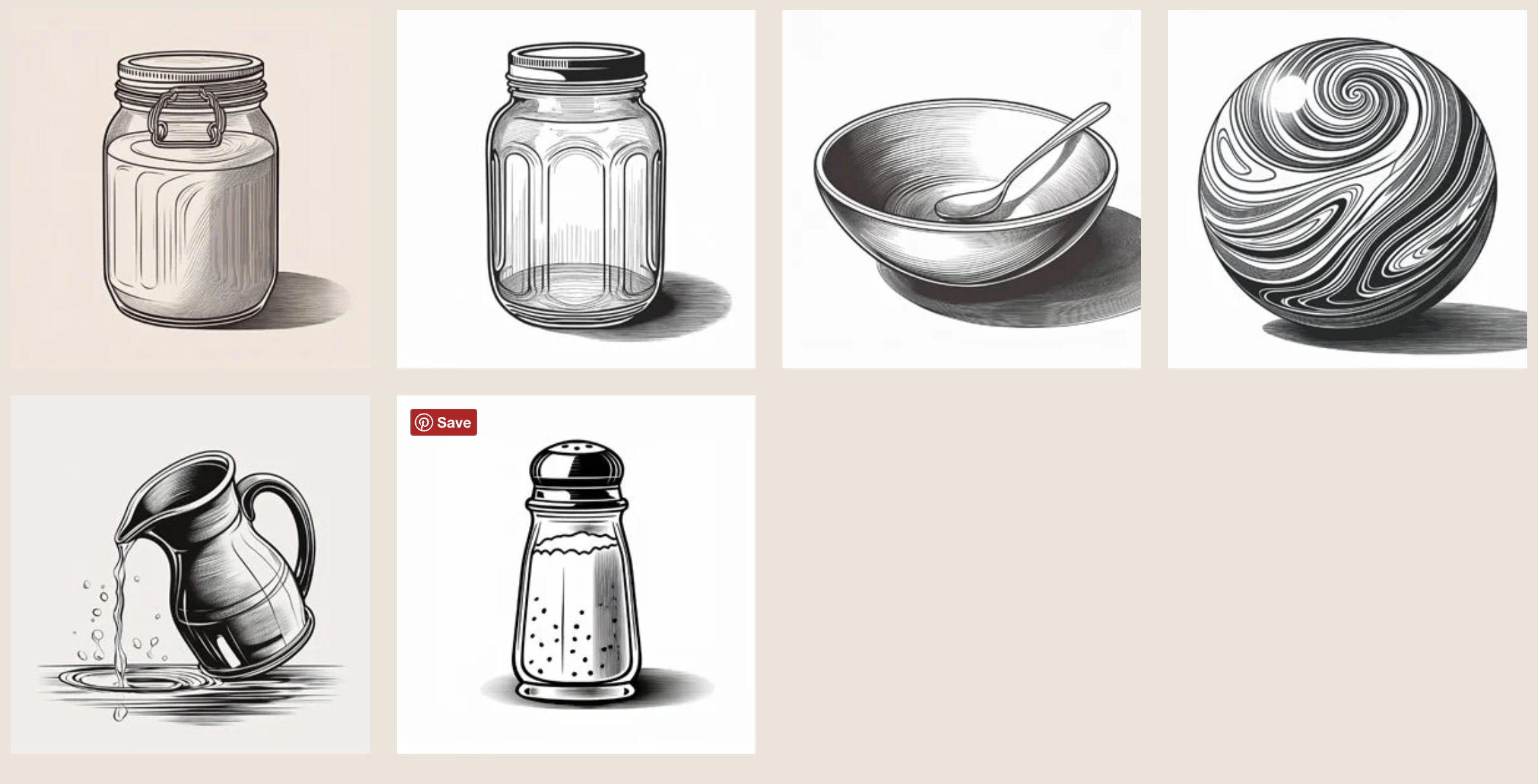
What You’ll Need:
• A pint or quart of fresh cream (raw is best!)
• A clean glass jar with a tight lid (like a mason jar)
• A bowl and spoon
• Optional: a clean marble or bead to speed up the shaking
• Cold water and a little salt (if you want to salt your butter)
Let’s Make Butter!
1. Pour your fresh cream into the jar (fill it halfway).
2. Drop in the marble (if using) and screw the lid on tight.
3. Shake it up! Dance around and have fun while shaking. It may take 5–10 minutes.
4. First, it turns to whipped cream—keep going!
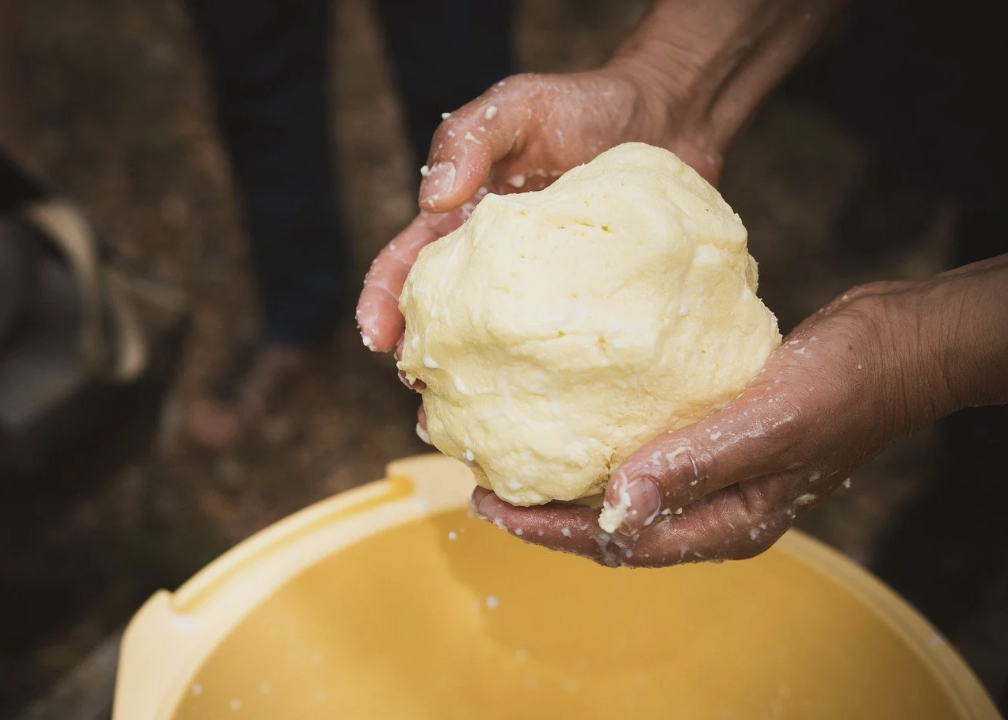
5. A soft lump forms and separates from the liquid. That’s your butter!
6. Pour off the buttermilk (but taste it first!) and save it for biscuits or pancakes.
7. Rinse your butter lump with cold water, then pat it dry.
8. Add a pinch of salt if you’d like, and pack it into a dish.
SCIENCE: What’s Happening in the Jar?
Cream is full of little fat globules. When you shake it, those tiny fat pieces bump together and start sticking. First, they turn into whipped cream—but keep shaking, and the fat clumps together into butter!
You’ll also see a milky liquid separate out—that’s called buttermilk, and it’s great for baking.
The History of Butter Churns
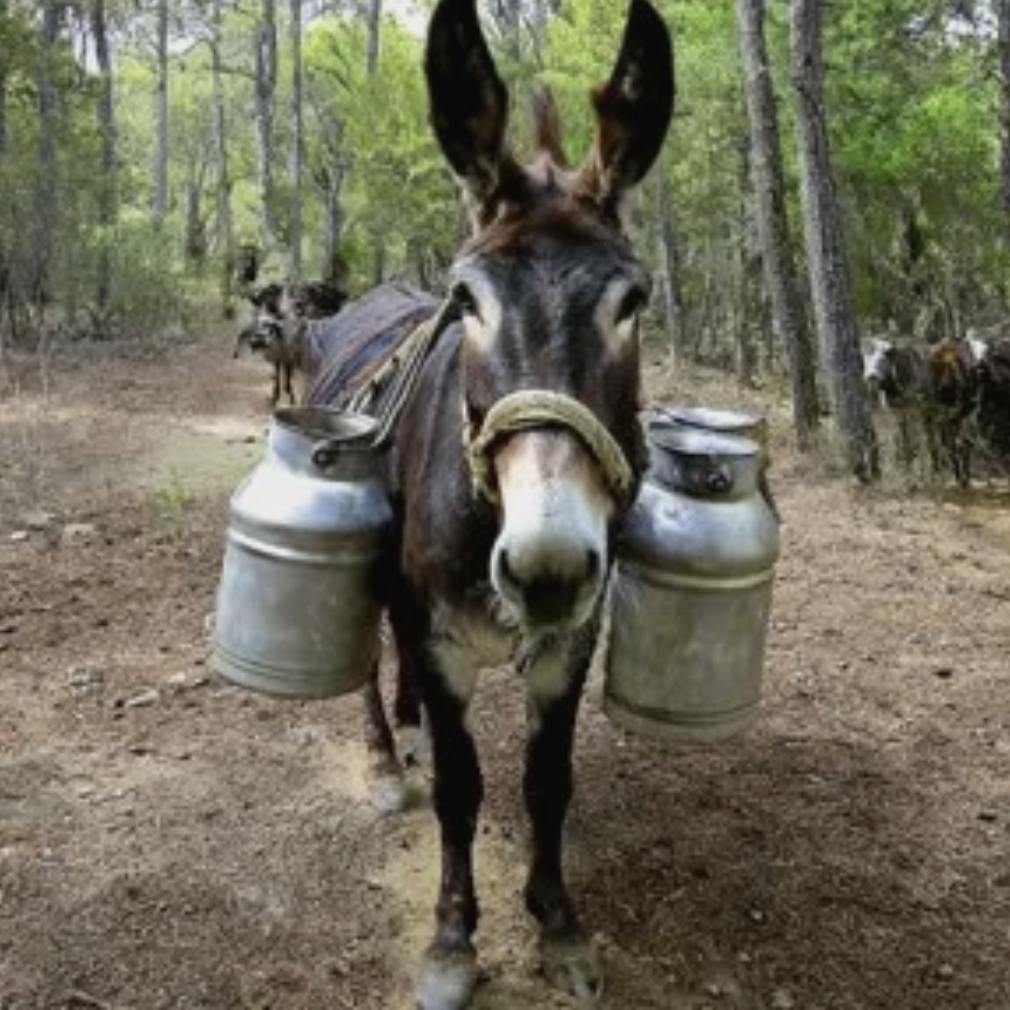
Long ago, people used animal skin bags to make butter. They tied the bags (and later milk cans) to donkeys or wagons, and the jostling from travel would churn the cream into butter. No hands required—just a bumpy ride!
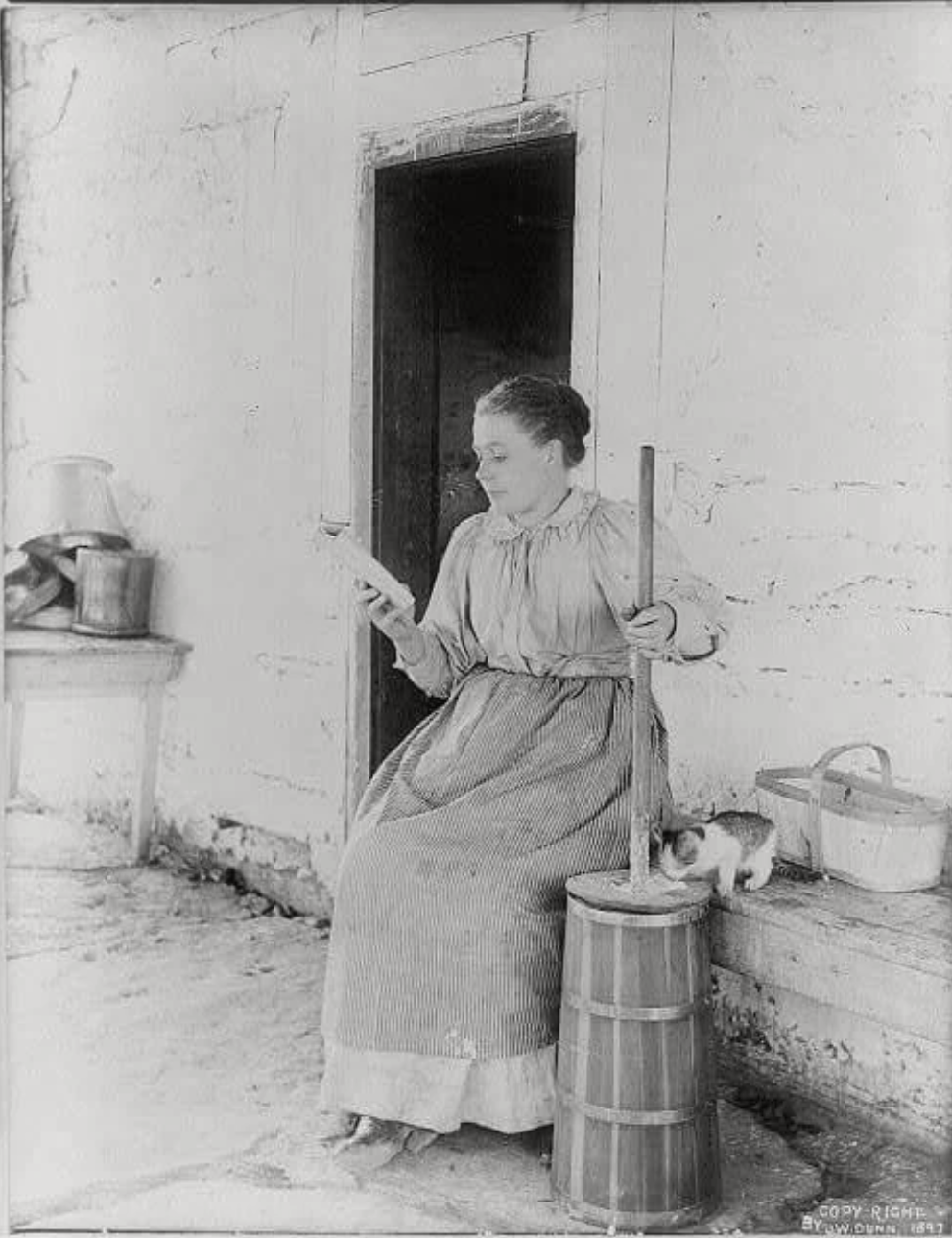
Later, wooden churns became popular. These were tall barrels with a stick (called a dasher) inside.
You would move the stick up and down to agitate the cream. It took time and muscle!
Next came tabletop churns with cranks. These churns had paddles inside and were easier to use.
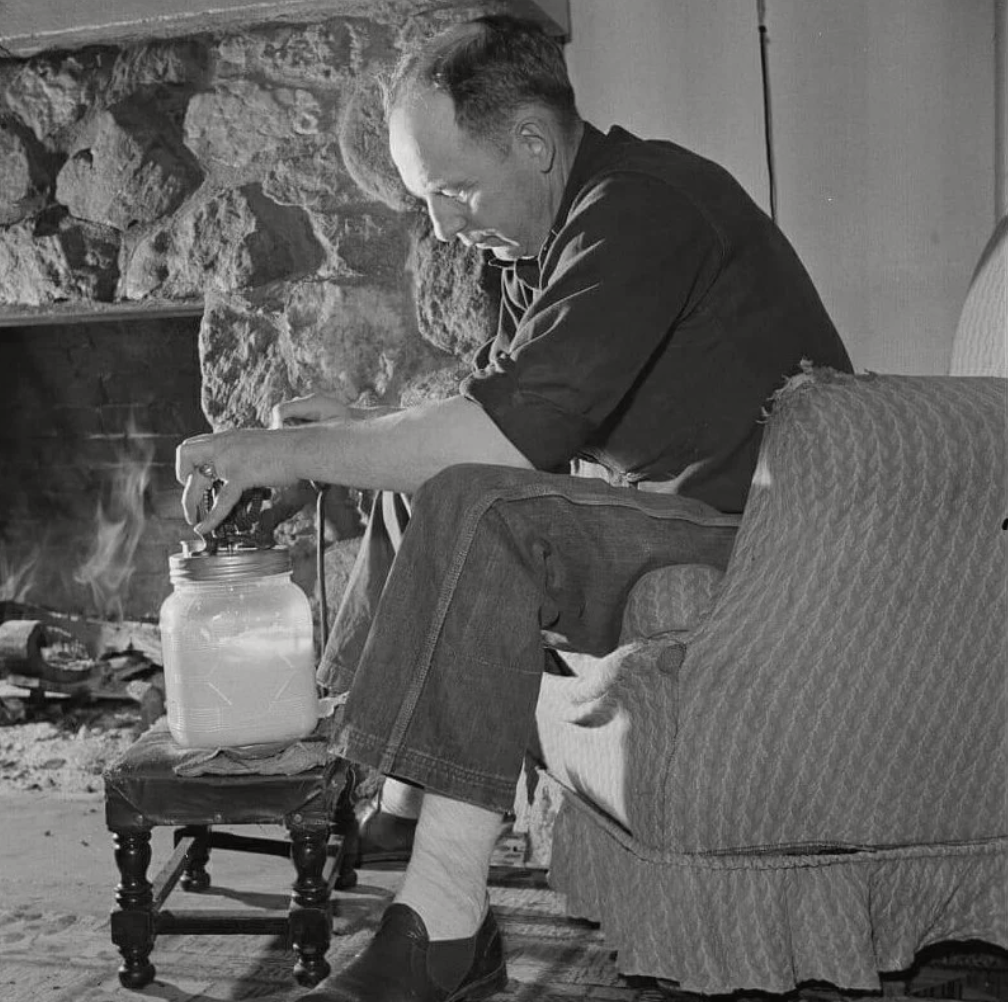
Families could sit down at the table, turn the handle, and watch the butter come together.
Today, we can make butter in a glass jar just by shaking it—or even use electric mixers.
But here’s the fun part: No matter what churn you use, the process stays the same. You keep the cream moving until the fat clumps together and forms butter!
That’s the secret of butter-making: shake, churn, stir, or mix—movement is the magic.
READING TIME
Butter in a Jar
by Suzi Wollman
I pour the cream and close it tight,
I shake with all my strength and might!
Around and ’round, I dance and spin—
A golden lump is found within!
The cream gets thick, it starts to whip,
It sloshes on my fingertips.
Then suddenly, the magic’s clear—
The butter’s soft and smooth and near!
I rinse it off and pat it dry,
I spread it on some toast nearby.
From cow to cream to butter bright—
I made it fresh, and took a bite!
Think About It
What surprised you?
Did the butter come together fast or slow?
What was the buttermilk like?
WRITING IDEAS
Pick one or more writing prompts:
• “My Butter-Making Day” – Tell the story of what happened, step by step. (See the download below)
• Butter Journal Page – Draw each stage of the process and label it.
• Butter Recipe Card – Create a homemade recipe card with steps and decorations.
CRAFT CORNER
1. Decorate a Butter Dish
Use markers, stickers, or paint to decorate a container to keep your fresh butter in the fridge. Rectangular glass containers with lids work well.
2. Make a Farm-to-Butter Wheel
Draw four stages on a circle:
Cow → Cream → Shake! → Butter
Attach an arrow with a brad to spin around and point to each step. (See download below.)
3. Old-Fashioned Butter Paddles
Decorate two wooden spoons with stickers, markers, or paint. These resemble the paddles used to make butter in the churns with cranks.
Wrap-Up
Butter isn’t just something that comes in a package—it’s made by hand, from the land, and with a little effort and fun. Making your own butter is a delicious way to learn about real food and the work behind it. Save your butter journal page and start a homemade recipe collection. You’re becoming quite the homestead chef!
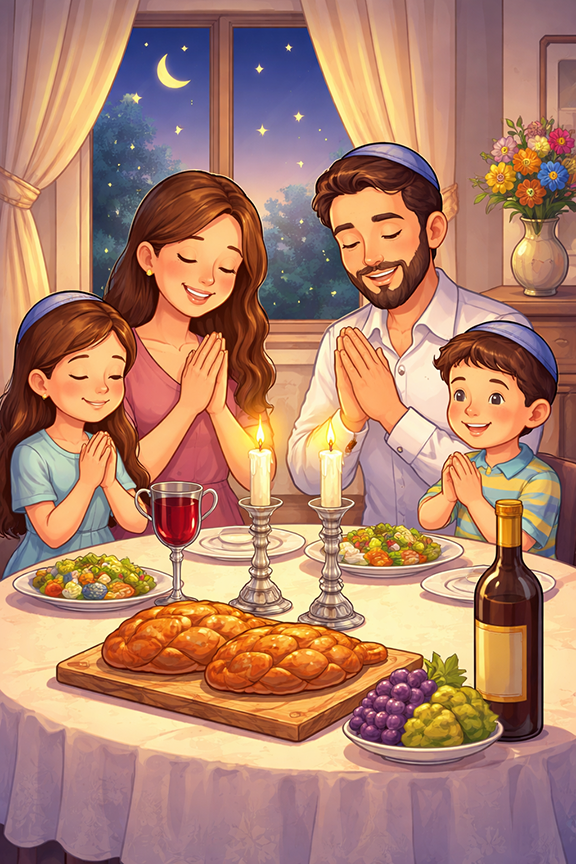
A Year of Feast-Based Homeschooling: Teaching Through the Moedim
Each year, the rhythm of God’s appointed times gently calls us back to Him. The Hebrew word "moedim" means "appointed times," and these Feasts of the Lord offer a sacred structure for worship, remembrance, and joyful celebration. For Messianic families and homesteaders like ours, they also provide a beautiful framework for homeschooling.
Instead of following only the traditional September-to-May academic calendar, why not let the biblical calendar lead your learning year? With each feast, your children can explore history, Scripture, science, art, music, and more. In this post, I’ll walk you through how to homeschool through the moedim and suggest fun, faith-centered ways to make each feast part of your family’s educational journey.It All Begins Here
Each year, the rhythm of God’s appointed times gently calls us back to Him. The Hebrew word "moedim" means "appointed times," and these Feasts of the Lord offer a sacred structure for worship, remembrance, and joyful celebration. For Messianic families and homesteaders like ours, they also provide a beautiful framework for homeschooling.
Instead of following only the traditional September-to-May academic calendar, why not let the biblical calendar lead your learning year? With each feast, your children can explore history, Scripture, science, art, music, and more. In this post, I’ll walk you through how to homeschool through the moedim and suggest fun, faith-centered ways to make each feast part of your family’s educational journey.
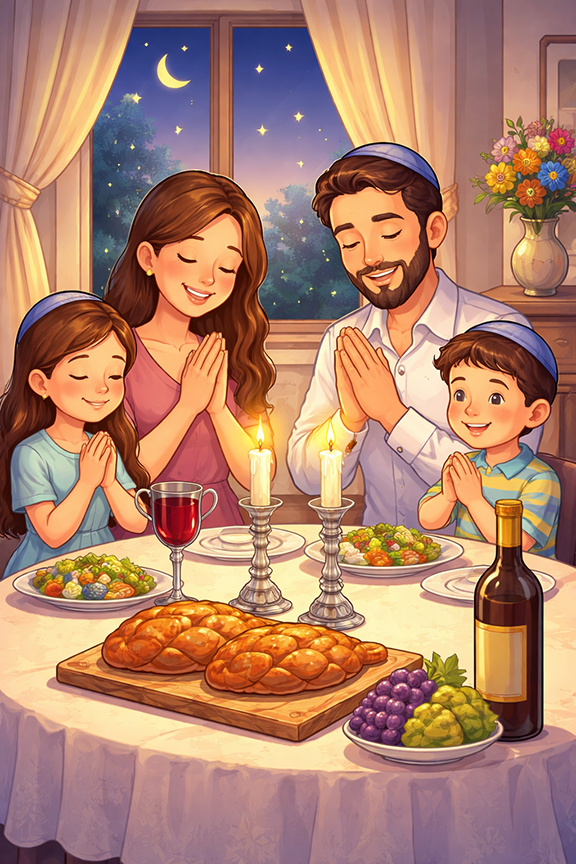

Raising Messianic Kids in a Post-Modern World
It All Begins HereRaising children has never been simple—but raising Messianic children in today’s world means navigating a landscape filled with competing stories about identity, purpose, and truth. In a culture that often prioritizes convenience, self-expression, and immediate fulfillment, families who choose a covenant-centered life are, in many ways, stepping into a quieter, countercultural way of being.

Raising children has never been simple—but raising Messianic children in today’s world means navigating a landscape filled with competing stories about identity, purpose, and truth. In a culture that often prioritizes convenience, self-expression, and immediate fulfillment, families who choose a covenant-centered life are, in many ways, stepping into a quieter, countercultural way of being.
Rather than assuming our children will inherit a clear sense of who they are, we recognize that identity is constantly being shaped—by media, peers, education, and the broader culture. This makes the work of formation more intentional. We are not just passing down information; we are cultivating belonging, memory, and meaning.
The Hebrew word kadosh (קָדוֹשׁ), often translated “holy” or “set apart,” carries the idea of distinction—but not isolation. It reflects a life shaped by rhythms, practices, and relationships that tell a different story about what matters. Sabbath, the feasts, and the life of Israel all embody this kind of purposeful distinction.
To raise children within this framework is to invite them into a story—one where identity is not self-invented but discovered within relationship: with God, with family, and with a people across generations. It means creating spaces where questions are welcomed, practices are lived, and meaning is formed over time.
This post offers a practical guide for Messianic parents who want to build homes where children can grow with a strong sense of identity, rooted in the rhythms of Torah and the love of Yeshua. Not perfectly, but faithfully—learning alongside their children, step by step.