
Before You Buy Homestead Tools: Ask These Two Questions First
Before you buy homestead tools, it helps to admit what usually happens. You see the butter churn, grain mill, dehydrator, seed-starting rack, fermentation crock, pressure canner, yogurt maker, or compost bin, and for a moment it feels like the missing piece.
Then it arrives. It needs a shelf. It needs parts. It needs cleaning. It needs a process. In a small home, every new tool either earns its place or starts taxing the household.
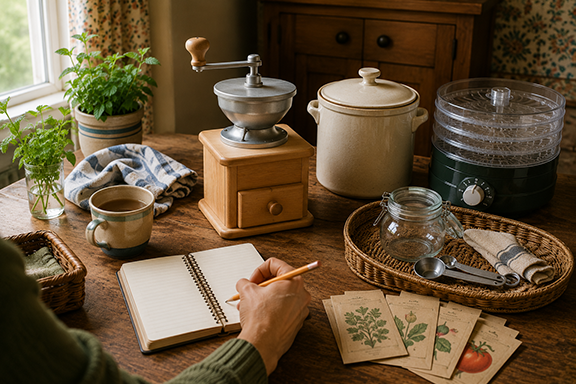
Plan before you buy.
The Two Questions to Ask Before Buying Any Homestead Tool
Before you buy a homestead tool, ask this:
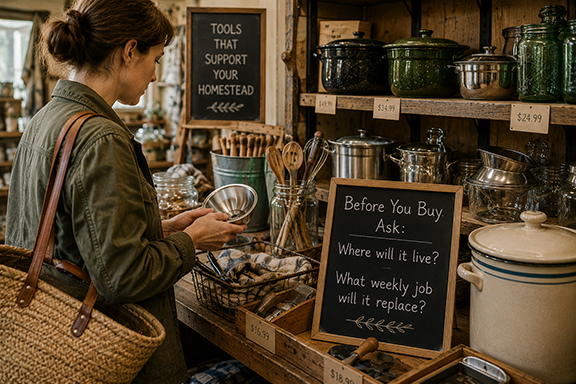
Where will this live, and what weekly job will it replace?
Not “Could I use this someday?” Not “Would this be useful if I had more time?” Not “Do real homesteaders own this?” Those questions lead to clutter.
A better question forces the tool to prove itself before it enters your home. It must have a place to live, and it must replace a job you already do often enough to matter.
If you cannot answer both parts, wait.
Before you buy a homestead tool, decide where it will live and what weekly job it will replace.
Why This Matters More in a Small Home
Small-space homesteading has different rules. You may not have a basement, mudroom, garage, barn shelf, walk-in pantry, or spare room. You may have one cabinet, one closet, one counter, and a kitchen table that already does five jobs.
That means every homestead tool has a hidden cost. It takes up space. It asks for maintenance. It creates another decision. It adds another object to move before you can wipe a counter, cook dinner, or start seeds.
A good tool reduces friction. A bad tool creates another chore wearing the costume of self-sufficiency.
The Habit: Pause Before You Buy
This Tiny Homestead Habit is simple.
When you want to buy a homestead tool, pause for twenty-four hours and answer two questions in writing:
Where will it live?
What weekly job will it replace?
That is the whole habit. Do not build a spreadsheet. Do not make a full inventory. Do not redesign the kitchen. Just pause long enough to keep hope from becoming clutter.
You can write the answers on a scrap of paper, in your phone notes, or on the back of the grocery list. The point is not documentation. The point is friction before spending.
A tool that needs storage, setup, cleaning, and guilt is not simplifying your homestead.
What Counts as a Weekly Job?
A weekly job is something already happening in your household. It might not happen perfectly, but it belongs to your real life.
Examples:
You already make yogurt every week using a pot and towel, and a yogurt maker would make the process easier.
You already dry herbs on a plate near the window, and a small dehydrator would help you preserve more without wasting bunches from the garden.
You already bake bread twice a week, and a grain mill would support a routine you already keep.
You already chop vegetables every evening, and a better knife would make daily cooking safer and faster.
Those tools might earn their place because they improve work already in motion.
A fantasy job sounds different.
“I want to start making all our crackers.”
“I might get into herbal medicine.”
“I should probably dehydrate more food.”
“I would cook from scratch if I had this.”
“I could preserve so much if I bought the right equipment.”
Those may become real later. They are not real yet.
The Shelf Test
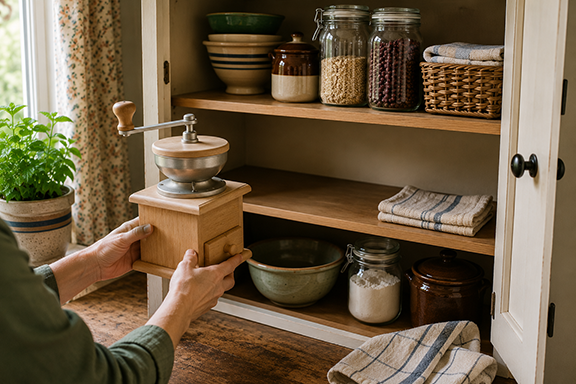
Checking shelf space after buying might not work
Before buying the tool, point to its home.
Not a general area. Not “somewhere in the pantry.” Not “I will make room later.”
Point to the shelf, drawer, cabinet, hook, or corner where it will live when clean and put away.
If that space already holds something else, decide what leaves. A small home cannot absorb endless good intentions. Something has to move out before something useful can move in.
This test protects you from the most common small-space homesteading problem: owning the tool before owning the rhythm.
The Replacement Test
Next, name the job it replaces.
A useful homestead tool should replace one of these:
A repetitive task that takes too long.
A messy workaround that keeps stopping you.
A store-bought item you already replace often.
A preservation method you already practice by hand.
A daily kitchen job that would become easier, safer, or less wasteful.
Small-space homesteading rewards tools that earn their place every week.
For example, a large electric grain mill may not make sense if you bake once a month and already struggle to store flour. A sturdy mixing bowl may make far more sense if you cook daily and need one reliable bowl for bread, salad, soaking beans, and mixing batter.
The smaller your home, the more a tool should multitask without becoming fussy.
Examples: Buy, Wait, or Skip
A yogurt maker might be worth buying if you already buy yogurt every week, eat it regularly, and have a shelf where the machine can live. It replaces a grocery item and supports a food rhythm you already keep.
A dehydrator might be worth waiting on if you only have one small herb pot and no regular surplus. Dry herbs on a plate or hang small bundles first. Buy the tool after the need becomes steady.
A fermentation crock might be worth skipping if one glass jar already handles your sauerkraut, pickles, or fermented carrots. A crock may look more traditional, but tradition does not pay rent in your cabinet.
A seed-starting rack might be worth buying if you grow from seed every season, have reliable light, and can place the rack without blocking daily life. It probably does not make sense if you only want three herb plants on a windowsill.
A pressure canner might be worth waiting on if you do not yet have a steady supply of produce, a safe place to store jars, and the time to run a full canning session. Start with refrigerator pickles, freezer jam, small-batch sauce, or water-bath canning where appropriate.
A Tool Should Not Make You Feel Behind
A homestead tool should serve the household. It should not sit on a shelf accusing you.
That guilt usually comes from buying too far ahead of your actual life. The tool belongs to a version of your home with more time, more space, more energy, more harvest, or more routine than you currently have.
You do not need to reject tools. You need to buy them in the right order.
Skill first. Rhythm second. Tool third.
Learn the task in the simplest way available. Repeat it enough to know whether it belongs in your life. Then buy the tool that makes the proven habit easier.
The best homestead tool is not the most traditional one. It is the one you will actually use.
What to Do Instead of Buying the Tool Today
Use the twenty-four-hour pause to test the need.
If you want a dehydrator, dry one tray of herbs in the oven on low heat or hang a small bundle in the kitchen.
If you want a yogurt maker, make one batch with a pot, warm spot, and towel.
If you want a seed rack, grow one herb pot where you already have light.
If you want a fermentation crock, ferment one jar of vegetables first.
If you want a grain mill, bake regularly with the flour you already buy.
The test should feel almost too simple. That is the point. A small trial shows whether the work fits your real home before the tool takes up permanent space.
When to Use This Habit
Use this habit any time you feel the urge to buy homestead equipment.
It works especially well before seasonal shopping: seed-starting season, canning season, holiday sales, garden clearance, and late winter planning. Those moments make useful tools look urgent.
They are rarely urgent.
Pause. Name the home. Name the weekly job. If the tool passes both tests, consider it. If not, keep your money and your shelf space.
The Tiny Homestead Starter Kit can support this kind of decision-making because it helps you choose small, useful steps instead of trying to build a full homestead system all at once. Use it when you need help deciding what belongs in this season and what can wait.
The Habit in One Line
Before you buy any homestead tool, ask where it will live and what weekly job it will replace.
That one pause can save money, space, and frustration. It also helps you build a homestead that fits the life you actually have, not the one a product photo is trying to sell you.
If you like this kind of content, you’ll love The Homestead Blog Hop!

