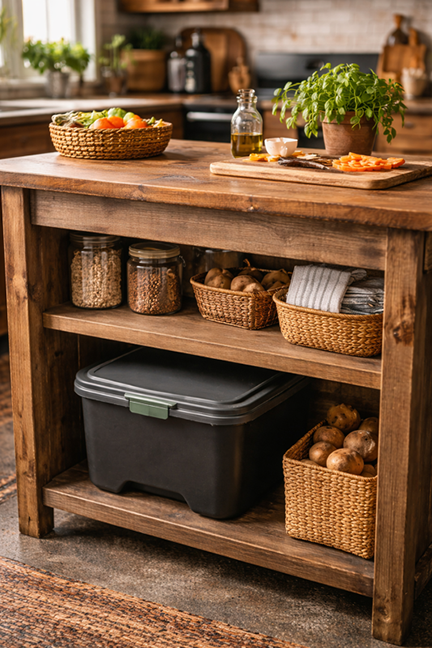
The Quietest Livestock You’ll Ever Keep
Farming Worms Inside a Small Home
Homesteading inside a small home has a way of stripping things down to what actually works. There’s no room for systems that demand constant attention or produce more than you can reasonably manage. Everything has to earn its place.
That’s where worms come in.
They don’t make noise. They don’t smell when cared for properly. They don’t demand daily attention. They simply do their work.
What worms are for
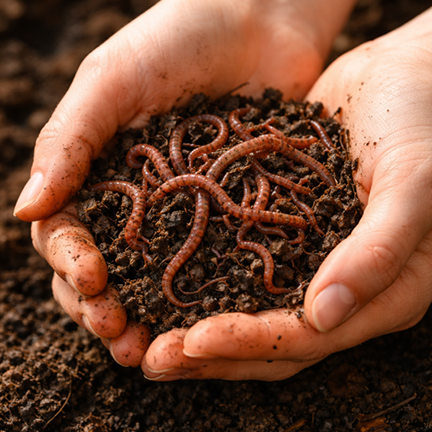
Worms—specifically red wigglers—turn kitchen scraps into vermicompost (worm castings), one of the most effective soil amendments you can make at home. In a small-home homestead, that means less food waste going out, less need to buy compost or fertilizer, and a closed-loop system that fits under a counter or in a closet. They are livestock in the truest sense: living creatures that convert inputs into nourishment. They just do it quietly.
What you actually need
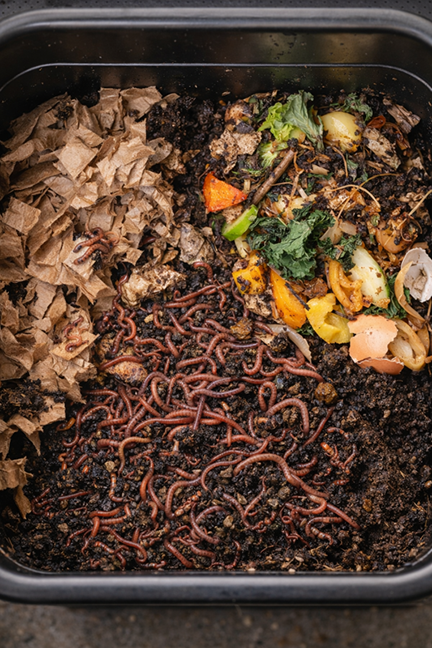
You do not need a complicated setup. At minimum: a worm bin (commercial or DIY), bedding such as shredded paper, cardboard, or egg cartons, red wiggler worms (not garden earthworms), and a location that stays above freezing and out of direct heat. If a system requires much more than this, it usually isn’t suited to a small home.
Daily and weekly care
Worms thrive on consistency, not fussing. Once or twice a week: bury a small amount of food scraps, keep bedding damp but not wet, and cover food completely. That’s the routine. No daily checks. No turning. No stirring. If you feel the urge to open the bin just to look, that’s often the moment to leave it alone.
Common mistakes
Most problems come from good intentions applied too heavily. Overfeeding leads to odor and pests; feed less and give the worms time. Too much moisture creates anaerobic conditions; add dry bedding. Expecting fast results leads to disappointment; worm systems work on weeks, not days. Treating the bin like trash disposal causes imbalance; think stewardship, not dumping. Worms reward patience far more than enthusiasm.
Can worms be added to an indoor compost system?
Yes—but with important limits. Worms are an indoor compost system, but they are not interchangeable with every type of composting setup. Worms do well when food scraps are added gradually, material is buried and balanced with bedding, and the environment stays moist, cool, and aerobic. They do not do well in hot compost, large single additions of waste, or systems designed to process yard debris. If you already use an indoor compost bin for food scraps, it can often be converted to vermicomposting by reducing input volume, adding bedding, and introducing worms slowly. If the system relies on heat, tumbling, or bulk processing, worms are not a good fit. In a small home, worms usually replace composting rather than supplement it.
Why worms fit small-home homesteading
Worms scale to real life. A small kitchen produces small inputs. Busy days require low-maintenance systems. Limited space demands a minimal footprint. They don’t push you to expand. They quietly teach you to manage what you already have.
When worms are not the right choice
Worms may not be a good fit if you are unwilling to manage food scraps intentionally, expect quick visible results, or are uncomfortable with unseen processes. A small home benefits more from honesty than from ambition.