
Why Every Homestead Needs Margin

There is a peculiar temptation that comes with homesteading. If there is an empty corner, we want to plant something in it. If there is room in the pantry, we want to fill it. If there is an unused Sunday afternoon, surely there is a project waiting for it. And if we discover that we can bake the bread, grow the herbs, preserve the tomatoes, mend the clothes, make the soap, teach the children, raise the chickens, and build the shelves ourselves, there is a dangerous little voice that whispers, Then perhaps we should.
Sometimes the wisest thing we can grow
on a homestead is margin.
Homesteading attracts people who are good at seeing possibilities. We look at an empty patch of ground and see beans climbing a trellis. We look at a basket of bruised peaches and see jars of preserves. We look at scraps and leftovers and worn-out things and wonder what they might become. I love that about this life. But I have also learned that not every bit of empty space needs to be filled. Sometimes the wisest thing we can grow on a homestead is margin.
Margin is the space between what we could do and what we actually commit ourselves to doing. It is having a little room left in the pantry instead of packing every shelf to the edge. It is an afternoon that hasn't already been promised to three different projects. It is a garden bed that isn't planted quite as intensively as it possibly could be, a little money that hasn't already been assigned somewhere, or a freezer with enough room for an unexpected abundance of berries. Sometimes margin is simply the willingness to look at a perfectly good idea and say, “Not this year.”
That last one may be the hardest for me. There have been seasons when I have tried to squeeze one more thing into an already-full life simply because it was a good thing. Good things are particularly difficult to turn down. Nobody has to convince me not to add something miserable to my calendar, but another garden project, another skill to learn, another beautiful thing I could make from scratch? Those are harder to resist. That is how a life can become crowded without ever becoming careless.
Margin isn’t wasted space. Margin is what allows
everything else to breathe.
Eventually, though, I began to understand that margin isn't wasted space. Margin is what allows everything else to breathe. A homestead without it is surprisingly fragile. When every hour is spoken for, one unexpected appointment can throw off the entire week. When every dollar has already been spent on paper, a broken appliance becomes a crisis. When every inch of the garden is planted, there is nowhere to tuck in the seedlings someone gives you. When the freezer is packed to the lid, there is nowhere to put an unexpected harvest. And when every bit of us is already committed, there is nothing left when somebody needs us.
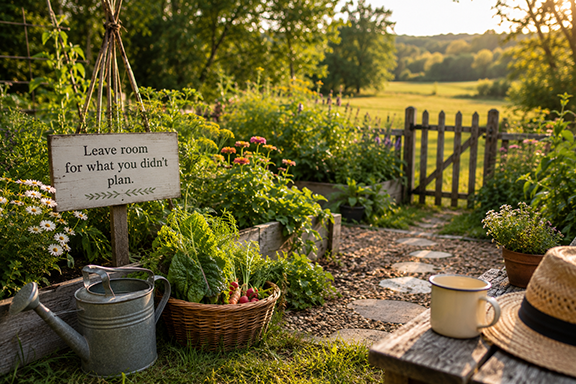
That may be the margin I value most now. Homesteading has taught me to prepare for abundance, but it has also taught me to prepare for interruption, because interruption is part of the rhythm of a household. Someone gets sick. The weather changes. Something breaks. A friend needs help. Dinner burns. The tomatoes all decide to ripen on the same afternoon. None of those things consult the calendar first.
Without margin, even blessings can begin to feel inconvenient.
Sometimes, of course, the interruption is something wonderful. Someone stops by and stays for supper. A child or grandchild wants to linger at the table and talk. The first truly beautiful evening of spring arrives and suddenly sitting outside with a glass of iced tea seems far more important than whatever we had intended to accomplish. Margin gives us room to say yes to those moments. Without it, even blessings can begin to feel inconvenient.
I don't want to live that way. I don't want every unexpected thing to feel like an intrusion into the life I carefully scheduled. I want enough looseness around the edges that life can actually happen there.
I think we sometimes imagine that good stewardship means using everything to its absolute maximum, but creation itself tells a different story. There are fallow fields and dormant seasons. Seeds lie quietly beneath the soil. Fruit trees cannot be bullied into producing twelve months of the year. The garden does not apologize for winter. Creation is full of pauses that can look unproductive until we understand what is happening underneath them.
We are given that pattern in time, too. Shabbat is not an empty day waiting to be made useful. It is holy time precisely because it has been set apart. For one day, we stop measuring the hours by what we can produce in them. The work may still be waiting when Shabbat ends—and usually it is—but for those hours we acknowledge that the world continues without our constant management. There is something wonderfully humbling about that.
I want enough looseness around the edges that life can actually happen there.
Perhaps our homes need smaller versions of that spaciousness throughout the rest of the week as well. I have become much less impressed by how much I can cram into a day and much more interested in whether the life I am building can withstand an ordinary Tuesday going completely sideways. That is a different measure of productivity, and I think it may be a wiser one.
The garden does not apologize for winter.
For me, leaving margin sometimes means not using every herb in the garden. I can take what I need and let the rest flower for the bees. I don't have to turn every available ingredient into another project, and I don't have to say yes simply because I can technically find enough hours to fit something in. I don't even have to treat rest as the reward I receive after everything is finished, because on a homestead everything is never finished.
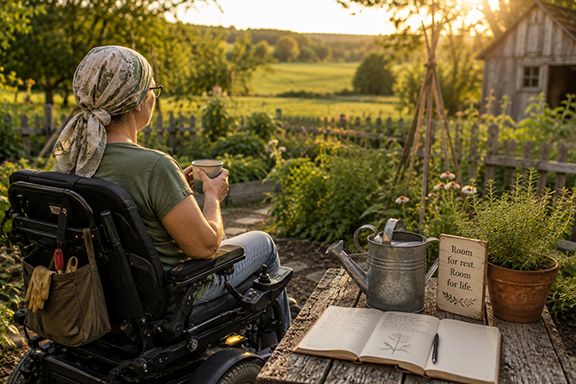
There will always be another weed, another meal, another load of laundry, and another thing that could be repaired, planted, preserved, organized, cleaned, learned, or made better. If I wait until all of it is done before allowing myself room to breathe, I will spend my whole life waiting. So I am learning that some things can remain deliberately unfinished for a while. Not neglected and not abandoned, but simply left with room around them. There is a difference.
Margin will look different in every household and every season. Six tomato plants may be plenty this year even if there is room for twelve. A few simple meals tucked into the freezer may be better stewardship than insisting that every dinner must be made from scratch. This may be the year to learn breadmaking while cheesemaking waits for another season. Sometimes the wisest thing I can do in the garden is sit there and enjoy what is growing instead of immediately cataloguing everything that needs my attention.
Shabbat is not an empty day waiting to be made useful. It is holy time precisely because it has been set apart.
That is homesteading too. In fact, I am beginning to think it is an essential part of it, because the goal was never to create another machine for producing things. The goal was to build a life, and life needs room. It needs room for weather and mistakes, neighbors and grandchildren, unexpected harvests and unexpected expenses, tired days and celebrations. It needs room for prayer and for sitting quietly while the bees work the flowers we decided not to harvest.
Perhaps that is the simplest definition of margin I know: leaving enough empty space for something you didn't plan. Not because we are expecting disaster, but because we are expecting life.
And life has never once asked permission before arriving.
Margin is leaving enough empty space for something you didn’t plan—not because you are expecting disaster, but because you are expecting life.

