
Tiny Homestead Habit: Put It Away.
When Did Simple Country Living Become “Homesteading”?
For years, we had a sign on our refrigerator that said:
“Use it up, wear it out, make it do or do without.”
I don't remember thinking of that as particularly “homesteady.” It was simply a sensible way to run a household. You ate the food you had before buying more. You wore clothes until they actually needed replacing. If something broke, you tried to fix it. If you needed something, you looked around to see whether something you already owned might do the job. And sometimes, after considering all the possibilities, you discovered that you didn't really need the thing after all.
Somewhere along the way, a lot of those ordinary practices acquired a new name. We started calling them homesteading.
I find that fascinating.
There was certainly a historical meaning to the word homestead, and today's homesteading movement is its own thing. But when I look at much of what we now describe as a homesteading lifestyle, I recognize things that were once simply part of ordinary country life. Growing a garden wasn't a movement. It was how you got really good tomatoes. Putting up peaches wasn't a hobby. The peaches were ripe, and there were too many to eat before they spoiled. You hung clothes on the line because sunshine was free. You saved jars because jars were useful. You cooked a chicken and then made something from what was left.
And you took care of your things.
I don't want to romanticize the past. There is a reason our grandmothers were delighted by washing machines and other conveniences that saved hours of very real labor. Plenty of old-fashioned country living was exhausting, repetitive work, and I have no desire to prove my homesteading credentials by making every task unnecessarily difficult.
But I do think there was something valuable in the assumption that the things we owned were meant to be used, cared for, and used again.
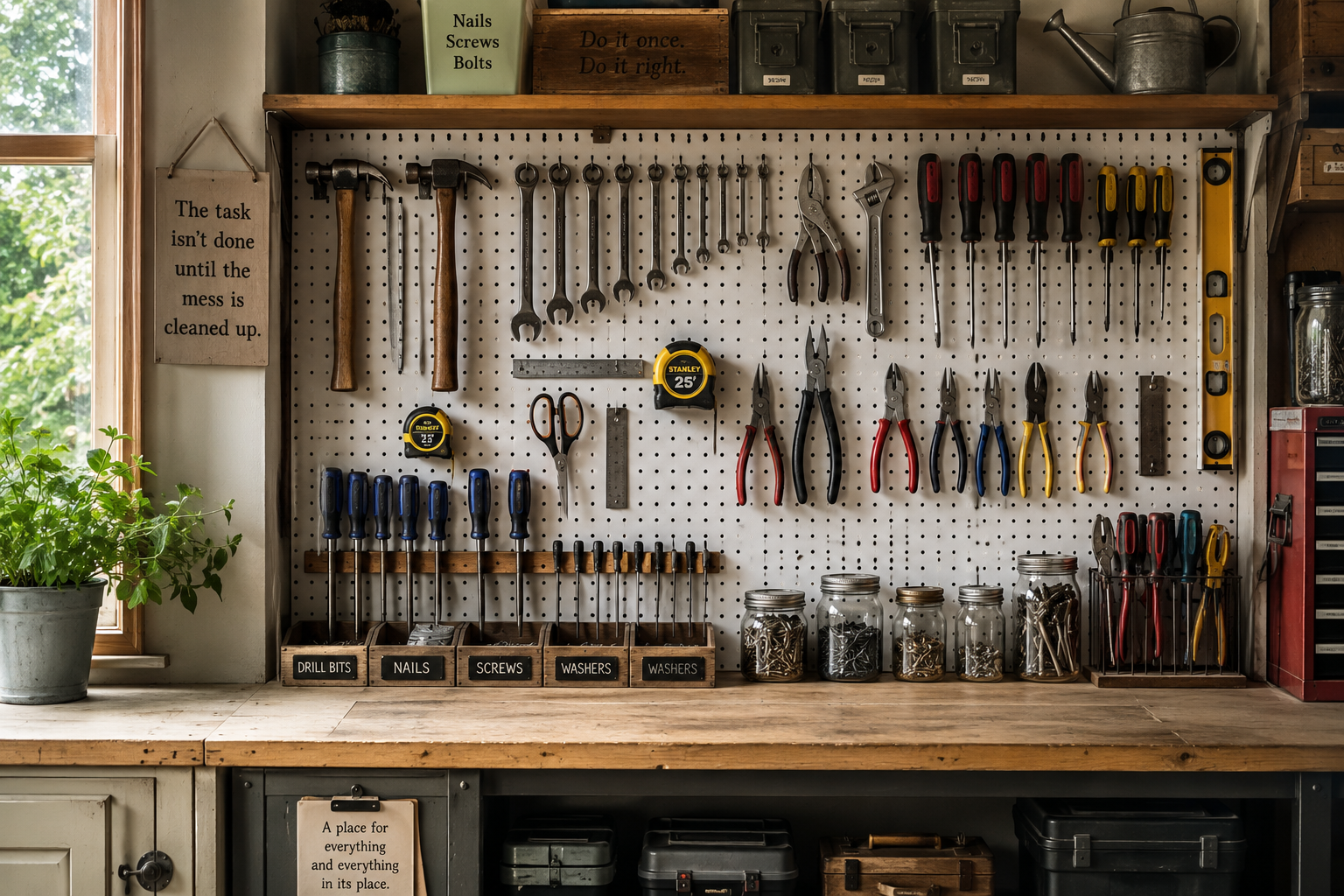
Tools are a good example. We believe in having good tools, and we take care of ours. A well-made tool that does its job for years is worth owning. And with a Home Depot right down the street, Jeff can almost always find a perfectly legitimate reason to go there.
Almost every day.
Still, I occasionally find myself looking around our house and wondering:
How many box cutters does one household actually need?
Jeff and I have slightly different philosophies about this.
Mine is, “If you put it back where you found it, you'll know where it is the next time you need it.”
Jeff's is more likely to be, “Just leave it there. I'll put it away later.”
And I do leave it there.
For a while.
When I am quite sure he has forgotten it, I put it away.
This little domestic difference has made me realize that taking care of what we own involves more than keeping things clean or repairing them when they break. There is another, much smaller part of stewardship that is so ordinary we hardly notice it.
Put it back where it belongs.
Because a tool we cannot find when we need it has a funny way of turning into another trip to the store.
And possibly another box cutter.
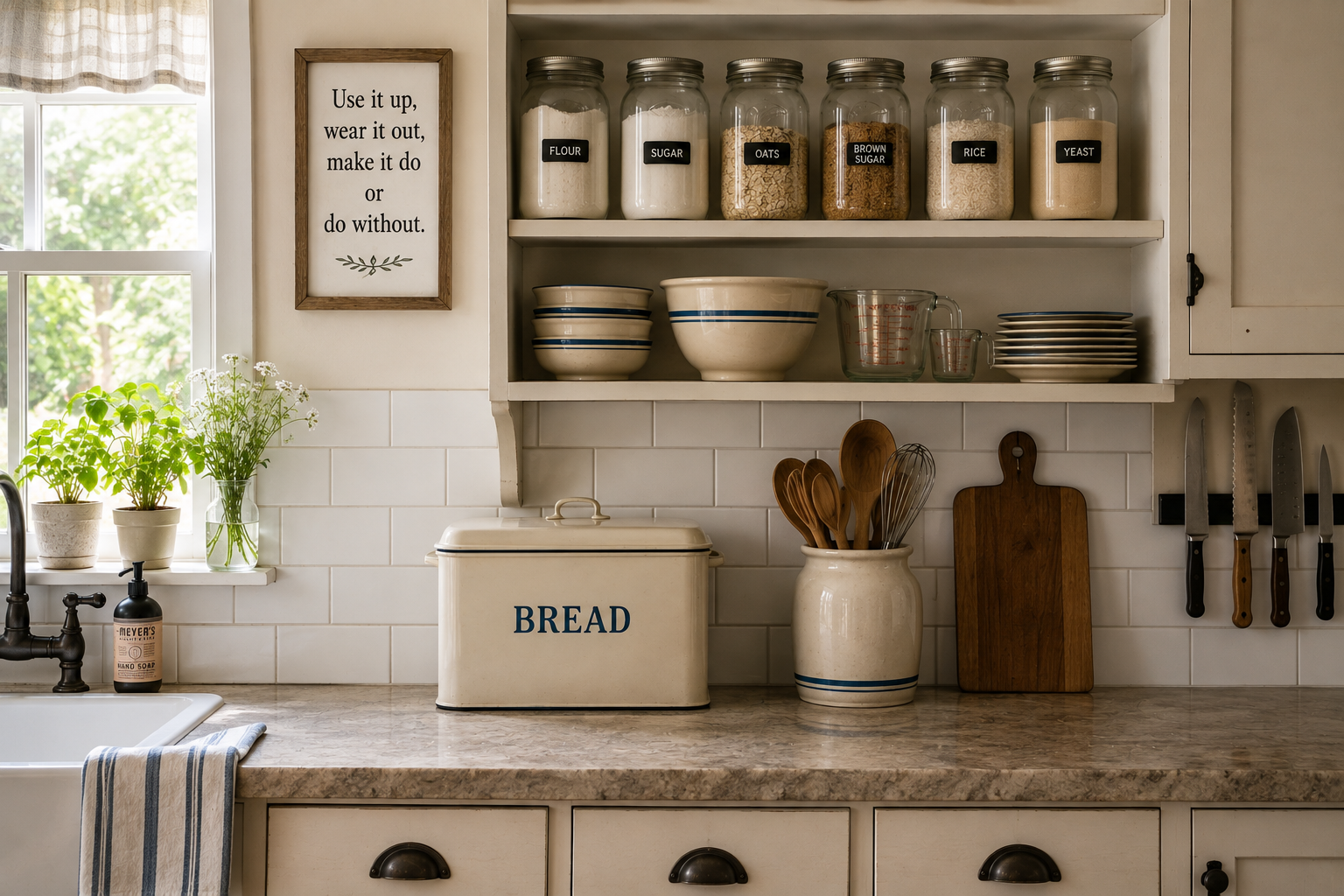
It happens with more than tools. We buy another roll of tape because we can't find the open one. Another pair of scissors appears because nobody knows where the kitchen scissors went. We discover three bottles of the same spice because they were hiding in three different places. We buy another package of something and then discover two perfectly good packages tucked behind something else.
The problem isn't necessarily that we own too much. Sometimes we simply don't know what we own.
That makes “use what you have” considerably more difficult.
Before I can use what I have, I need to know that I have it. I need to have some idea where it lives. And when I finish using it, I need to return it so that the next person—or the future version of me—can find it again.
That is such a small thing that it hardly seems worthy of being called a homesteading skill.
Maybe that's exactly the point.
We can make homesteading terribly complicated if we aren't careful. There are skills to learn, equipment to buy, systems to create, gardens to plan, food to preserve and an endless supply of beautiful things on the internet assuring us that our lives would run much more smoothly if only we owned the correct basket.
Meanwhile, one of the most useful household habits costs absolutely nothing.
When you finish using something, put it back where it belongs.
Not later.
Not when you organize the whole room.
Not after you buy a lovely set of matching storage containers and print labels for them.
Just when you're finished with it.
For years, I have said to Jeff, “The task isn't done until the mess is cleaned up.”
He doesn't always agree.
I think, in his mind, if the shelf is hung, the shelf is hung. The drill, screws, tape measure and whatever else accompanied the project can wait. In my mind, putting those things away is still part of hanging the shelf.
Neither of us has managed to convert the other completely.
And perhaps, after all these years, that is one of the things I love about him.
There is something endearing about living with another person long enough to know exactly which harmless habits will probably never change. I know that “I'll put it away later” may eventually become “Where did that go?” He knows that if he leaves something sitting long enough, there is a reasonable possibility that I will quietly return it to its home—although I try to wait until I'm sure he's actually finished with it.
Still, I stand by my rule.
The task isn't done until the mess is cleaned up.
Not because I need the house to look perfect. It doesn't. We live here. Projects happen, meals are cooked, things are repaired, gardens are tended, and any household in which real work is happening is going to have some evidence of it.
Cleaning up is simply the last part of the work.
If I bake bread, washing the bowl and putting away the flour are part of baking the bread. If I work in the garden, returning the tools is part of gardening. If we repair something, gathering the screws, putting the screwdriver back and sweeping up whatever landed on the floor are part of the repair.
When I think about it that way, putting things away stops being a separate chore waiting for me after the “real” work is finished.
It is part of the real work.
And that may be the Tiny Homestead Habit hiding inside all of this:
Finish the whole task.
Use the thing. Care for the thing. Put the thing back. Clean up what the work left behind.
Then you're done.
It isn't glamorous, and nobody is going to put photographs of a properly returned box cutter on a homesteading inspiration board. But these are the little habits that make a household work. They help us know what we have, care for it well and find it again when we need it.
Maybe simple country living became “homesteading” when we needed a name for practices that used to be ordinary. That's all right. I'm rather fond of the word.
But perhaps the heart of it is still very ordinary indeed.
Grow some food. Make useful things. Take care of what you own. Use what you have. Clean up after yourself.
And when the job is finished, put the box cutter back where it belongs.
Unless, of course, you live with Jeff.
In that case, give him a few minutes first.
