
Keeping a Homestead Notebook
I am always quite certain I will remember.
Surely I will remember which tomato variety did especially well this year. I will remember when the strawberries first began producing, how much flour I ordered, which project needed that particular size screw, and exactly what we decided to change before we do this again next year.
Then next year comes.
Apparently, the person I was so certain would remember all those things has left the premises.
That is why every homestead needs a notebook.
A homestead accumulates an enormous amount of knowledge that is surprisingly easy to lose. A notebook gives that knowledge
somewhere to live.
Not necessarily a beautiful notebook, although it certainly can be. It doesn't need carefully designed pages, matching pens, or a complicated system of symbols that requires its own instruction manual. What it needs is to be somewhere you will actually use it, because a homestead accumulates an enormous amount of knowledge that is surprisingly easy to lose.
A homestead notebook gives all that knowledge somewhere to live.
Your Homestead Has a History
Even a very small homestead changes constantly. The garden is different from one year to the next. Household routines change. We try recipes, move things around, repair what breaks, discover better ways to do familiar jobs, and occasionally make decisions so spectacularly unsuccessful that we are certain we could never forget them.
We forget them.
What makes this especially frustrating is that much of what we learn is specific to our own place. A gardening book can tell me approximately when something should be planted in my growing zone, but it cannot tell me what happened in my garden when I planted it on April 20 last year. A recipe can tell me how long bread should bake, but it doesn't know that my particular oven tends to run hot. Instructions can tell us how to build something, but they won't remind us why we changed the dimensions halfway through the last time we built it.
Those details become the accumulated wisdom of a household, but only if we keep them somewhere.
A notebook turns experience into information we can use again.
Write Down What You Will Wish You Knew
The trick is not to record everything that happens. Nobody needs another obligation that follows them around the house demanding documentation.
Instead, I like to think in terms of my future self.
What will she wish I had written down?
That question changes the notebook considerably. If I open a new bag of flour, I probably don't need to record the occasion for posterity. If I discover that one particular flour produces a noticeably better loaf, however, that is worth a note. If we replace a faucet, the date itself may not matter much, but the model number and the odd little trick that finally made the installation work might save us considerable aggravation someday.
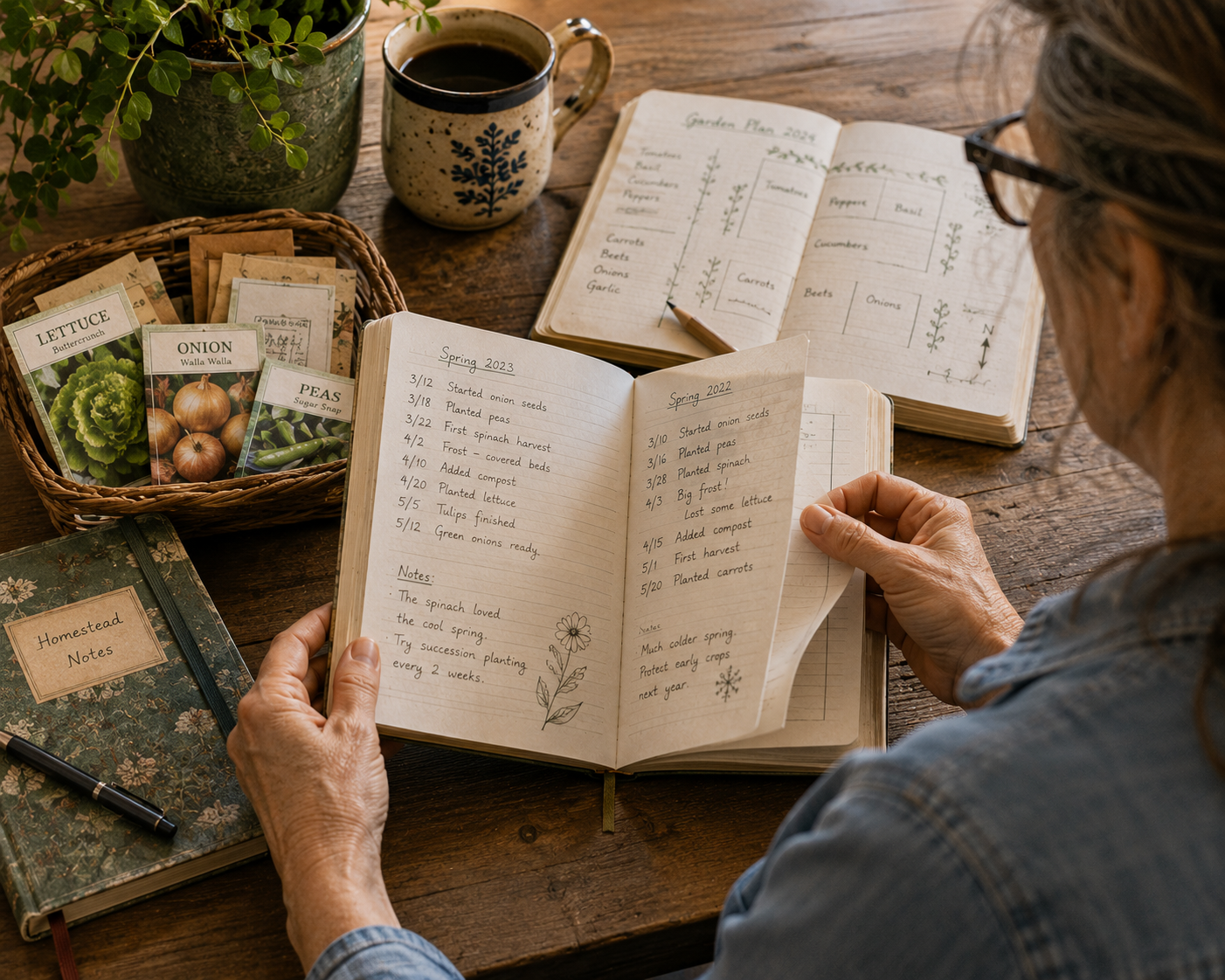
The garden is especially good at producing information worth saving. Planting dates become much more useful when they are accompanied by what happened afterward. A note that says planted peas March 10 tells me one thing. A note added several weeks later saying that the earlier planting outperformed the second planting tells me something I can actually use next spring.
The same principle applies all over a homestead. How much produce did we need to make enough tomato sauce for the year? Was that amount of jam far too much or mysteriously gone by February? Did buying something in bulk actually save money once we saw how quickly we used it? Which repair lasted, and which supposedly clever solution had to be redone six months later?
Those are the things our future selves would very much like to know.
Keep the Failures
Successes are easy to record because we enjoy remembering them. Failures are often more useful.
A failed experiment is still useful—especially if you write down enough to keep yourself from repeating it next year.
When something goes badly, our first instinct may be to clean up the mess and move on. But before moving too far, write down what happened—especially if you have some idea why.
A failed garden crop can tell you about soil, timing, pests, watering, or variety selection. A preserving recipe nobody liked can prevent you from spending another August afternoon making twelve more jars of it. A household system that seemed brilliant in January but had completely collapsed by March has taught you something about how your family actually lives.
That last part matters. Homesteading can tempt us to build systems around the way we think we ought to live rather than the way we really do. A notebook quietly exposes the difference.
If a system continually fails, perhaps the people using it aren't the problem. Perhaps the system is.
Writing that down gives us permission to stop repeating an experiment that has already produced an answer.
Let the Notebook Become Messy
A well-used homestead notebook should probably acquire a few stains.
It may contain a quick sketch with measurements for a shelf beside notes about how many jars of peaches are left. A seed packet might be tucked between the pages. Someone may scribble down the name of a paint color, and three pages later there may be calculations for how much fencing a future project will require.
That isn't disorganization. It is a working record of a working home.
You can certainly divide the notebook into sections if that makes information easier to find. An index at the front can be enormously helpful, particularly after the notebook begins filling up. Dates help too. But I would resist creating so much structure that writing something down becomes a chore.
The best organizational system is the one that does not prevent you from using the notebook.
If you find yourself thinking, I don't know which section this belongs in, write it down anyway. You can always find it later. You cannot find something you never recorded.
Some Things Are Worth Recording Year After Year
Once you have kept a homestead notebook for a while, patterns begin appearing.
The first tomato ripens earlier one year and later another. A perennial you thought had died suddenly returns. The amount of food your household consumes changes as children grow or people move in and out. Certain expenses begin appearing at roughly the same time each year. A repair you thought was permanent turns out to have a three-year life span.
One isolated note may not tell you much. Five years of notes can tell a story.
That is when the notebook becomes more than a place to store information. It becomes a record of the homestead itself.
You can see what you tried when you were first learning, what you eventually stopped doing, and what became so ordinary that you hardly think about it anymore. The little improvements accumulate on paper just as they accumulate in the home.
Some entries may eventually become family history. A notation about the first handful of strawberries from a new garden may seem insignificant when you write it. Years later, it can bring back the entire season—the place you lived, what you were building, what you hoped to do next.
Not everything we record needs to be practical forever.
Some things are simply worth remembering.
Begin With the Homestead You Have
Perhaps the best thing about a homestead notebook is that you do not have to wait until you have the homestead you imagine someday having.
The notebook begins with the homestead you have, not the homestead you
hope to have someday.
You can begin in an apartment. You can begin with a windowsill herb garden, a sourdough starter, household repairs, grocery experiments, and plans drawn for a garden that does not exist yet. Homesteading has never depended upon acreage nearly as much as people sometimes imagine.
The notebook begins where you are.
Write down what you tried today. Record what worked. Be particularly honest about what didn't. Save the details you know you will otherwise forget, and leave enough room for plans that are still only possibilities.
Then keep going.
A year from now, you will have something far more useful than a collection of tidy records. You will have a conversation with the person who was learning all of this last year.
And for once, when you ask, Now, how did I do this before?—
she may actually have left you the answer.
A Page I Didn't Know I Needed
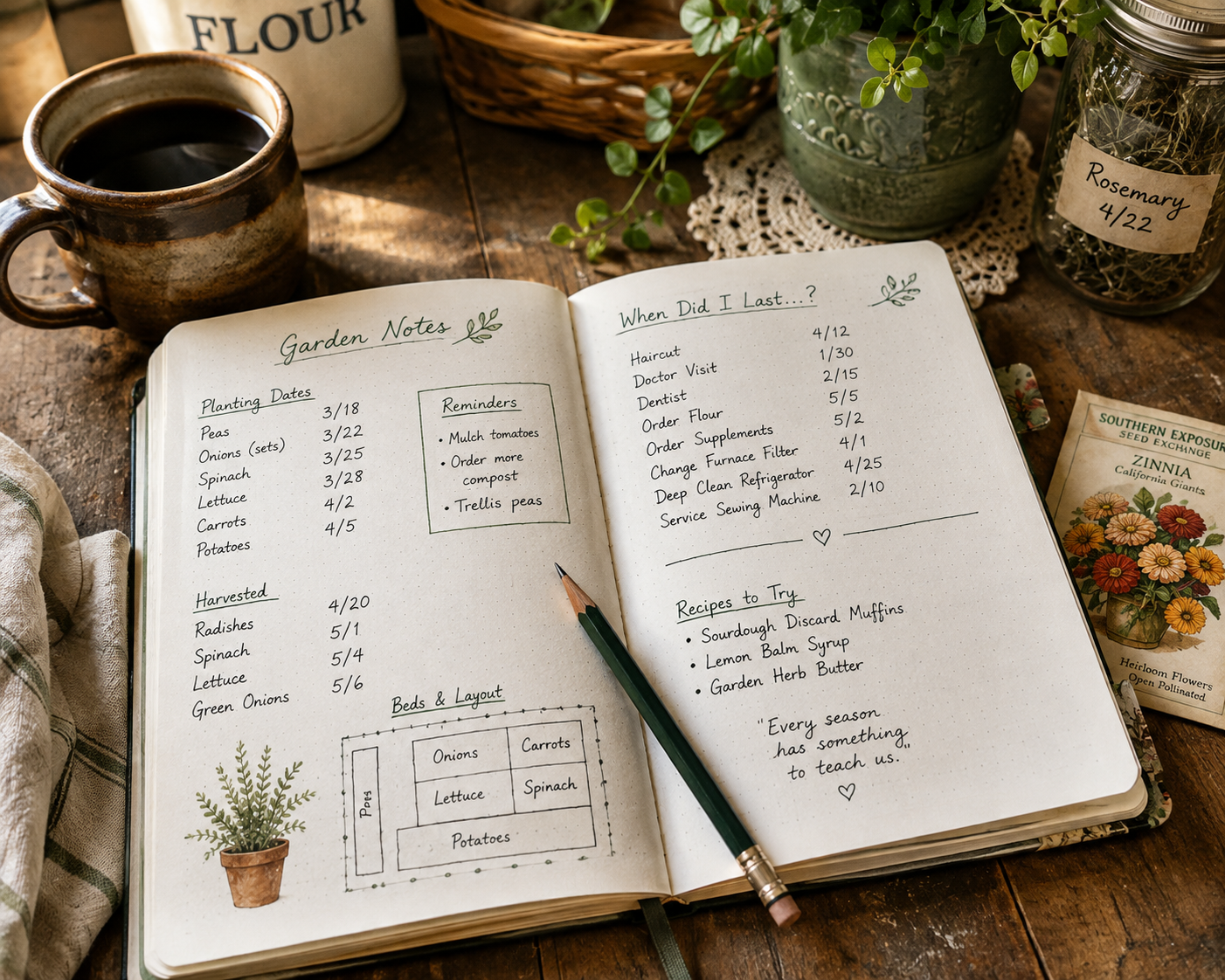
One of the most useful pages in my notebook turned out to be one of the simplest. I call it my “When Did I Last…?” page.
Some things happen too infrequently to become habits but often enough that knowing the last date matters.
Certain questions come up over and over again, and I can never answer them as confidently as I think I should. When did I last get my hair cut? When did I order flour? How long has it been since that appointment? I know the information exists somewhere. I could search through my calendar, receipts, emails, or old notebook entries until I found it, but usually I don't need all that history. I just need to know how long it has been.
So I keep those dates together.
This is different from scheduling the next appointment or setting a reminder. I may not know when something needs to happen again. I simply want a quick reference for when it happened last. When the answer changes, I update the date.
The same idea works beautifully for the homestead. When did we last change that filter, have something serviced, order a particular bulk staple, sharpen a tool, or check a piece of equipment? Some things happen too infrequently to become habits but often enough that knowing the last date matters.
A single page saves an astonishing amount of searching.
It also reveals time rather mercilessly. What I was quite certain happened “a couple of months ago” occasionally turns out to have happened sometime during the previous presidential administration.
That alone makes the page worth keeping.

