
Counting the Omer: Living the Days Between Redemption and Revelation
Passover does not end the story.
It begins it.
Israel walks out of Egypt in a single night, but they do not arrive at Sinai in a single step. Between rescue and revelation lies a stretch of days—numbered, intentional, and not to be skipped.
This is the counting of the Omer.
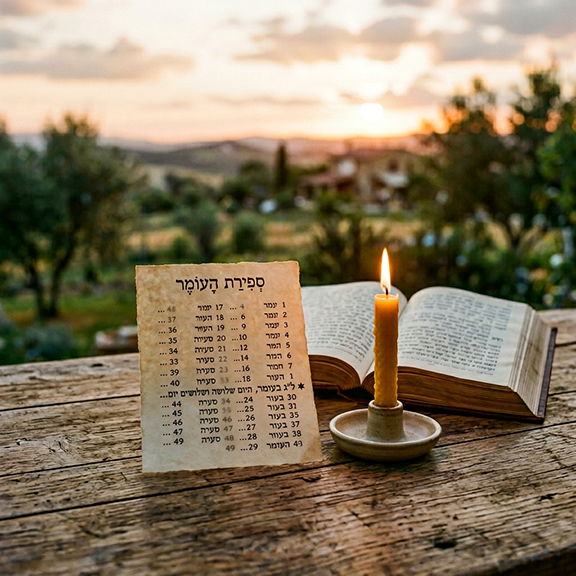
From the day after Passover, Scripture commands a daily count—seven weeks, forty-nine days—leading to Shavuot, the Feast of Weeks (Leviticus 23:15–16). Each day is named. Each day matters. Nothing is rushed.
We tend to treat spiritual growth like a door: open it, step through, done.
God treats it like a path.
Why Count at All?
Counting forces attention.
When you number your days, you stop drifting through them. You begin to notice patterns—where you rush, where you resist, where you avoid what is being formed in you.
Israel did not leave Egypt ready to receive Torah. Freedom came first. Formation came next.
The Omer is that formation.
It is the slow work between “You are free” and “Now live as My people.”
The Biblical Instruction (And Where It Gets Complicated)
On the surface, the command seems straightforward:
“Count from the day after the Sabbath… seven full weeks.”
But that one phrase—the day after the Sabbath—is where the debate begins.
There are two primary ways this has been understood:
1. Rabbinic (Traditional Jewish) Counting
The “Sabbath” is understood as the first day of Unleavened Bread (a festival Sabbath).
→ Counting begins the day after Passover week begins.
→ Shavuot falls on a fixed calendar date (Sivan 6).
2. Karaite / Literal Reading
The “Sabbath” is understood as the weekly Sabbath during Passover week.
→ Counting begins on a Sunday.
→ Shavuot always lands on a Sunday.
Both approaches are trying to honor the text.
They simply answer the same question differently.
So… Which One Is Right?
You can spend a long time trying to solve that question.
Or you can notice something more important:
God commanded the counting more clearly than He resolved the debate.
That should get your attention.
The emphasis is not on winning the calendar argument.
The emphasis is on participating in the count.
Choosing a Faithful Practice for Your Home

Here’s the part most people skip.
You do not need to solve 2,000 years of debate to begin.
You need a faithful, consistent practice.
Pick a lane, and walk it.
Here are three grounded options:
Option 1: Follow the Traditional Jewish Calendar
This aligns you with the majority of the global Jewish community today.
t provides structure, consistency, and widely available resources.
Option 2: Follow the Weekly Sabbath Interpretation
This aligns with a more literal reading of the text.
It emphasizes the rhythm of weekly Sabbath cycles within the count.
Option 3: Choose Consistency Over Precision (For Beginners)
If you are new, start counting from a known point (for example, the day after Passover) and focus on building the habit.
You can refine your calendar later. Formation first, precision later.
If you change methods every year, you will never experience the weight of the practice.
Consistency forms you.
Constant adjustment distracts you.
The Shape of the Journey
The count moves from barley to wheat—from the simplest provision to a fuller harvest. It mirrors a shift from survival to purpose.
You can see it in the story:
They leave Egypt in haste.
They learn dependence in the wilderness.
They arrive at Sinai prepared to hear.
That preparation is not passive. It is daily.
Day one.
Day two.
Day three.
No shortcuts. No collapsing the process.
The Discipline of Numbered Time
We like big moments—Passover night, Sinai fire, the giving of the Spirit in Acts 2. But Scripture gives equal weight to the days in between.
Those days are not empty space. They are where alignment happens.
Counting the Omer teaches:
Time is not disposable
Growth is cumulative
Obedience is built, not declared
Each day is a small act of agreement with God’s timing.
Shavuot: Not Just Arrival
By the time Shavuot comes, something has changed.
At Sinai, the people stand ready to receive instruction.
In Acts, the disciples stand ready to receive the Spirit.
Shavuot is not just a date on the calendar. It is the moment when preparation meets giving.
God does not pour revelation into unprepared space.
He prepares the space first.
How to Actually Count (Simple, Real-Life Practice)
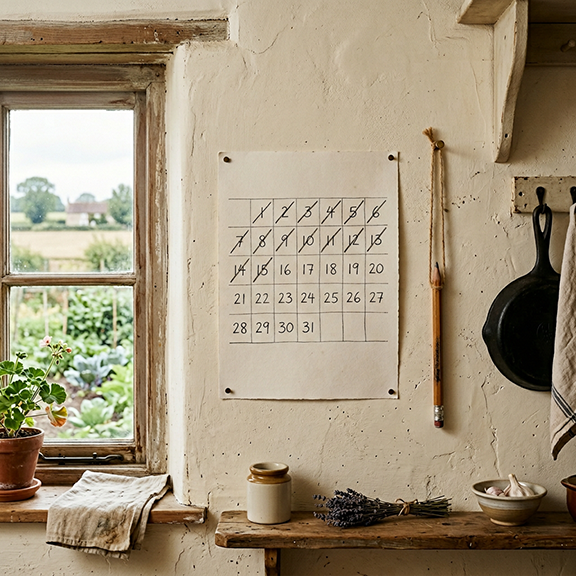
Do this at sundown each day:
Say the day out loud:
“Today is day ___ of the Omer.”
Mark it somewhere visible:
A printed page, a notebook, a chalkboard in the kitchen.
Ask one question:
What is being formed in me today?
That’s it.
No elaborate system required.
A Different Kind of Waiting
We usually think of waiting as empty time.
The Omer reframes it.
Waiting becomes active.
Time becomes structured.
Expectation becomes grounded in daily faithfulness.
You are not waiting for Shavuot.
You are walking toward it—one counted day at a time.
