Why We Began Shabbat at Home (And Why We Kept It Simple)
There was no dramatic moment. No lightning bolt of conviction. No perfectly set table glowing in candlelight while violins played softly in the background.
There was simply a growing sense that our weeks were slipping past us without a pause. Work blended into errands. Errands blended into screens. Even good things—ministry, learning, productivity—piled up into a life that never quite exhaled.
We didn’t begin Shabbat because we had mastered theology.
We began because we were tired of living without rhythm.
For years, I had studied the Scriptures with care. The Sabbath was not hidden. It was not obscure. It was woven into creation itself. God did not rest because He was exhausted. He rested because the work was complete. He blessed a day and set it apart in time.
That detail stayed with me.
Shabbat is not collapse. It is completion.
And somewhere along the way, I realized I had been finishing nothing. I was simply moving from task to task, carrying unfinished thoughts into the next week, and calling that productivity.
So we began.
Not with a feast. Not with twenty guests. Not with handmade challah and polished silver.
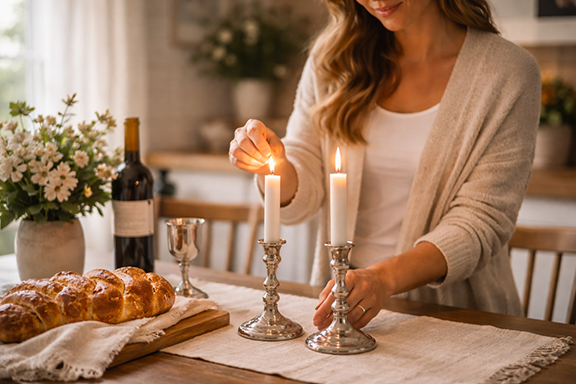
We began with two candles and a meal we were already planning to eat.
That was it.
I did not want to perform Shabbat. I wanted to enter it. There’s a difference. Performance adds pressure. Entrance requires intention.
The first few weeks felt awkward. We weren’t sure what to say. I stumbled through a blessing. We forgot the grape juice once and laughed about it. Nothing looked like the beautiful photographs you see online.
And yet something shifted.
Lighting candles marked the boundary. It said, “The workweek is done.” Even when projects remained unfinished, we declared the week complete. That act alone changed something in me. It required trust.
Over time, the simplicity became the anchor. We did not add layers quickly. We resisted the urge to “upgrade” the experience. No elaborate décor. No social media posts. No pressure to replicate someone else’s tradition.
We kept it small so it could be sustainable.
I have learned that when something is simple enough to repeat, it becomes a rhythm. And rhythm shapes the soul.
Shabbat began teaching us things we did not expect. It exposed how addicted we were to busyness. It revealed how often I measured worth by output. It showed me that rest is not the absence of work; it is the presence of trust.
Trust that the world will continue spinning.
Trust that God is not dependent on my constant effort.
Trust that provision does not evaporate when I stop producing.
We also discovered joy in small details. The same meal tasted different when it was unhurried. Conversation stretched. Scripture reading felt less like study and more like dwelling. Even silence felt full instead of empty.
We did not begin Shabbat at home because we were trying to be impressive. We began because we needed a sanctuary in time.
And we kept it simple because simplicity protects joy.
There is a temptation to complicate spiritual practices. To turn them into systems. To measure them. To optimize them. But Shabbat resists optimization. It resists hustle. It refuses to become another achievement badge.
It is a gift.
The more we stripped away, the clearer that became.
Now when Friday evening arrives, there is a gentle anticipation. Not because everything is perfect. Not because the house is spotless. But because we know what the lighting of those candles means. It means we are stepping into completed time.
We are declaring, again, that we are not slaves to production.
We are remembering that God finished His work and called it good.
If you are considering beginning Shabbat at home, start smaller than you think you should. Resist the urge to replicate someone else’s tradition overnight. Light a candle. Bless the day. Share a meal. Read a passage.
That is enough.
Let it be simple enough to return to next week.
Because Shabbat is not built in a single evening. It is woven through repetition.
And over time, that simple, faithful repetition becomes a quiet revolution in the soul.