
What Makes a Homestead Real (Even When It’s Tiny)
There’s a quiet doubt I hear again and again from women who love the homestead life.
It usually sounds like this:
“Someday, when we have more land…”
“Once we move…”
“If we ever get acreage…”
As if homesteading begins only after the dream comes true.
I don’t believe that.
I’ve come to believe that a homestead isn’t defined by size or scale. It’s defined by how you relate to your home, your food, and your time.
And by that measure, many of the most real homesteads I know are very small.
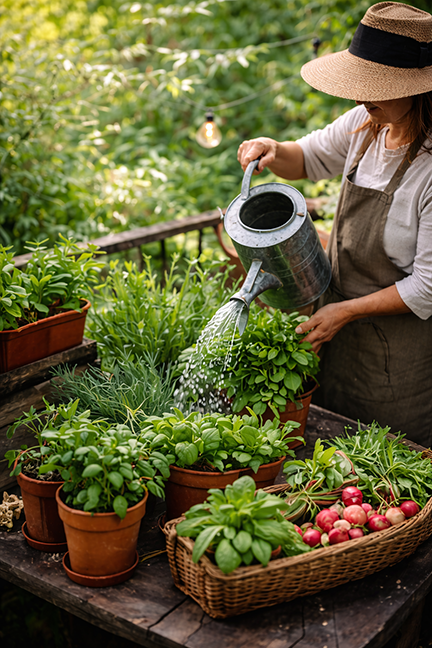
Grow your own groceries!
A Homestead Is Not a Property — It’s a Posture
A homestead isn’t something you buy.
It’s something you practice.
It begins the moment you decide that your home is not just a place to land between errands, but a place where life is actively shaped.
Homesteading starts when you take responsibility for something essential:
• feeding yourself
• tending living things
• learning skills that reduce dependence
• choosing rhythms over convenience
None of those require acreage.
If You Tend Life, You Are Homesteading
Rabbits in a shed—or in your living room.
Quail in a small pen—even one in the laundry room.
Herbs on a windowsill.
Bread rising on the counter.
If you are tending life — animal, plant, or process — you are doing homestead work.
Scale doesn’t change the nature of the task.
Care does.
A woman raising quail in her backyard and a woman managing a hundred acres are practicing the same skill: stewardship.
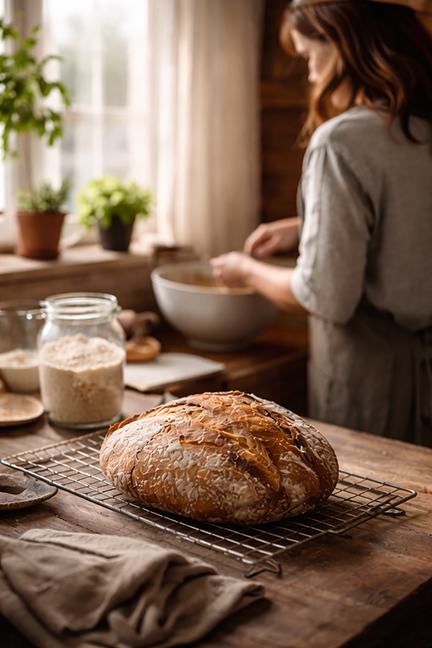
Kitchen creations
Making Do Is a Homestead Skill
Real homesteads are built on adaptation.
They are shaped by:
• zoning laws
• family needs
• physical limitations
• seasons of life
Learning how to work within constraints is not a compromise. It is one of the central homestead skills.
If you’ve learned to:
• fit animals into a small footprint
• preserve food without a pantry
• compost creatively
• reuse, repurpose, and simplify
You are not “pretending.”
You are practicing.
Food Is a Foundation, Not a Hobby
One of the clearest markers of a real homestead is this: food matters.
When you care where it comes from, how it’s grown, how it’s prepared, and how it’s preserved, you are doing homestead work.
It doesn’t matter if that food comes from:
• a garden bed
• a CSA
• a freezer full of meat you sourced carefully
• animals you raise in small numbers
Intentional food choices are foundational homesteading, not a side interest.
A Real Homestead Has Rhythms
Homesteading shows up in the shape of your days.
Feeding schedules.
Cleaning cycles.
Preservation seasons.
Rest days.
Even in a small space, these rhythms anchor you.
If your life is shaped by tending rather than consuming — by maintaining rather than replacing — your home is already functioning as a homestead.
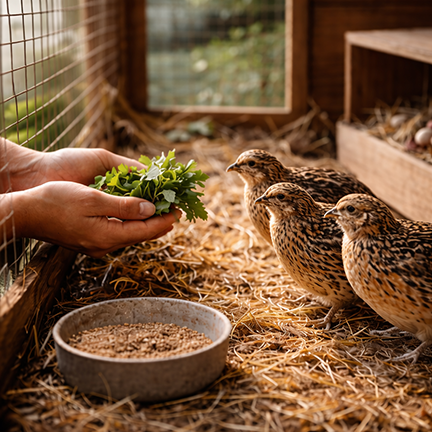
Giving quail a treat
You Don’t Have to Wait to Be Legitimate
Here’s what I wish more “dreamsteaders” knew:
You don’t become a homesteader when the dream arrives.
The dream arrives because you’ve been becoming one all along.
Every skill you learn now carries forward.
Every habit you form now scales later.
Every rhythm you practice now deepens when space expands.
Tiny homesteads are not placeholders.
They are training grounds.
Start Where You Are — And Stay Faithful There
If you feel called to this way of life, you don’t need permission.
You don’t need more land to be real.
You don’t need bigger projects to be legitimate.
You don’t need to wait.
If you are tending, learning, and choosing a slower, more intentional relationship with your home — you are already homesteading.
Start where you are.
Stay faithful there.
That’s how real homesteads are built.
Like this content? Check out The Homesteading Blog Hop!
