
Fiber Rabbits: Keeping Livestock in your home You Don’t Have to Kill
I’ve raised animals for food. Quail didn’t trouble me the way I expected—they were practical, contained, and their purpose felt clear. Rabbits are different. They live closer to us. They are fluffy. They make eye contact. And while many people raise rabbits for meat with gratitude and resolve, I know myself well enough to say: if an animal lives in my house, I don’t want my relationship with it to end in slaughter.
That doesn’t make me less of a homesteader. It makes me honest.
Years ago, when my husband and I lived in Russia, we were in a small apartment building—a flat. Two floors above us, a woman raised goats. In her apartment. I am not suggesting that. But it left a lasting impression on me: people have always found ways to keep provision close, even in the tightest spaces. The question isn’t can it be done. The question is what kind of keeping is wise.
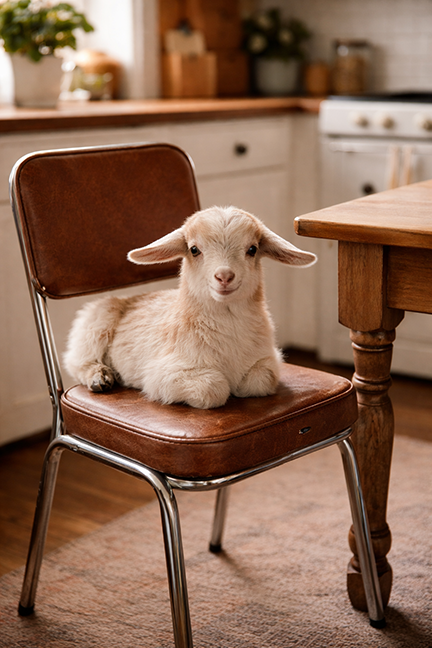
For me, that wisdom looks like fiber rabbits.
Why Fiber Rabbits Belong in the Home
Fiber rabbits are uniquely suited to indoor life. They are quiet, gentle, and thrive on predictable routines. Unlike animals that merely tolerate indoor spaces, these rabbits actually benefit from them: steady temperatures, protection from drafts, and consistent care all support healthy coats.
They are not pets pretending to be livestock. They are livestock with a different purpose.
Daily care becomes part of the household rhythm—feeding, checking water, tidying bedding, brushing fiber. It is steady, calm work. The kind that fits naturally into a life lived close to home.
A note on allergies
Rabbits are not hypoallergenic. Most reactions, however, are not caused by the rabbit’s fiber itself but by dander, urine, or—most commonly—the hay they require. Some people with mild pet allergies find rabbits easier to tolerate than cats or dogs, especially with regular grooming and good ventilation, but this varies from person to person. Anyone with known sensitivities should spend time around both rabbits and hay before committing. Orchard grass hay is sometimes better tolerated than timothy, but discernment and honest trial matter more than labels.
Choosing a Fiber Breed
Angora rabbit is the umbrella term most people recognize, but there are several varieties worth knowing.
English Angora are smaller and exceptionally fluffy, though they require more frequent grooming.
French Angora are a favorite for beginners, with fiber concentrated on the body rather than face and ears.
Satin Angora produce a lustrous fiber that blends beautifully with wool.
All can live indoors successfully. The real deciding factor is not square footage, but your willingness to keep up with grooming.

transparency
I should say plainly that I don’t currently have rabbits in my home—but I have raised fiber rabbits in my home before. When we lived on our small mountain homestead, even though we had land and a barn, I chose to keep my rabbits in a room off the main bedroom that had once housed a hot tub. The tub was long gone when we bought the house, but the decking and concrete pad remained, and it made a perfect, protected space. We didn’t just raise rabbits there; we also brought our miniature goat does inside to kid, because owls and hawks can lift a miniature kid without difficulty. At one point, we even raised chicks in the kindling box in our office. Keeping animals close was never about novelty—it was about safety, stewardship, and doing what made sense in that season.
Indoor Housing Basics
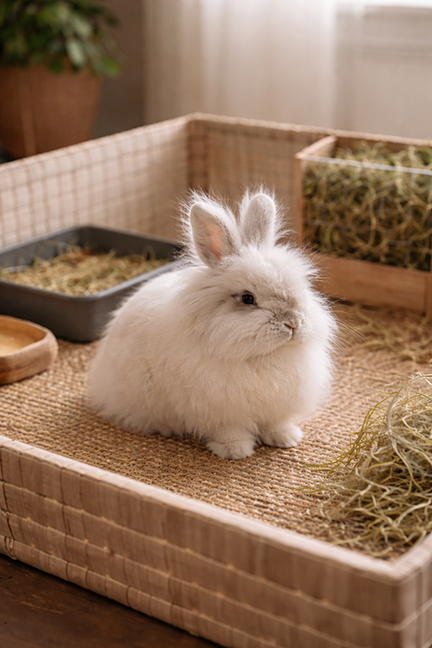
Fiber rabbits do not belong on wire floors. Solid flooring with soft bedding protects both feet and coats. Many people use a roomy pen or dedicate a quiet corner of a room. Cleanliness matters more than size.
Good airflow without drafts, access to natural light, and a consistent routine will do more for coat health than elaborate setups. Indoors, smells stay minimal when bedding is changed regularly and hay is managed well.
This is one of those cases where simplicity wins.
Grooming Is the Harvest
This is where fiber rabbits truly shine.
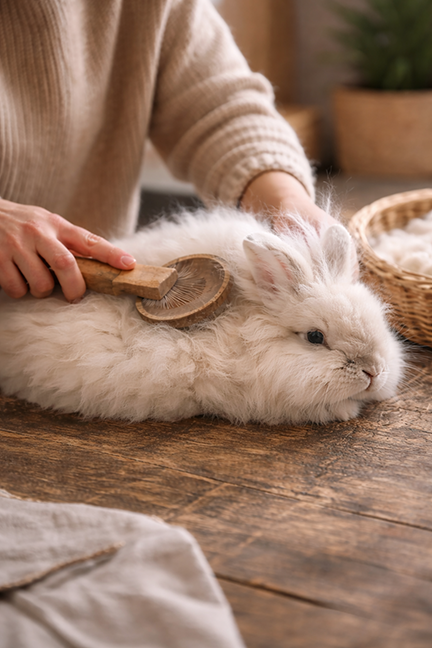
Fiber is harvested through regular grooming—brushing, combing, or gently plucking when the coat naturally releases. There is no rush. No single dramatic moment. Fiber is gathered a little at a time, over weeks.
Rabbits are often calmer after grooming, not stressed by it. The process becomes a quiet practice: sit, tend, collect, set aside. Over time, those small handfuls add up.
Harvest, here, looks like care.
What You Can Make
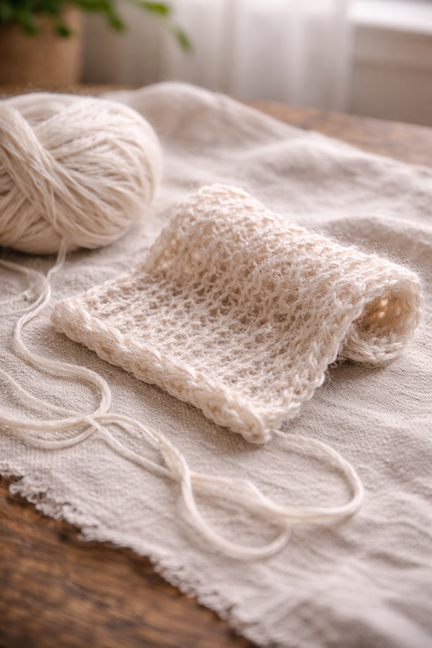
Rabbit fiber can be spun on its own or blended with wool for strength. It felts beautifully. It creates soft, warm yarn for scarves, mittens, hats, and small household textiles.
There is something deeply satisfying about using fiber grown in your own home—fiber you tended, cleaned, prepared, and transformed. It fits naturally into a life that values making, mending, and meaningful work.
An Honest Word About Emotion
I didn’t feel conflicted about quail. I do feel conflicted about rabbits. That matters.
Stewardship isn’t about forcing ourselves into someone else’s version of faithfulness. It’s about discerning what we are actually called to carry. Not every household is meant to hold the same kinds of animals—or the same kinds of endings.
Fiber rabbits allow me to keep livestock close, to practice responsibility and provision, without hardening myself into something I’m not meant to be.
Closing
Homesteading is not a test of toughness. It is a relationship with life.
Fiber rabbits remind us that there are many faithful ways to live close to provision—and that honesty, gentleness, and discernment belong at the heart of a household just as much as productivity does.
If you find yourself nodding along but also feeling the tension of where to draw your own lines, you’re not alone. Choosing fiber rabbits is just one expression of a larger truth: faithful homesteading looks different in different households and in different seasons. I wrote more about why discernment is not failure—and why staying small can be an act of wisdom—in Drawing Lines in Homesteading: Why Discernment Is Not Failure.
If you like this kind of content (and I think you do, since you’ve read this far), check out The Homestead Blog!
Wondering if raising fiber rabbits is right for YOUR home? I’ve crafted a Discernment Sheet to help you decide. Download it here.
