
The Homestead Is Growing Me
I spend a fair amount of time thinking about what we will grow when we have our homestead again. There will be a larger garden, certainly, and strawberries will have a place in it if I have anything to say about the matter (and believe me, I will). There will be herbs and vegetables, things to preserve for winter and things that will probably be eaten before they ever make it into the house. We want animals again, too, and land to tend, and enough room for the projects that seem to multiply whenever Jeff and I start talking about the future.
Right now, though, we are still in our little blue condo.
I may be waiting for the homestead to grow, but the homestead is already growing me.
Our future homestead exists mostly in plans and conversations. Jeff does most of the gardening we can do here, while I have claimed the strawberries as my particular responsibility. Eventually, we plan to put down pavers so that I can get around outside more easily in my wheelchair. For now, the garden isn't very accessible to me, and our little patch of growing things bears almost no resemblance to the homesteads we have known before or the one we hope to have someday.
It would be very easy to think of this as the time between homesteads. A waiting room, so to speak. We had that life before, and we hope to have it again, but right now we are living in the pause between the two.
Except I don't think that's true anymore.
I may be waiting for the homestead to grow, but the homestead is already growing me.
When Homesteading Was Easier to See
There was a time when our homesteading life was much easier to recognize. There were animals to care for, gardens to tend, food to put up, bread to bake, children to teach and the endless ordinary work of making a life close to the land. At the end of the day, you could point to the evidence. There were jars on the shelf, a loaf cooling on the counter, feed in the bins, something coming up in the garden, or schoolwork spread across the table.
I still believe deeply in all of those things. I think people should know how food is grown and how to make something useful with their own hands. I think children benefit enormously from discovering that bread doesn't originate in a plastic bag and eggs don't begin their existence in cardboard cartons. Knowing how to cook, preserve, mend, grow, repair and make do are useful skills, and I have no intention of surrendering them just because our circumstances have changed.
But after enough years of doing those things, you begin to realize that the skills were never the whole point.
While your hands are learning one thing, something else is happening underneath. A garden teaches patience because no amount of enthusiasm will make a tomato ripen tomorrow. A failed crop has a rather efficient way of teaching humility. Animals teach faithfulness because they need care whether the morning is convenient or not. Putting food away in August teaches you to think about February. Neglect something long enough and there will be consequences; tend it faithfully and there will be consequences of another kind.
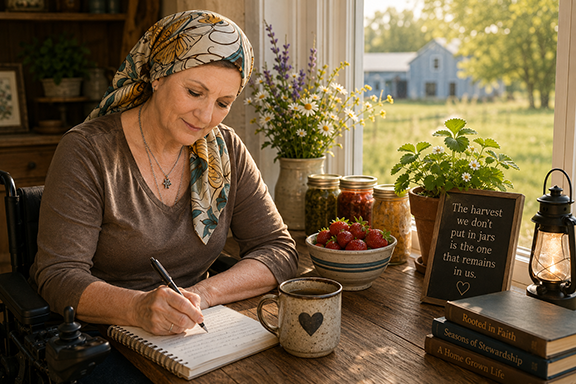
“A wise gardener does not stand over bare January soil and accuse it of failing to produce tomatoes.”
None of those lessons arrives with much ceremony. They accumulate quietly, season after season, until one day you realize that while you thought you were cultivating the garden, the garden was cultivating you.
While we are cultivating the homestead, the homestead is cultivating us.
The work teaches more than skills. Season after season, it quietly forms patience, faithfulness, humility, resourcefulness, and the willingness to begin again.
Perhaps that is why this season doesn't feel quite so much like an interruption anymore.
It is simply cultivating something different.
Learning to Tend What Is Within Reach
This season has required me to let other people do things I once would have done myself, and I cannot say that I have always enjoyed that lesson. Jeff does most of the gardening now. I tend my strawberries. There was a time when I might have measured that arrangement mostly by what I could no longer do, comparing a few strawberry plants with gardens and animals and all the work I once took for granted.
But a strawberry plant doesn't know that it is a small responsibility.
A strawberry plant doesn't know that it is a small responsibility.
It still needs tending. I can notice when it needs water, watch for new growth, see when berries are forming and pay attention to what is thriving and what isn't. I can care well for what is within my reach.
That has changed the question for me. Instead of continually asking how much I can manage, I am learning to ask what God has put into my hands today. Those are very different measurements, and the second one leaves much more room for gratitude.
Our condo is not the homestead we hope to have, and I don't want to romanticize that. I want the land. I want paths wide and solid enough for my wheelchair and gardens designed so I can actually work in them. I want animals again and the rhythms that come with caring for a place through the seasons. I look forward to all of it.
But longing for what comes next can make us remarkably inattentive to what is already here.
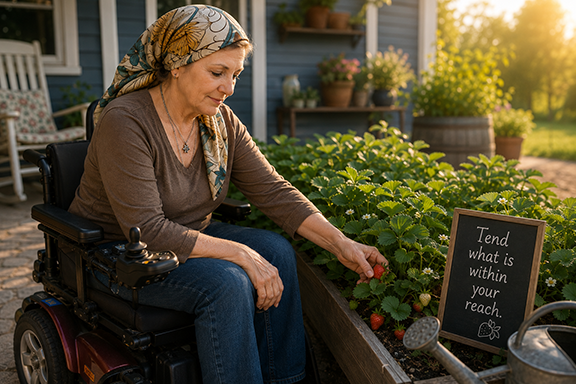
There are strawberries growing outside. There is food being made in the kitchen and work being created in my studio. There are grandchildren to teach, stories to tell and skills accumulated over a lifetime that can be passed to someone else. There is a home to tend and a life being built here. More acreage would give us room to do more of those things, but it would not make them begin.
In fact, this small place may be teaching us some of the things our future homestead will need.
Because now I think about accessibility before the garden is built rather than afterward. I notice paths differently. I think about how far one task is from another, how high something should be, whether a growing space can actually be reached, and whether a system works for the people who will really use it. I think more carefully about what I can do, what Jeff can do, and what we can do together.
Those aren't consolation prizes for the homestead we don't have yet.
They're plans for the one we will.
The Harvest We Don't Put in Jars
Homesteading has taught me to pay attention, and I think that may be one of its greatest gifts. When you live close to growing things and animals, attention matters. You learn to notice the sky because weather matters. You notice whether a plant looks different this morning or an animal is behaving differently than yesterday. You learn that the same crop can thrive in one part of a garden and struggle only a few feet away.
You also learn that ordinary little systems matter. You notice when the flour jar is getting low, but you don't pour fresh flour endlessly on top of old flour just because there is room. Anyone who has kept animal feed learns the same lesson even more emphatically. Empty the bin first, clean it when necessary, and then refill it. Otherwise stale feed, moisture, mold and insects have a wonderful opportunity to teach their own memorable little homesteading lesson.
Attention becomes a habit. Eventually you find yourself carrying it beyond the garden and kitchen. You begin noticing what in your life is flourishing and what has been neglected, what needs tending and what needs pruning, what can be encouraged and what simply needs time. Most importantly, perhaps, you begin learning to recognize seasons. A wise gardener does not stand over bare January soil and accuse it of failing to produce tomatoes.
I am trying to offer myself the same courtesy.
When we eventually move onto land again, I don't think we will be starting over. We will be beginning another homestead, certainly, but we won't arrive there as beginners. We will bring every place we have lived with us. We'll bring the things that worked and the mistakes we have no intention of repeating. We'll probably make several imaginative new mistakes just to keep things interesting.
And I will bring this season.
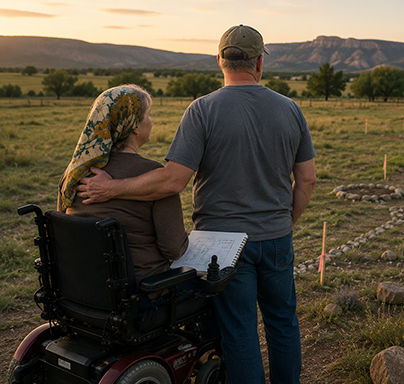
I'll bring what I've learned about accessibility and limitations, about receiving help and about designing a place around the people who actually live there. I'll bring the lesson of those strawberries: that stewardship isn't measured in acres and that something small is still worth tending well.
For many years, when I thought about a harvest, I thought about tangible things: vegetables from the garden, herbs hanging to dry, fruit being preserved, milk and eggs and jars lined up against another season. I still love that kind of harvest, and I hope there is plenty of it in our future.
But there is another harvest that takes longer to recognize. It is what remains in us after years of planting things that sometimes grew and sometimes didn't, caring for creatures that depended on us, feeding families, teaching children, making mistakes, beginning again and learning that some things simply cannot be hurried.
That harvest doesn't fit into a canning jar.
I still want to grow things. Lots of things. I hope there are overflowing gardens in our future, animals to care for, food to preserve and probably more projects than Jeff and I have good sense to undertake.
But I'm beginning to understand that all these years, something else has been growing alongside them.
Me.
And apparently, I'm not finished yet.

