
Natural Cleaning Products You Can Make from Pantry Ingredients (Non-Toxic, Easy Recipes)
If you want to replace the commercial cleaners under your sink with non-toxic alternatives, you do not need a dedicated supply cabinet or a long list of specialty ingredients. Four pantry staples handle the majority of household cleaning jobs: white vinegar, baking soda, washing soda, and liquid castile soap. Salt functions as an abrasive when you need one. That is the whole supply list for most small homestead kitchens.
The problem with most DIY cleaning recipes is that they mix ingredients that cancel each other out. Vinegar and castile soap should never go in the same bottle.
Before going further: vinegar and castile soap should never be combined in the same bottle. Vinegar is acidic. Castile soap is alkaline. Mixed together, they unsaponify the soap — it curdles into a film and both ingredients become ineffective. This is the most common mistake in DIY cleaning recipes, and it is worth knowing before you start.
Four ingredients — white vinegar, baking soda, castile soap, and salt — replace the majority of commercial cleaning products in a small home.
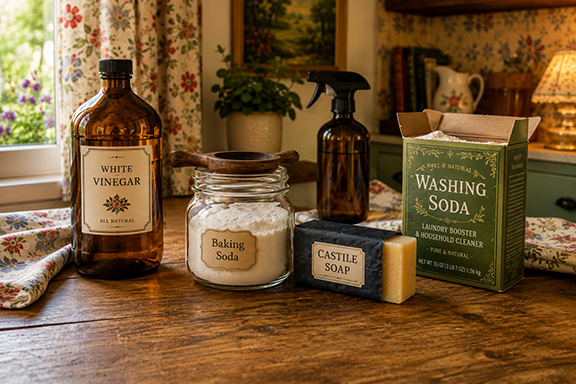
What Each Ingredient Actually Does
White distilled vinegar is a mild acid. It cuts grease, dissolves mineral deposits and hard water scale, kills most common household bacteria and molds on contact with adequate dwell time, and deodorizes. It is not effective against all pathogens — it does not replace disinfectants in situations requiring them — but for general kitchen and bathroom cleaning it is proven and reliable. Use it undiluted for heavy mineral deposits, diluted 1:1 with water for general surface wiping.
Baking soda (sodium bicarbonate) is a mild alkali and a gentle abrasive. It neutralizes odors chemically rather than masking them, lifts light grease and grime from surfaces, and works as a non-scratching scrub on sinks, tubs, and stovetops. It does not disinfect. It works by mild mechanical and chemical action, not by killing anything.
Washing soda (sodium carbonate) is stronger than baking soda — more alkaline, more effective on grease and heavy buildup, and useful in laundry and for cutting through stubborn residue. It is not the same as baking soda and should not be substituted for it in recipes that call for one or the other. Most grocery stores carry it in the laundry aisle.
Liquid castile soap is a plant-based soap — traditionally olive oil, now often a blend — that is concentrated, biodegradable, and genuinely effective as a surfactant. A small amount cuts grease and lifts grime. It rinses clean without residue when used at the right dilution. Dr. Bronner's is the most widely available. Dilute it more than you think you need to — most people use too much and get a residue film.
Salt is a mechanical abrasive and a mild antimicrobial when used in concentration. It does not disinfect at household use levels, but it scours surfaces effectively without scratching and pulls moisture out of stains.
Homemade non-toxic cleaners are not a compromise. Most of them clean as well as or better than their commercial equivalents on the surfaces they're designed for.
The Recipes That Actually Work
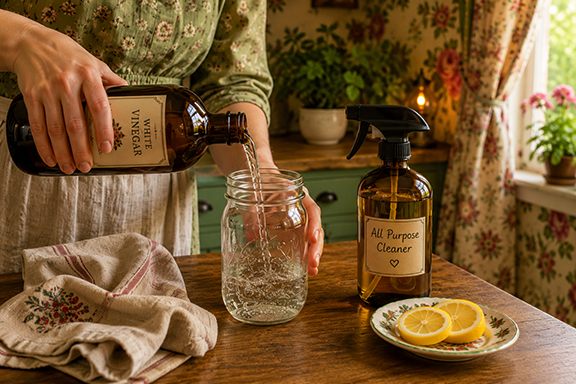
All-Purpose Surface Cleaner Mix 1 cup white vinegar with 1 cup water in a spray bottle. Add 15 drops of tea tree essential oil if you want additional antimicrobial action — tea tree has documented efficacy against a range of bacteria and fungi at this concentration. Use on countertops, stovetops, sealed tile, appliance exteriors, and bathroom surfaces. Do not use on natural stone (granite, marble) — the acid etches the surface over time. Do not use on cast iron.
Non-Scratching Scrub Combine ½ cup baking soda with enough liquid castile soap to form a paste — roughly 2 tablespoons, added gradually. Use immediately; this does not store well because the mixture continues to react and can lose its texture. Apply with a damp cloth or sponge to sinks, tubs, stovetop grates, and grout. Rinse thoroughly. For a dryer version that stores better, use baking soda alone with a few drops of castile soap applied directly to the wet surface.
Heavy-Duty Grease Cleaner Mix 1 tablespoon washing soda with 1 cup hot water and 1 teaspoon liquid castile soap. Note: washing soda and castile soap do not react the way vinegar and soap do — this combination is stable. Use on oven interiors, range hood filters, greasy stovetop surfaces, and grimy tile. Apply, let it dwell for five to ten minutes, scrub, and rinse. For baked-on oven grease, make a paste of washing soda and a small amount of water, apply to the surface, leave overnight, and wipe clean in the morning.
Glass and Mirror Cleaner Mix 2 cups water, ¼ cup white vinegar, and ¼ cup rubbing alcohol (70% isopropyl) in a spray bottle. The alcohol speeds drying and prevents streaking, which is the main complaint about vinegar-only glass cleaners. Wipe with a lint-free cloth or crumpled newspaper. This cleans as well as commercial glass cleaners on windows, mirrors, and glass stovetop surfaces.
Drain Maintenance Pour ½ cup baking soda down the drain, followed by ½ cup white vinegar. Let it fizz for five to ten minutes, then flush with boiling water. This does not dissolve clogs — it will not clear a blocked drain. What it does is break up light buildup, deodorize, and slow the accumulation of residue in the drain. Done weekly or biweekly, it reduces the frequency of actual clogs. For a real clog, use a drain snake.
Laundry Booster Add ½ cup washing soda directly to the drum with your laundry. It softens hard water, boosts the cleaning power of whatever detergent you use, and whitens without bleach. This is not a full laundry detergent replacement — it works as a booster. If you want a full homemade laundry detergent, a reliable formula is 1 cup washing soda, 1 cup baking soda, and ½ cup finely grated castile soap bar, mixed dry and stored in a jar. Use 2 tablespoons per load.
Toilet Cleaner Sprinkle ¼ cup baking soda around the inside of the bowl, add ¼ cup white vinegar, let it fizz and dwell for ten minutes, scrub with a toilet brush, flush. For stubborn staining and hard water rings, apply undiluted white vinegar, let it sit for thirty minutes to an hour, then scrub. For persistent hard water rings that vinegar alone does not shift, a pumice stone used wet will remove them without scratching porcelain.
You don't need a supply of specialty products to keep a non-toxic home. You need three or four pantry staples and the right ratios for each job.
Storage in a Small Kitchen
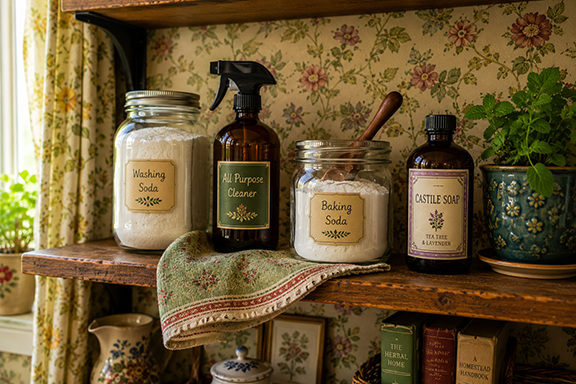
Every one of these recipes stores in a mason jar, a repurposed spray bottle, or a small glass jar with a lid. The all-purpose cleaner, glass cleaner, and heavy-duty grease cleaner store indefinitely in spray bottles. The dry laundry detergent stores in a quart mason jar. The scrub paste is best made fresh each time in small amounts. Label everything with masking tape and a marker. Keep the four base ingredients — vinegar, baking soda, washing soda, castile soap — in whatever space you have, and mix as needed.
If you are just starting out and want to know what to stock first, the Tiny Homestead Starter Kit includes a pantry checklist that covers both food and household staples worth keeping on hand. It is a practical starting point for building out a functional small homestead kitchen. You can grab it free at [link to lead magnet].
What This Does Not Replace
These recipes handle general cleaning reliably. They do not replace clinical-grade disinfectants in situations that require them — illness in the home, raw meat contamination, or immune-compromised household members. In those situations, a diluted bleach solution or a proven EPA-registered disinfectant is the right tool. Non-toxic does not always mean appropriate for every situation. Know the difference and use the right product when it matters.
I’ve made some pretty homestead labels for your Non-Toxic Cleaners.
Just print them out on sticker paper and cut along the crop marks.
Want more homemade recipes and natural remedies? Try this:
Planting a Medicinal Herb Garden: Grow Your Own Remedies from the Ground Up
How to Make Natural Insect Repellent Sprays at Home
If content like this is interesting to you, check out The Homestead Blog Hop!
