
Every Homeschool Begins at Home
Introducing the Kitchen Table School Series
Every summer, as one school year drew to a close, I began thinking about the next one.
What would we study? Which books would we read? What new skills were my children ready to tackle? How could I help each one continue growing, even though they were all at different stages of learning?
Like many homeschool parents today, I spent time looking through curriculum catalogs and collecting ideas. But eventually I realized something important.
The curriculum was never the heart of our homeschool.
Home was.
Our children are grown now. Some are homeschooling children of their own. Others have chosen different paths, just as they did after graduating from our homeschool. Some continued on to college. Others stepped directly into careers, ministry, or family life.
I also had the privilege of homeschooling two of my grandchildren, watching another generation discover the joy of learning.
And now, somehow, time has marched on. A few of those grandchildren are old enough to begin thinking about the families they may someday raise.
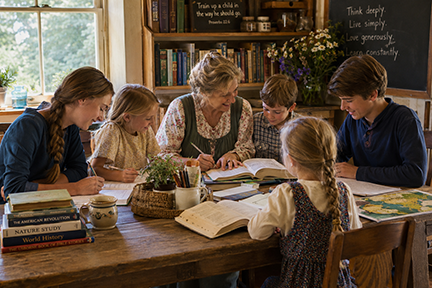
Looking back over those decades has given me a perspective I simply couldn't have had when I was standing in the homeschool aisle comparing grammar books.
I don't remember which spelling curriculum we used in fourth grade.
I couldn't tell you the publisher of every history book we owned.
Some of those details have faded with time.
What hasn't faded is what really mattered.
My children learned how to learn.
That was always the goal.
People sometimes assume that because I homeschooled all five of my children from their earliest years through high school graduation—and later homeschooled two of my grandchildren—I must have a teaching degree or a state teaching certificate.
I don't.
What I had was a love of teaching and a willingness to keep learning.
My greatest goal wasn't raising children who knew the answers. It was raising children who knew how to learn.
If I didn't understand a subject, I learned it. If I reached the limits of my own understanding, I wasn't afraid to ask for help. That only happened once, when mathematics wandered beyond geometry. By then I knew people who loved advanced math far more than I did, and they gladly stepped in.
One of my children eventually went on to college to study in mathematics.
Apparently, admitting I didn't know everything didn't ruin anyone's education.
My children learned something valuable from that.
Adults don't know everything.
Adults keep learning.
Adults don't know everything. Adults keep learning.
I also wrote nearly all of our curriculum myself. Not because I believed published curriculum wasn't valuable, but because I wanted our studies to fit our family instead of trying to make our family fit someone else's lesson plans.
With five children spread across different ages, learning looked different than it does in many homes.
One of my favorite approaches was asking the older children to teach a lesson to one of the younger ones. Under my supervision, of course, but the responsibility belonged to them.
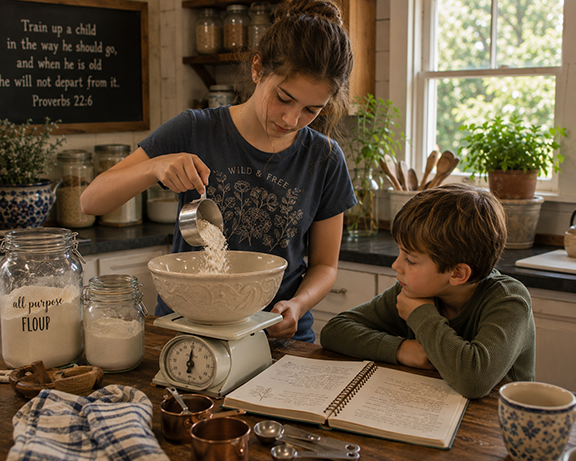
If they could teach it clearly, they truly understood it.
Tests rarely consisted of sitting quietly and trying to remember facts from the previous two weeks.
I wanted what they learned to become part of who they were.
History wasn't merely read.
It was lived.
The curriculum was never the heart of our homeschool. Home was.
We reenacted battles from the American Revolution in the yard. Sometimes the children wrote skits to explain an important event. Other times they composed songs that helped everyone remember what had happened, much like The Battle of New Orleans tells its story through music.
Lessons spilled out of books and into everyday life.
The homestead itself became our classroom.
Bread dough taught chemistry.
Gardens taught biology.
Budgets taught mathematics.
Animals taught responsibility.
Scripture shaped every subject because it shaped our understanding of the world itself.
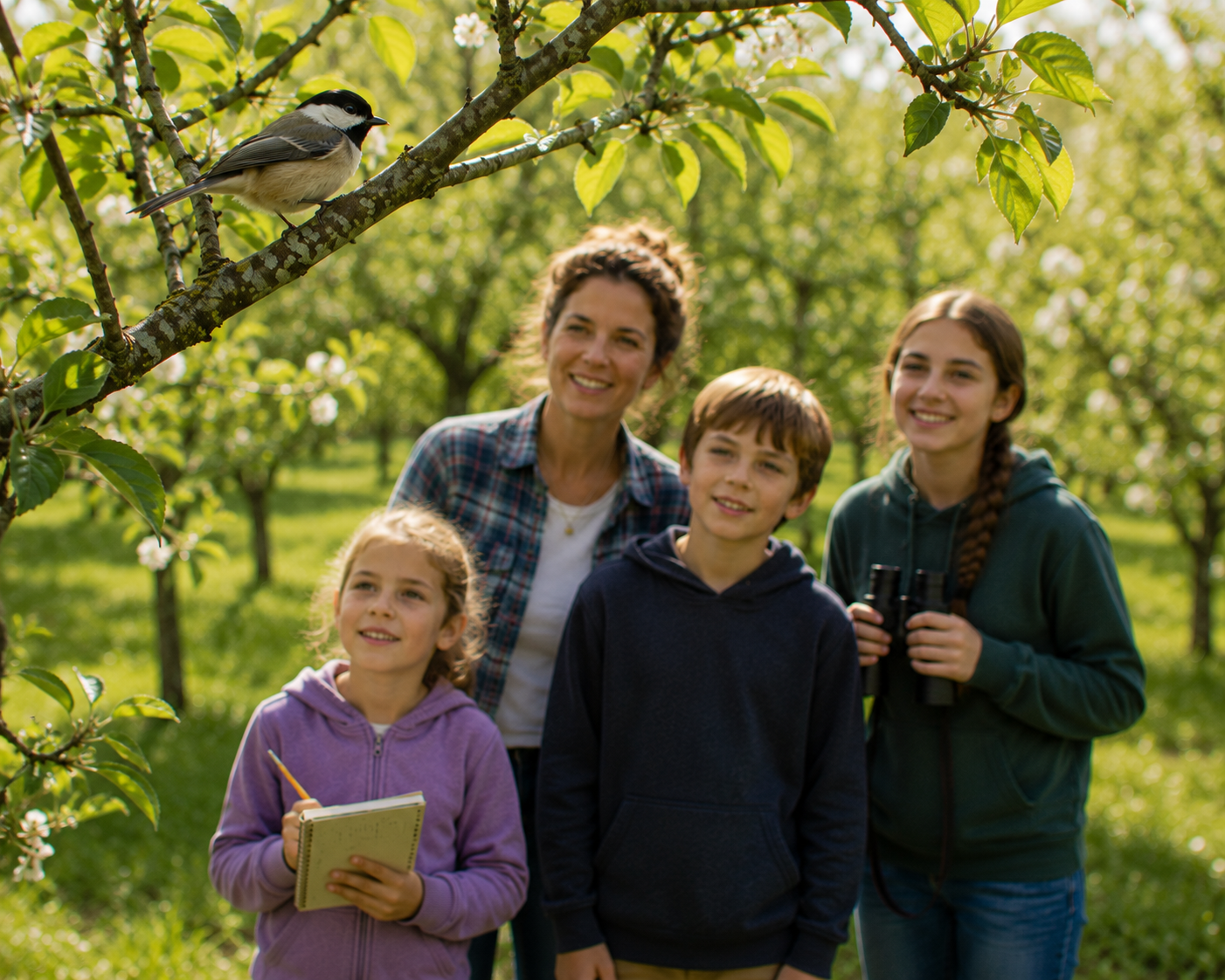
Most of all, I wanted my children to ask questions.
To wonder.
To observe.
To think.
To connect one idea with another.
Facts have their place, and there are certainly times when memorization is necessary. But facts learned only for a test are easily forgotten.
Understanding lasts.
Curiosity lasts.
Wisdom lasts.
I happen to love teaching. It's simply how God created me. Give me a room full of curious people—children or adults—and I'm happy.
But here's something I've learned over the years.
You don't have to love teaching to homeschool. You have to love your children.
The best homeschool parents I've known were not necessarily the ones with the most beautiful lesson planners or the newest curriculum.
They were the ones who knew their children well enough to recognize when something wasn't working, patient enough to try another approach, and humble enough to learn right alongside them.
People often ask if I would homeschool again.
Without hesitation, my answer is yes.
Not because every day was easy.
It wasn't.
There were tears. Frustrations. Lessons that flopped spectacularly. Days when I wondered whether I was doing enough.
But when I look back now, those aren't the memories that come first.
I remember reading together.
Long conversations around the kitchen table.
Children discovering they could do something they once believed was impossible.
Watching confidence grow one small step at a time.
It was a glorious journey.
That's why I'm beginning this new series, Kitchen Table School.
We'll certainly talk about curriculum. We'll discuss books, nature journals, notebooks, family libraries, handwriting, practical skills, and all the wonderful tools that support learning.
But we'll begin somewhere much more important.
We'll begin at home.
Because every homeschool begins there.
Long before the first workbook is opened or the first lesson is taught, education begins with a family that loves learning together.
Years from now, your children may not remember every workbook they completed or every quiz they took.
Years from now, your children won't remember every worksheet they completed. They'll remember who sat beside them.
But they'll remember who sat beside them.
Who listened to their questions.
Who encouraged them when they struggled.
Who believed they could learn.
Everything else is simply a tool.
That is what Kitchen Table School is about.
Welcome to the table.
Want homeschooling resources? Click here.

