
Real Homemade Mayonnaise
Three Ways to Make It
Same ingredients. Different tools. Choose your rhythm.
There’s something quietly defiant about making your own mayonnaise. It takes five minutes, a handful of ordinary ingredients, and just enough patience to build an emulsion the old-fashioned way. No preservatives. No mystery oils. Just egg, lemon, salt, and a slow drizzle of oil transforming into something thick and luminous. Once you taste real homemade mayonnaise, the jar from the grocery store feels like a compromise you no longer need to make.
Ingredients (All Methods)
• 1 whole egg, room temperature
• 1 tablespoon fresh lemon juice (added at beginning)
• ½ teaspoon salt
• 1 teaspoon Dijon mustard (optional but helpful for stability)
• 1 cup light olive oil or avocado oil
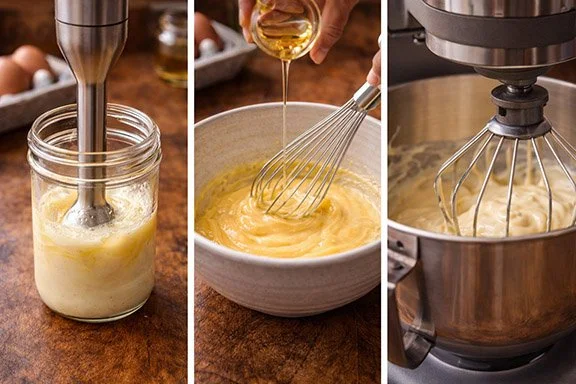
Method 1: Immersion Blender (Fastest)
Best for: efficiency and minimal dishes.
Add egg, lemon juice, salt, and mustard to a wide-mouth jar.
Pour oil gently over top.
Place immersion blender flat on bottom of jar.
Blend without moving until thick emulsion forms at base.
Slowly lift blender to incorporate remaining oil.
Ready in about 20 seconds.
Texture: thick and stable.
Effort: low.
Risk of breaking: low.
Method 2: Wire Whisk (Traditional, Slower)
Best for: control and tactile satisfaction.
In a ceramic or glass bowl, whisk egg, lemon juice, salt, and mustard until slightly thickened and pale.
Begin adding oil one drop at a time while whisking constantly.
Once mixture begins to thicken (true emulsion forming), you may increase to a thin steady stream.
Continue whisking until all oil is incorporated and mixture is glossy and thick.
Time: 5–10 minutes of steady whisking.
Texture: silky and light.
Effort: moderate.
Risk of breaking: medium (if oil added too quickly at start).
Pro tip: The first ¼ cup determines success. Go slow.
Method 3: Stand Mixer (Hands-Free Traditional)
Best for: larger batches or less arm fatigue.
Add egg, lemon juice, salt, and mustard to mixing bowl.
Begin mixing on medium speed.
With mixer running, add oil very slowly at first — almost drop by drop.
Once thickening begins, increase oil to a thin steady stream.
Continue mixing until fully emulsified.
Texture: smooth and slightly denser.
Effort: low physical effort.
Risk of breaking: medium if oil is rushed early.
If It Breaks
Don’t panic.
Place a fresh egg yolk in a clean bowl.
Slowly whisk broken mayonnaise into the new yolk.
Emulsion usually reforms.
Mayonnaise is less fragile than it feels.
A Note on Raw Egg Safety
Traditional homemade mayonnaise uses raw egg. Most fresh, properly handled eggs are safe, but there is always a small risk of salmonella when consuming raw or undercooked eggs.
To reduce risk:
• Use very fresh, high-quality eggs from a trusted source.
• Keep eggs refrigerated until ready to use.
• Wash hands and utensils thoroughly.
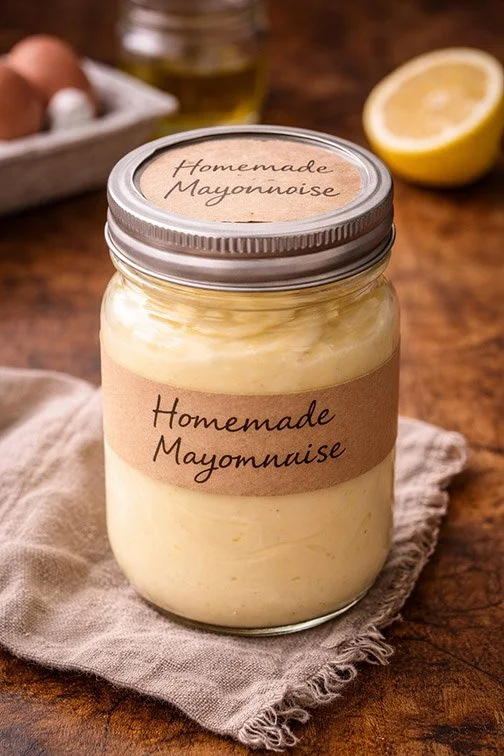
• Store finished mayonnaise in the refrigerator.
• Use within 5–7 days.
If serving elderly guests, young children, pregnant women, or anyone with a compromised immune system, consider using pasteurized eggs.
For those who keep their own hens or source locally, you are responsible for understanding your flock health and handling practices.
Homemade mayonnaise is simple food. Handle it simply and wisely.
