
Teach the children well. They are our future.
Teach the children well. They are our future.
Welcome to our homeschool journey!
How to use this page
When you see a lesson that you’d like to explore, click on the image. A new page will open that will give you more information and a download link that contains lots of material for teaching the concept.
Before you scroll, take a quiet moment to watch the video below. It’s a small window into what homeschooling means to us—not just books and lessons, but a way of walking through life together with wonder, courage, and trust.
At The Once and Future Homestead, we believe learning begins with love—love of family, of truth, of quiet moments, and of the One who authored every page of our story. Homeschooling isn’t just an educational choice; it’s a lifestyle of discipleship, discovery, and delight.
You won’t find perfection here. You’ll find slow days and silly questions. Muddy boots and bedtime read-alouds. Kitchen table science and middle-of-math tears. And through it all, you’ll find the same gentle rhythm: turning the page, together.
Whether you’re just beginning or looking for fresh inspiration, I hope you’ll find rest, encouragement, and a few ideas here to carry into your own homeschool days.
Welcome, friend. Let’s begin this chapter together.
Graphing God’s Growing World
Homestead Math Lesson
Ages: 8–12
Time: Five lessons (30–45 minutes each)
Subjects: Math, Science, Nature Study,
Record Keeping
Big Idea
Homesteaders don't guess—they observe,
measure, record, and learn from patterns.
Graphs help us see what God is doing in the garden and around the home.
Learning Objectives
Students will:
• Collect real-world data
• Organize information into tables
• Create bar graphs, line graphs, and pictographs
• Interpret graphs and make predictions
• Practice careful observation
Seed Math Activities: Growing Math Skills at the Kitchen Table
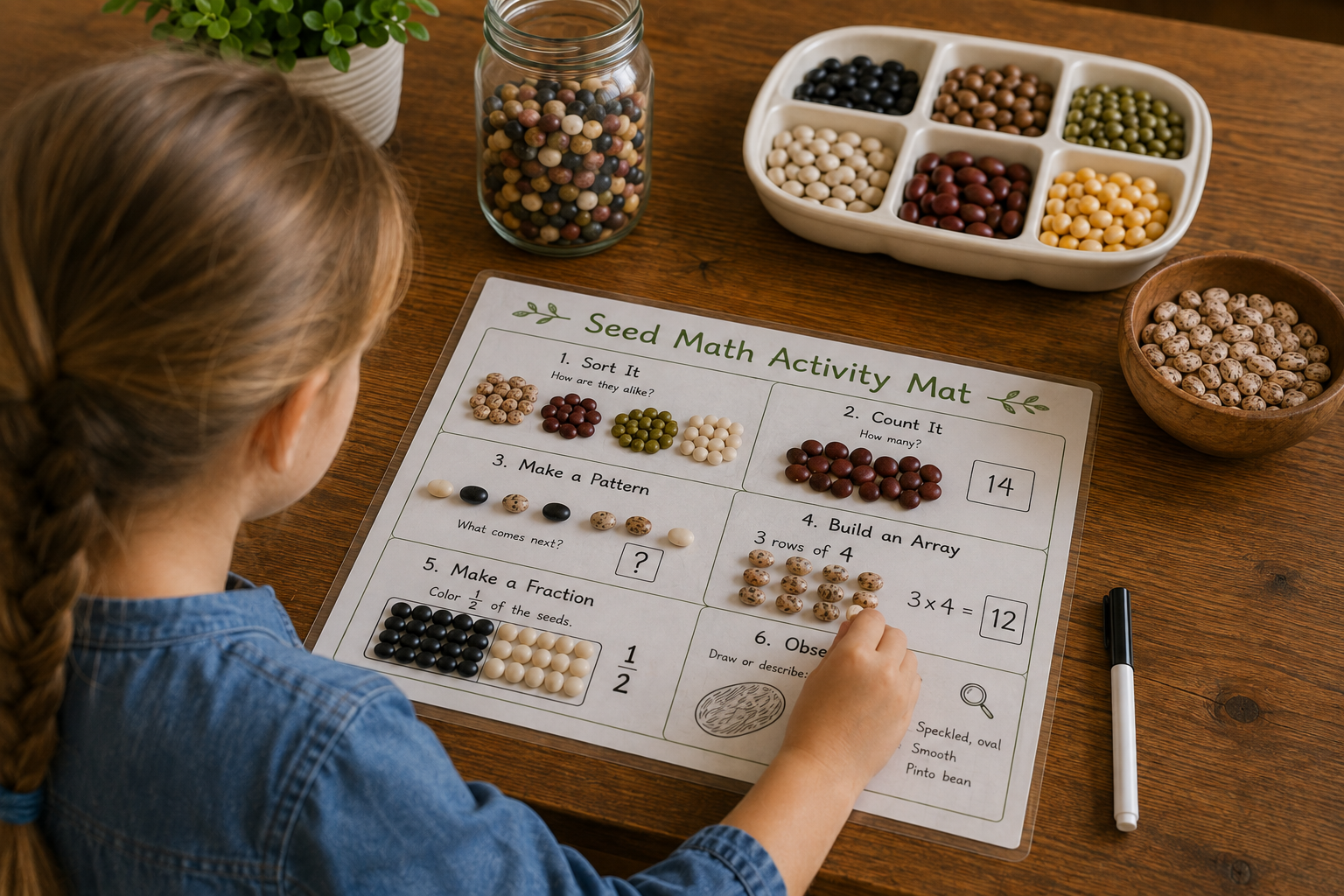
A handful of beans or seeds can become an entire math lesson. These simple, hands-on seed math activities help children explore counting, patterns, multiplication, fractions, measurement, estimation, and more—right at the kitchen table.
Kitchen Table School
Some of the best math manipulatives don't come in a brightly colored box from an educational supply company.
Sometimes they come in a seed packet.
Beans, peas, sunflower seeds, corn kernels, and pumpkin seeds are just about perfect for hands-on math. They're small enough to count and sort, different enough to compare, and plentiful enough that nobody needs to panic when one rolls under the refrigerator.
And unlike plastic counting bears, seeds have a story.
A bean isn't merely something that represents the number seven. It's something a child can hold in his hand today, push into the soil tomorrow, and—with a little water, sunshine, and patience—pick from a plant months from now.
That's the kind of learning I love.
Start With a Bowl of Seeds
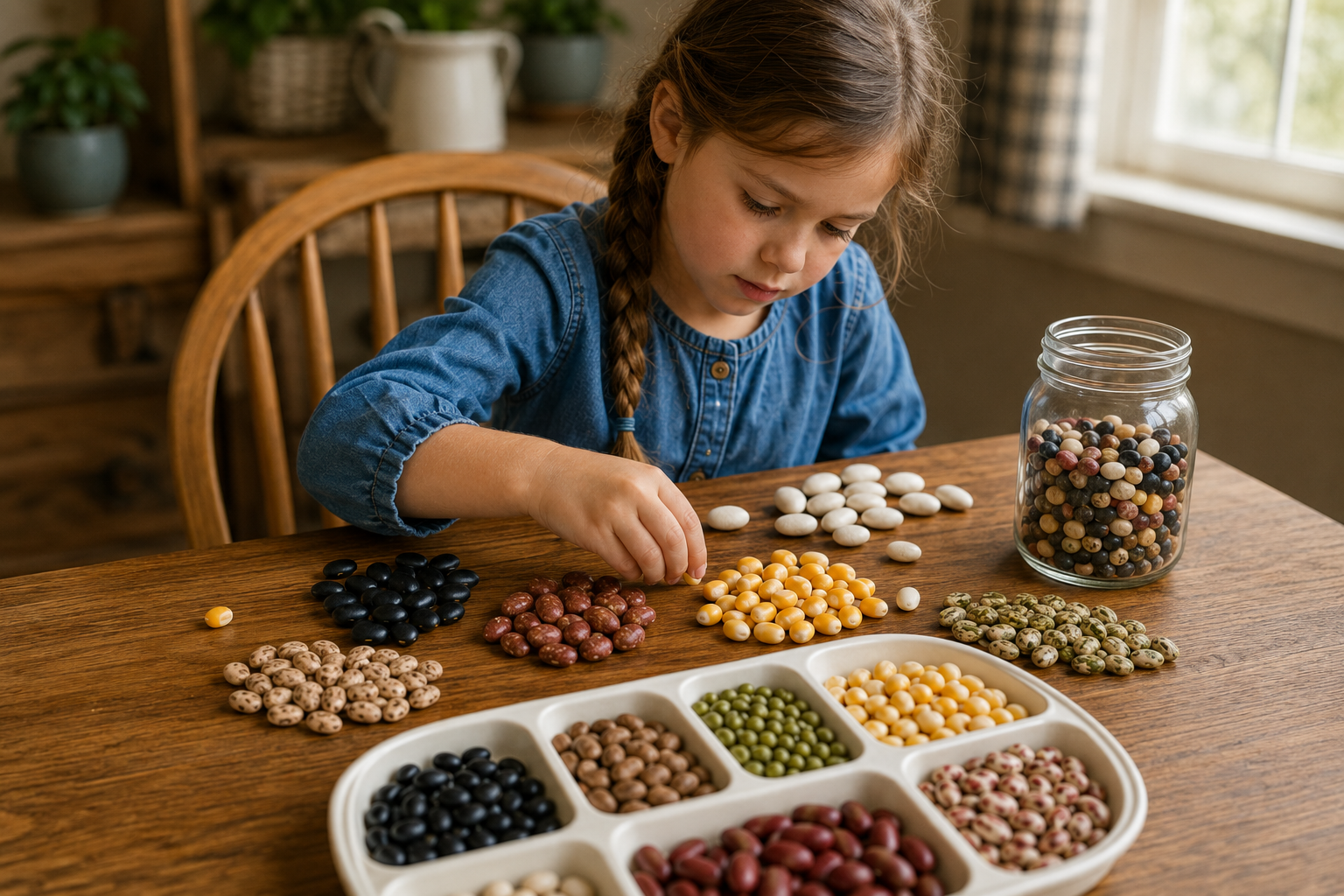
You don't need anything elaborate for seed math. Gather several kinds of dried beans or seeds from the pantry, garden, or inexpensive seed packets.
Choose larger seeds for younger children, especially if you have little ones who are still inclined to investigate things with their mouths. Seed activities with small children should always be supervised.
Then put the seeds on the kitchen table.
Before you give any instructions, see what your children do with them.
They may begin sorting them without being asked. They may line them up from smallest to largest. Someone may make a picture. Someone else will almost certainly announce that one bean looks like a potato.
They're already observing, comparing, classifying, and organizing.
In other words, they're doing math.
Count the Seeds
For your youngest mathematicians, begin with simple counting.
Put a small pile of seeds in front of your child and ask her to count them. Have her move each seed from one side of the table to the other as she counts.
That little movement matters. It helps children understand one-to-one correspondence—that each object counted represents one number.
Try making number cards from 1 through 10. Let your child choose a card and place the correct number of seeds on it.
Older children can work with larger numbers. Give them a handful of beans, have them estimate the quantity first, and then count to see how close they came.
Don't skip the estimating. Being able to make a reasonable guess about quantity is an important mathematical skill.
Sort and Classify
Mix several kinds of seeds together and ask your child to sort them.
Don't tell him how.
That's the interesting part.
He might sort them by color, size, shape, or type. Once he's finished, ask:
Why did you put these together?
Now rearrange them using a different rule.
A child who sorted beans by color the first time might sort them by size the second time. Older children can create increasingly complicated classification rules.
Try:
light and dark
round and long
large, medium, and small
edible seeds and seeds we don't normally eat
seeds from fruits and seeds from vegetables
seeds that grow underground crops versus above-ground crops
Classification is foundational mathematical thinking—and it crosses beautifully into science.
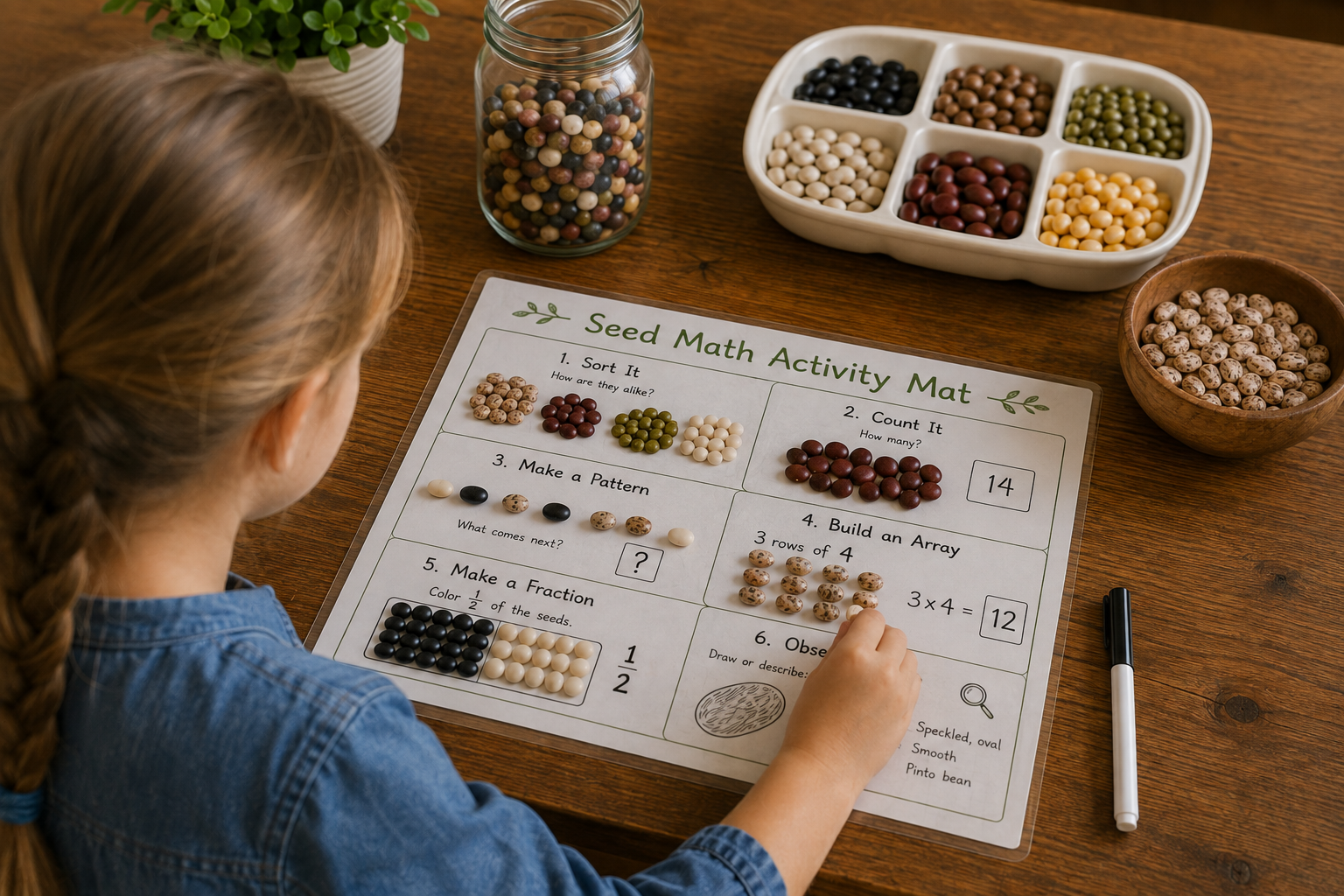
Make Patterns
Start a pattern with your seeds:
Bean, bean, corn.
Bean, bean, corn.
Bean, bean...
What comes next?
Once your child understands the idea, let her make patterns for you to complete.
Begin with simple AB patterns and gradually make them more complicated:
ABAB
AABAAB
ABCABC
ABBABB
AABCAABC
For older children, turn the activity around. Make a complicated seed pattern and ask them to describe the repeating unit.
Suddenly you've moved from preschool pattern play toward the kind of thinking they'll eventually use in algebra.
Practice Addition and Subtraction
Seeds make wonderful counters.
Try a tiny garden story:
"I planted five bean seeds in one row and four in another. How many seeds did I plant altogether?"
Let the child physically build the problem with seeds.
For subtraction:
"We planted ten sunflower seeds, but three didn't sprout. How many plants grew?"
Move three seeds away.
The symbols 10 − 3 = 7 are abstract. Ten sunflower seeds sitting on the table are not.
Once children understand what the numbers mean, the symbols have something to attach themselves to.
Build Multiplication Arrays
Now plant an imaginary garden.
Make three rows with four bean seeds in each row.
Ask:
How many rows are there?
How many seeds are in each row?
How many seeds altogether?
Then write:
3 × 4 = 12
You've just created a multiplication array.
And unlike an arbitrary worksheet array, this one reflects something gardeners actually do.
Try different garden beds:
2 rows of 6 peas
4 rows of 5 beans
5 rows of 8 corn seeds
Children who are beginning multiplication can build each problem. Children who already know their multiplication facts can predict the answer first and then use the seeds to check themselves.
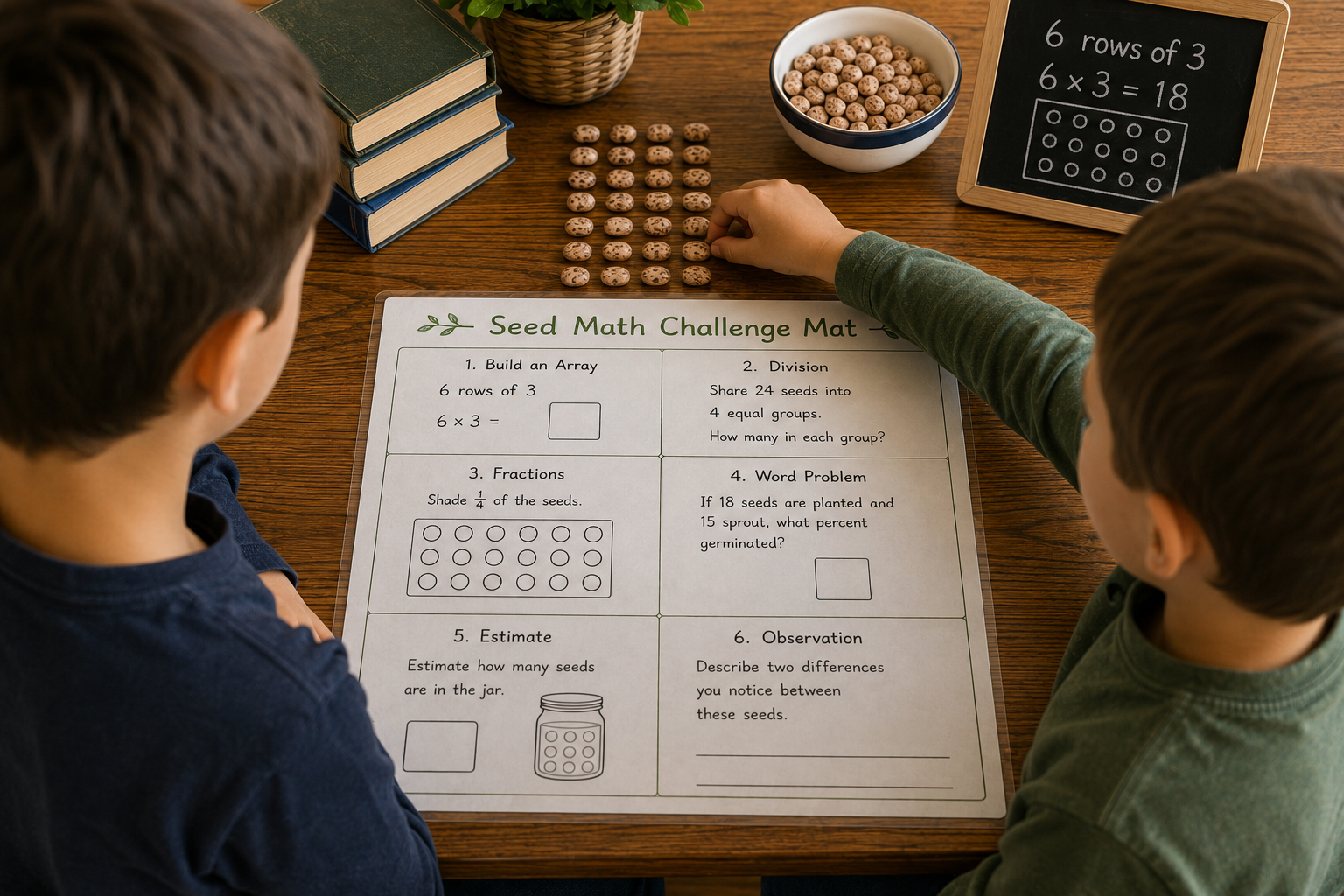
Discover Division
Take 24 beans and announce that you have four garden rows.
How many seeds should go into each row if every row gets the same number?
Let your child distribute the beans one at a time.
Then write:
24 ÷ 4 = 6
Try changing the question:
What if we want six seeds in each row? How many rows can we plant?
Same seeds. Same numbers. Different way of thinking.
Explore Fractions
Seeds make fractions wonderfully visible.
Put 12 beans on the table.
Ask your child to divide them into two equal groups.
Each group is one-half.
Put them back together and divide them into four equal groups.
Each group is one-fourth.
Then begin asking questions:
What is half of 12?
What is one-fourth of 12?
What is three-fourths of 12?
Older children can write the corresponding equations after building them.
You can also mix seed varieties.
Put out 10 seeds—5 beans, 3 corn kernels, and 2 pumpkin seeds.
What fraction are beans?
5/10, which can also be written 1/2.
Now fractions aren't mysterious pieces of pizza that nobody actually gets to eat. They're right there on the table.
Measure and Compare
Seeds are terrific for informal measurement.
How many bean seeds long is your pencil?
How many sunflower seeds wide is a notebook?
Which seed makes the best measuring unit?
Children will quickly discover an important principle: measurement only works well when the units are reasonably consistent.
That's why measuring a pencil with a mixture of giant lima beans and tiny lentils gives rather questionable results.
It's also a delightful way to introduce the reason we use standard units.
Graph Your Seeds
Sort a mixture of seeds by type and count each group.
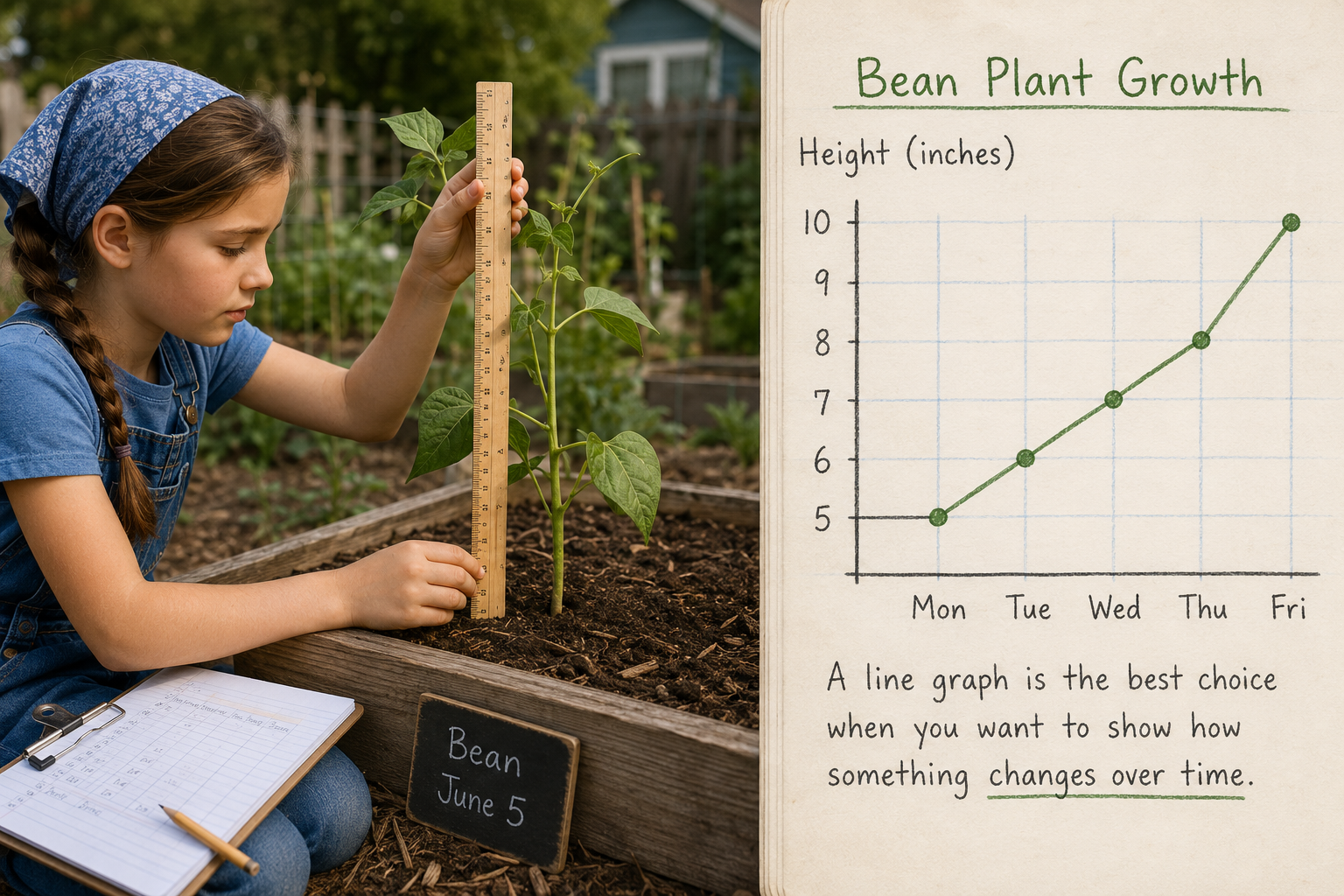
Then make a simple bar graph.
Younger children can make a concrete graph by lining up the actual seeds in columns.
Older children can transfer their results to graph paper.
Ask questions about the graph:
Which group has the most?
Which has the least?
How many more beans are there than corn kernels?
How many seeds are there altogether?
What fraction of the seeds are sunflower seeds?
One bowl of seeds has now taken you from counting all the way to data analysis.
Estimate Germination
Here's where seed math gets even better.
Plant some.
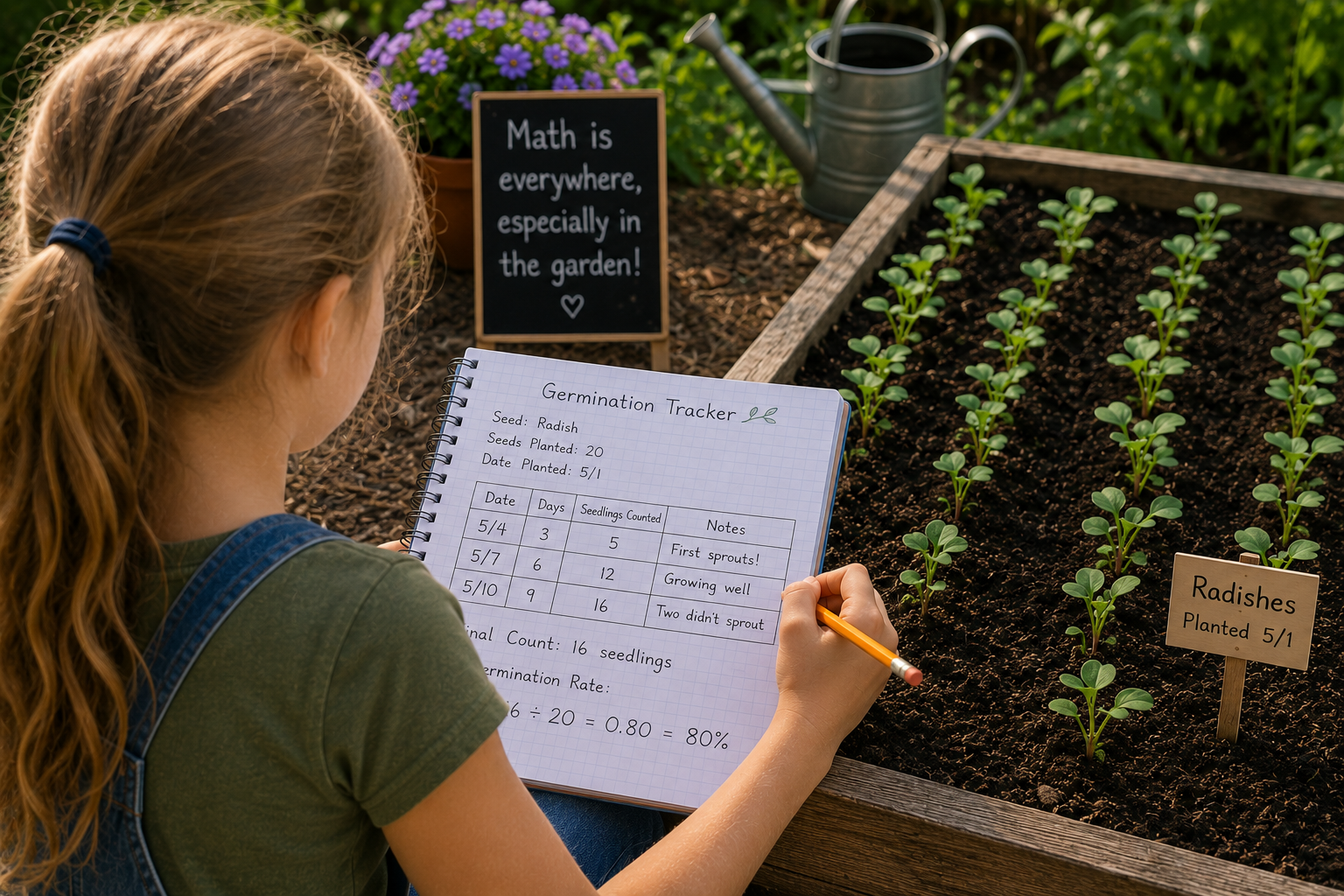
Before planting, count your seeds. Suppose you plant 20 radish seeds.
Ask your child to predict how many will germinate.
A week later, count the seedlings.
If 16 of your 20 seeds sprouted, younger children can simply compare 16 sprouts with the 20 seeds planted.
Older children can calculate the germination rate:
16 ÷ 20 = .80
or
80% germination
Now percentages have a reason to exist.
Keep a record and compare different kinds of seeds. Which had the best germination rate? Does the age of the seed matter? Does soaking make a difference?
At this point, your math lesson has wandered cheerfully into science, gardening, record keeping, and experimental design.
I see no reason to chase it back into its proper subject.
Plan a Tiny Garden
For older elementary children, take the math outside.
Give your child the dimensions of a small garden bed—or let him measure one.
Then look at the planting directions on the seed packet.
If beans should be planted four inches apart, how many will fit in a four-foot row?
How many rows will fit in the bed?
How many seeds will you need?
Do you have enough seeds in the packet?
How many plants could the entire bed hold?
Now you're working with measurement, multiplication, division, area, estimation, and practical problem solving.
And there is an actual garden at the end of the equation.
Let Several Ages Learn Together
This is one of my favorite things about hands-on learning.
You don't necessarily need a separate lesson for every child.
Put the same bowl of seeds in the middle of the table.
Your preschooler can sort and count.
Your early elementary child can practice addition and subtraction.
Another child can make multiplication arrays.
An older student can calculate fractions, percentages, germination rates, or garden spacing.
They're working with the same materials and sharing the same experience, but each child is doing mathematics at an appropriate level.
That makes life considerably easier when you're teaching several children at once.
Math Is Already Everywhere
Children sometimes get the impression that math lives in textbooks.
It doesn't.
Math is in recipes and fence posts. It's in egg cartons and feed buckets. It's in measuring garden beds, doubling bread recipes, figuring out whether six bales of hay will fit in the truck, and deciding how many bean plants will fit along a trellis.
It's even hiding in a handful of seeds.
So pour some beans onto the kitchen table and see where the lesson goes.
You may start with counting.
You may end up planting a garden.
Around here, I'd call that a very successful school day.