
Measuring from the Garden
Kitchen Table School
One of the best things about teaching children at home is that math doesn’t have to stay at the kitchen table.
Sometimes it grows outside.
A garden is full of things begging to be measured. A bean vine climbs another inch. A tomato gets heavier. A pumpkin slowly takes over its corner of the garden. The row that looked perfectly straight when you planted it turns out to have its own ideas. Even a handful of strawberries can become a math lesson before somebody eats the evidence.
And unlike a page of measurement problems in a workbook, these measurements have a reason behind them.
We want to know.
Start With a Ruler
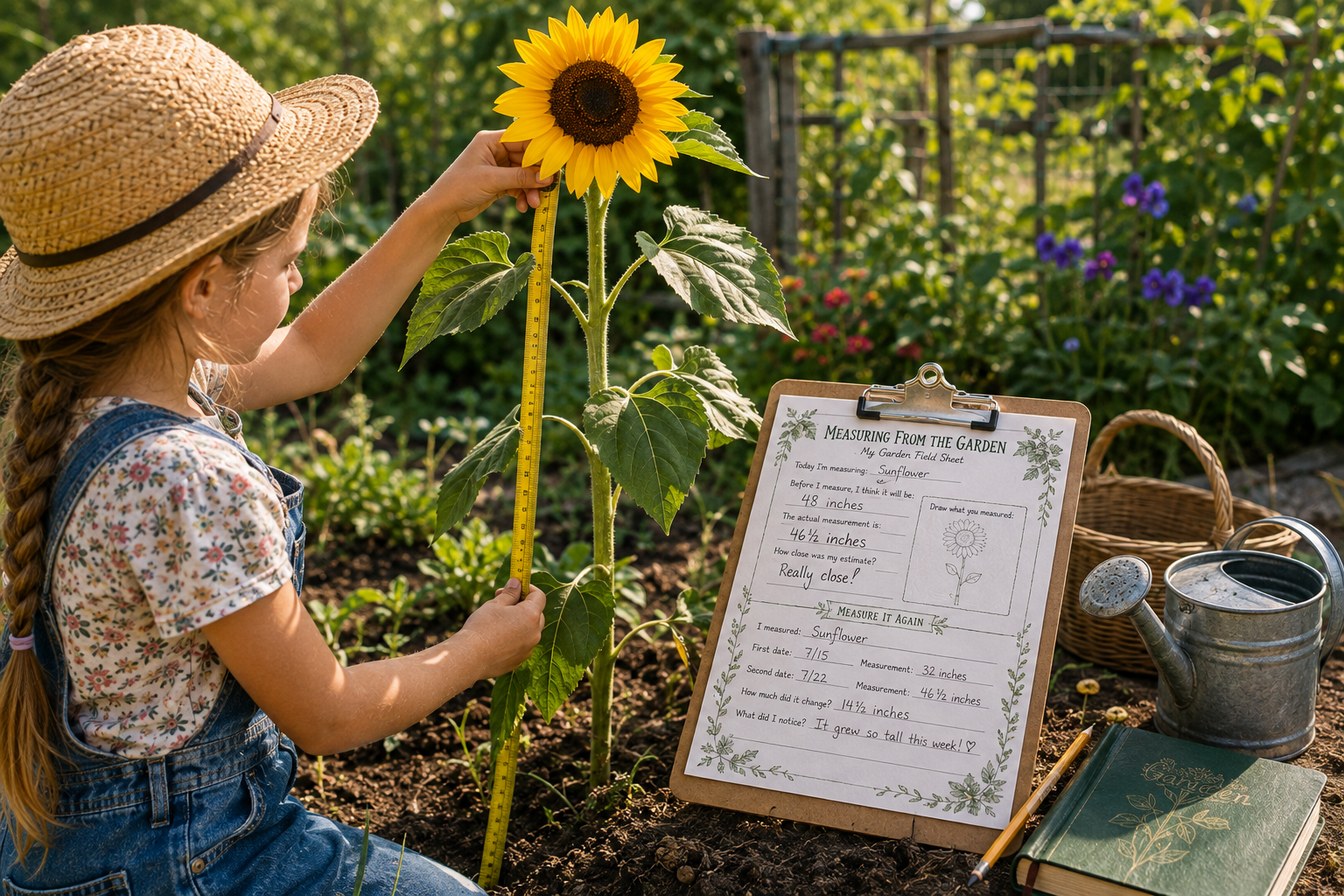
For a young child, measuring can begin as simply as carrying a ruler into the garden.
How long is that cucumber?
How wide is the biggest leaf on the squash plant?
How tall is the basil?
Which carrot is longer?
Before measuring anything, let the child guess. A child might look at a cucumber and decide it is six inches long, then discover that it is actually nine. That little moment teaches something important about measurement: our eyes aren't always very good measuring tools.
A ruler gives us a common language.
Once inches make sense, introduce half inches and quarter inches naturally. Garden produce rarely has the courtesy to grow to exactly seven inches.
That crooked cucumber may be 7½ inches long, which gives fractions an immediate purpose.
When Twelve Inches Becomes a Foot
The garden is also a wonderful place to discover why we need different units.
Measuring a radish with a yardstick would be ridiculous. Measuring the length of the garden bed with a six-inch ruler would be equally ridiculous, although doing it once might convince a child of that far better than explaining it.
Bring out the tape measure.
Measure the length and width of a raised bed. Measure the distance between plants. Measure how far a vine has traveled. Measure the height of a trellis.
Sooner or later, twelve inches will turn into a foot.
Instead of simply memorizing 12 inches = 1 foot, a child can actually see it happen on the tape measure.
Then try predicting.
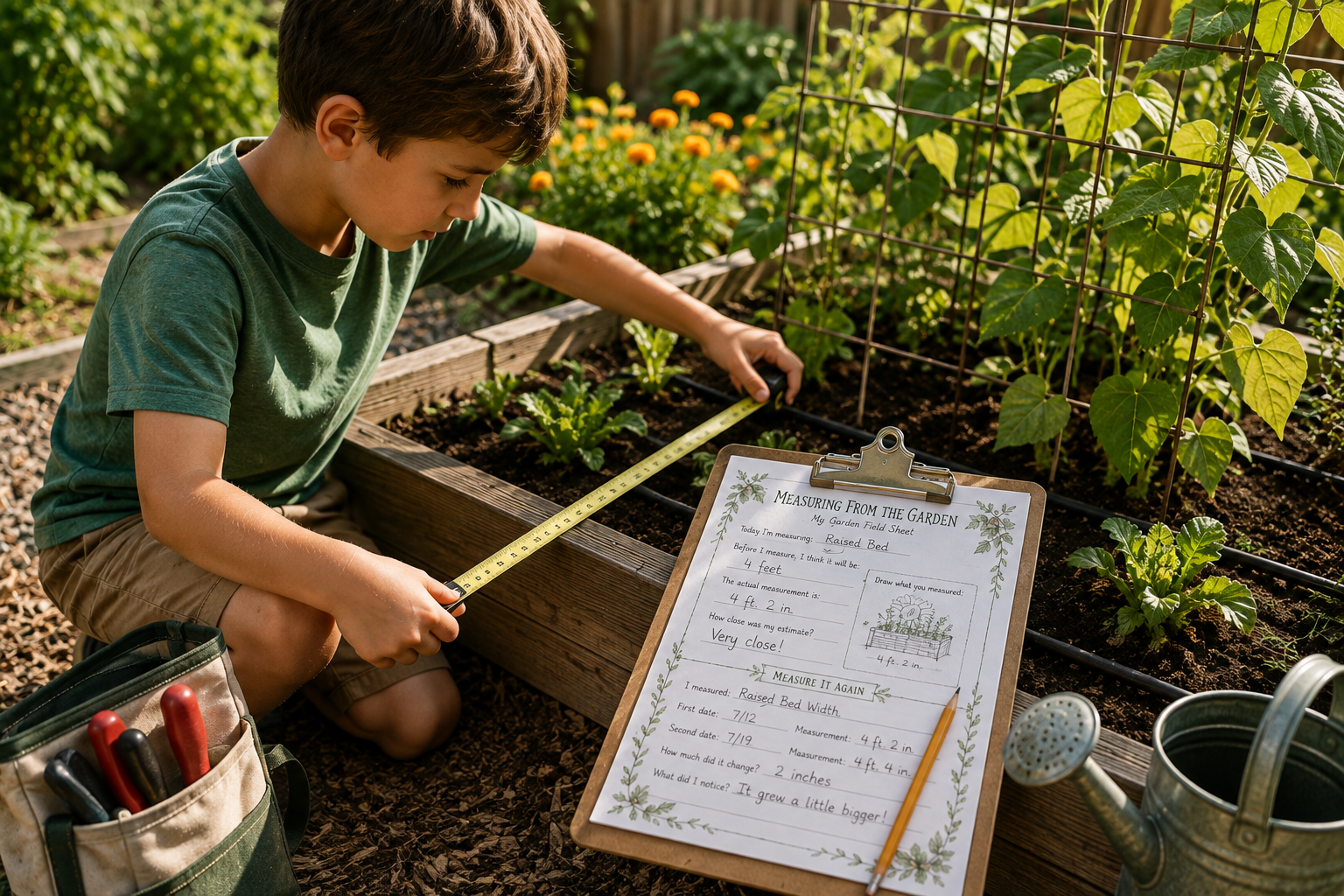
If a garden bed is four feet long, about how many inches should it be?
Don't calculate it first. Guess. Measure it. Then figure out why the answer makes sense.
That's mathematical thinking, not just arithmetic.
Measure the Same Thing Again
Some of the best garden measurements aren't taken once.
Choose something that's growing quickly—a sunflower, bean vine, cucumber vine, tomato plant, or pumpkin—and measure it regularly.
Mark the date and measurement in a notebook.
A week later, measure again.
Now the questions get more interesting.
How much did it grow?
Did it grow more this week than last week?
How tall do you think it will be next Tuesday?
If it keeps growing at about the same rate, when might it reach the top of the trellis?
The child has quietly moved from measuring into subtraction, comparison, estimation, data collection, and prediction.
Older children can calculate an average rate of growth. Younger children can simply draw a line showing that the plant is taller than it was before.
Both are doing real mathematics.
Bring the Harvest to the Kitchen Table
Eventually the garden lesson follows us back inside.
Now we can weigh things.
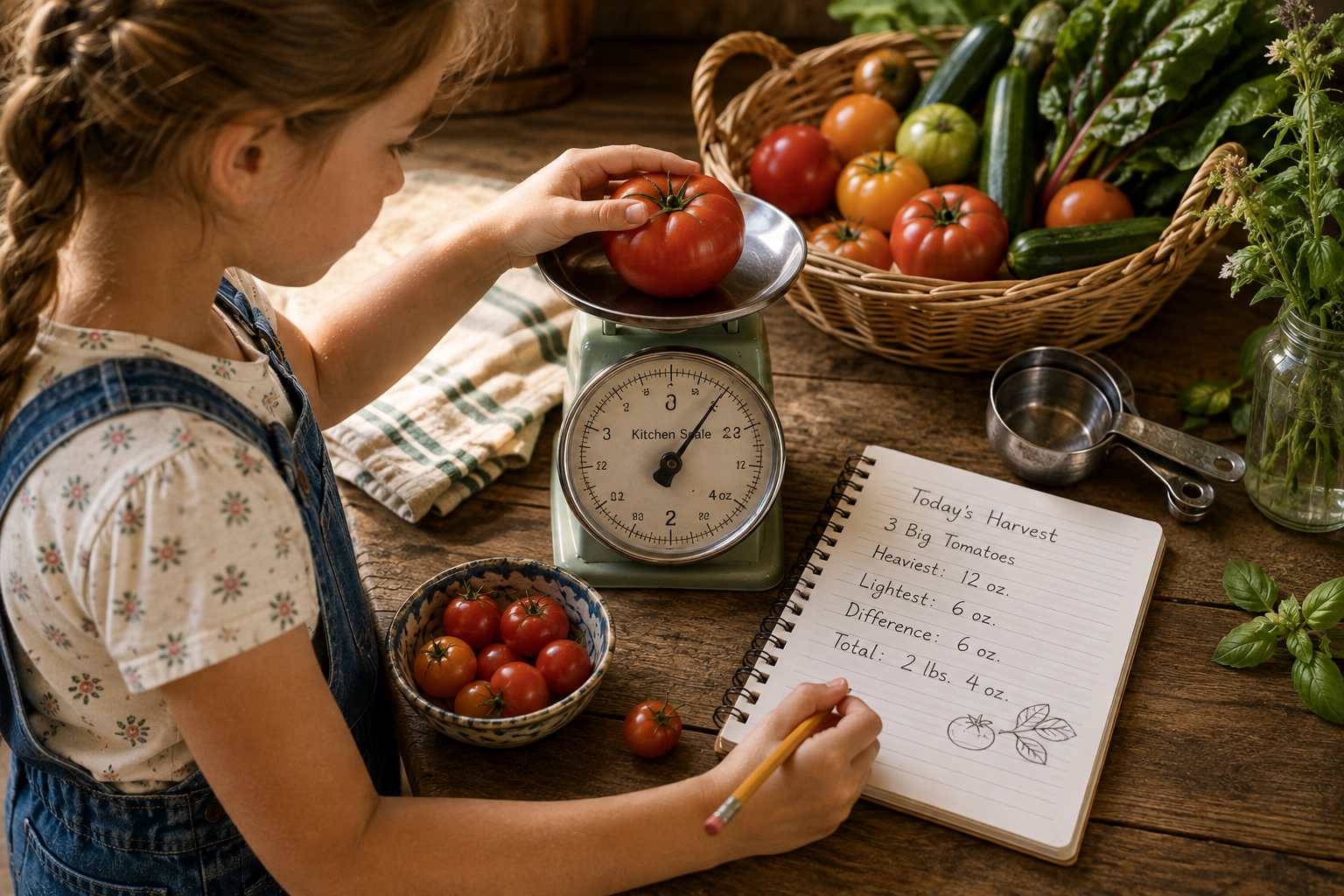
Put the kitchen scale on the table and let children compare vegetables before checking their actual weights.
Which tomato feels heavier?
Do three little tomatoes weigh more than one large tomato?
How many cucumbers does it take to make a pound?
How much did today's entire harvest weigh?
This is also a good place to introduce ounces and pounds. Sixteen ounces stops being an isolated fact to memorize when a child can keep adding tomatoes to the scale until the display reaches one pound.
If you use both a digital scale and an old-fashioned kitchen scale, even better. Reading the markings on an analog scale is its own little math lesson.
Measuring What We Use
Garden measurement doesn't end with length and weight.
Bring the measuring cups into it.
If you've picked basil for pesto, how many cups of loosely packed leaves do you have? If a recipe needs two cups and you have three, how much will be left?
Measure berries before making jam. Measure chopped herbs. Measure beans after shelling them. Measure tomatoes before turning them into sauce.
Then play with the quantities.
If the recipe calls for one cup and you're making half a batch, what do you need?
What if you're doubling it?
A child who has held a ½-cup measure and poured it twice into a one-cup measure has experienced the relationship between one-half and one whole. The fraction isn't floating mysteriously on a worksheet anymore. It is right there in her hands.
Don't Forget the Garden Itself
Older children can begin measuring the space rather than just what grows in it.
How much room does a garden bed take up?
Measure its length and width and introduce area.
A 4-foot-by-8-foot bed gives you 32 square feet of growing space. Now seed-packet spacing starts to mean something.
If lettuce plants need to be six inches apart, approximately how many can we fit?
Would we fit more if we planted them in a grid instead of a single row?
How much soil would we need to fill a new raised bed?
How much fencing would go around the garden?
These are the sorts of problems adults actually solve. Children don't have to wonder when they will ever use this math. They're already using it.
Let the Child Ask the Question
This may be the most important part.
You don't need to turn every trip to the garden into a formal math lesson. In fact, please don't.
Sometimes a tomato should just be a tomato.
But keep a ruler, tape measure, kitchen scale, measuring cups, pencil, and notebook handy. When someone wonders whether this week's zucchini is bigger than last week's, you've got a lesson.
Follow the question.
"I wonder how tall that is."
Let's measure it.
"I think this pumpkin weighs more than that one."
Let's find out.
"Do we have enough strawberries for the recipe?"
How could we figure it out?
That little phrase—how could we figure it out?—may teach more mathematics than anything on the page.
Because math isn't really about getting through a workbook.
It's one of the ways we make sense of the world around us.
And sometimes the world around us happens to be growing zucchini.
Take the Lesson Outside
To make it easy to put these ideas into practice, I created a free two-page Measuring from the Garden printable to take along with you. The first page gives children a place to estimate and measure something they find in the garden, draw what they measured, and come back later to see how it has changed. The second page takes the math a little further with garden-bed measurements, plant spacing, harvest weights, kitchen measurements, and a chance for children to invent a garden math problem of their own. Print the pages, tuck them onto a clipboard with a pencil, grab a ruler or tape measure, and head outside. You don't need to complete every section—or even call it a lesson. Just follow the questions your garden gives you.

