
Keeping A Nature Notebook
Years ago, when I was homeschooling my children, nature study did not require a complicated curriculum.
Sometimes it required a notebook.
We kept birdwatching notebooks, and the children learned to look closely enough to tell one bird from another. They recorded what they saw, drew pictures, asked questions and gradually began recognizing familiar visitors without needing someone to tell them what they were looking at.
The notebook wasn't the education.
Paying attention was.
That is still one of my favorite ways to teach children about the natural world, and a homestead—or even a very small patch of ground—is an especially good classroom for it. There is always something changing. A plant has put out another leaf. A spider has built a web where there wasn't one yesterday. The first strawberry is beginning to turn red. A bird that was common all winter has disappeared, while another has suddenly arrived.
A child who learns to notice those things is doing far more than nature study.
He is learning how to learn.
You Don't Need a Homestead to Study One
The name homestead nature notebook may conjure up acres of pasture, chickens scratching in the yard, a large vegetable garden and perhaps a convenient red barn in the distance.
None of that is required.
Right now, our own homesteading happens at our little blue condo. We have a small amount of growing space, and Jeff does most of the gardening while I tend my strawberries. Yet there is still plenty to observe.
A nature notebook can begin on an apartment balcony, in a suburban backyard or beside one tomato plant growing in a pot. It can travel to a park, a walking trail, Grandma's house or the patch of weeds beside the driveway that adults have been ignoring for years.
In fact, that patch of weeds may turn out to be extremely interesting.
The important thing is not how much nature is available.
It is how carefully we look at what is there.
Begin With a Real Notebook
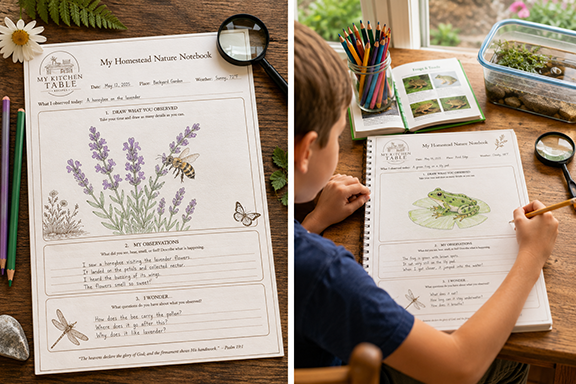
I prefer an actual paper notebook for this.
A child can certainly photograph things, and photographs can be useful references later. But drawing requires a different kind of attention. To draw a leaf, you have to notice its shape. You begin to see whether the edge is smooth or toothed, how the veins branch, whether the leaves grow opposite one another or alternate along the stem.
The drawing does not have to be beautiful.
That needs to be established immediately, especially with a child who announces, “I can't draw.”
This is not an art contest. The purpose is to record what was observed.
A spiral-bound sketchbook works beautifully because it gives children room to draw and write on the same page. Older children may enjoy a more formal field journal. Younger children can use an inexpensive blank notebook and dictate their observations to an adult when writing becomes an obstacle to the actual lesson.
Put the child's name and the year on the front.
Then begin.
The First Entry
For the first nature-notebook lesson, don't send children outside with instructions to “find something interesting.”
That's enormous.
Give them one thing to observe.
It might be a strawberry plant, a tree, a chicken, an ant trail, a bird at the feeder, a tomato blossom or even a dandelion.
Ask the child to spend a few minutes simply looking before drawing or writing anything.
This part is harder than it sounds.
We are accustomed to glancing at things and immediately deciding what they are. That's a leaf. That's a bird. That's a bug.
Nature study asks us to stay with the thing a little longer.
What shape is it?
How many leaves can you count?
Where do they attach to the stem?
Is the top of the leaf the same color as the underside?
Does the insect walk continuously or stop periodically?
What is the bird doing?
Those questions aren't a worksheet to be answered in order. They are examples of the kinds of questions a good observer begins asking.
After looking, make the first entry.
Put the date at the top. Add the place. Record the weather if it seems relevant. Then draw what you observed and write a few sentences about it.
That's enough.
Teach the Difference Between Seeing and Assuming
Here is where nature notebooks become particularly good science lessons.
Suppose a child writes:
The bird was looking for worms.
Perhaps it was.
But did we see worms?
What we actually observed may have been:
The bird hopped across the lawn and stopped several times to peck at the ground.
That distinction is enormously important.
One statement records an observation. The other offers an interpretation.
There is nothing wrong with interpretation. Scientists make hypotheses all the time. We simply need to know which is which.
The notebook can contain both:
I observed the bird pecking at the ground.
I wonder if it was looking for worms or insects.
Now we have science happening.
We have evidence, a question and something we could investigate further.
Go Back to the Same Things
One of the best things you can do with a nature notebook is resist the temptation to make every entry about something new.
Go back.
Draw the same strawberry plant next week.
Visit the same tree once a month.
Count birds at the same feeder.
Watch the same patch of garden.
This is where the notebook becomes more than a collection of nature drawings.
A child who draws a tree in September, November, January, April and June has recorded seasonal change. A child who watches a strawberry plant move from blossom to green fruit to ripe berry has recorded a life cycle. A child who keeps track of which birds visit throughout the year has begun collecting data.
And now there are questions worth asking.
When did we first see blossoms?
How long did it take before we found the first ripe berry?
Were the same birds here in January and July?
When did the leaves begin changing color?
The answers aren't coming from a textbook.
They're coming from the child's own records.
That matters.
Let the Notebook Grow With the Child
A nature notebook can begin very simply with a picture, a date and one sentence.
It does not have to remain that way.
As children grow, measurements can become part of their entries. They can record temperatures, rainfall, plant height, the number of eggs collected, sunrise and sunset times, or the number of birds of each species observed during a particular period.
Older students can learn proper plant and animal names. They can use field guides to identify species, research unfamiliar behavior and begin adding scientific vocabulary to their entries.
Eventually the notebook can cross rather delightfully into mathematics.
If a child records the height of a sunflower every week, those measurements can become a graph. Bird counts can become bar graphs. Temperatures can be compared from month to month. The dates of first blossoms or migrating birds can be compared from one year to the next.
This is one of the things I have always loved about homeschooling.
Subjects refuse to stay in their assigned boxes.
Science wanders into art. Art bumps into writing. Writing leads to research. Research produces numbers. The numbers become mathematics, and before long one little strawberry plant has apparently taken over the school day.
Good.
Let it.
Resist the Urge to Correct Everything
If a child draws a bird with enormous feet and a head twice the appropriate size, leave it alone.
If the purpose of the entry is observation, we want children to become more observant—not more anxious about producing something that looks correct to an adult.
You can ask questions.
“Were its legs really that long?”
“Look at your leaf and then look at the real one. Do you notice anything you want to add?”
That sends the child back to the subject instead of back to you for the right answer.
Over time, the drawings will often become more accurate because the seeing becomes more accurate.
That is the skill we are after.
Make Room for Wonder
Not every entry needs measurements, scientific names or research.
Sometimes a child sees something wonderful.
Record that, too.
Tape in a feather if it is legal and safe to keep it. Press a fallen leaf or flower. Write down the funny thing the goat did. Sketch the enormous spiderweb discovered one foggy morning. Record the first robin, the first frost, the first tomato, the day the tadpoles suddenly had legs.
Write down questions even when nobody knows the answers yet.
Especially then.
A nature notebook should contain facts, but I don't want it to squeeze the wonder out of nature in the process.
I want a child to learn the names of things and still be astonished by them.
A Record of More Than Nature
Keep the notebooks.
Years from now, they will contain something you did not realize you were recording.
Childhood.
There will be uncertain handwriting that gradually becomes confident. Funny spellings. Crooked birds. A leaf taped to a page. An observation that makes you laugh years later. Perhaps there will be a page where an older sibling helped a younger one identify something or where a child recorded the first egg from a favorite hen.
The notebook will show what grew outside.
It will also show the child growing.
And perhaps that is why I still love this simple kind of schooling so much.
You do not need an elaborate curriculum to teach a child to observe carefully, ask good questions, keep useful records and follow curiosity wherever it leads.
Sometimes you simply need to put a notebook in a child's hands, take them outside, and say:
“Show me what you notice.”

